How to Choose the Right Frequency Converter for Your Needs?
When selecting a Frequency Converter, it’s important to understand your specific needs. A frequency converter adjusts electrical frequency for various applications. Choosing the wrong model can lead to inefficiencies and higher costs.
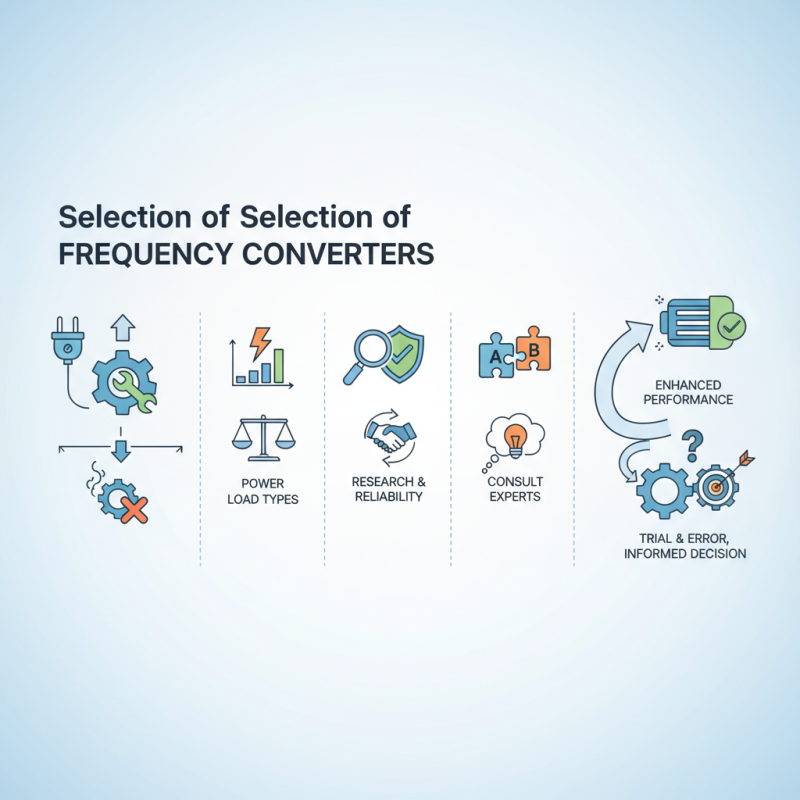
Consider factors such as power requirements and load types. Not all converters are created equal. Some may not handle high loads effectively. Research is crucial to avoid costly mistakes. Look for converters with proven reliability and robust support.
Don’t overlook the importance of compatibility. Different systems have unique specifications. It’s easy to make assumptions, but these can be misleading. The right frequency converter can enhance performance significantly. Yet, finding it requires careful analysis and sometimes trial and error. Always consult with experts in the field. Their insights can be invaluable in making an informed decision.
Understanding frequency converters is crucial for various applications. These devices change the frequency of electrical power. They ensure machinery operates smoothly and efficiently. A basic knowledge of how they work can help you make informed choices.
Frequency converters come in different types, each serving unique purposes. Some are designed for variable speed applications, while others cater to specific electrical conditions. It’s important to consider the specific requirements of your machinery. Factors include voltage levels, load characteristics, and environmental conditions. Not all converters are suitable for every situation. Research is vital.
Choosing the right converter may not be straightforward. Many face challenges such as mismatched specifications or inadequate support. Reflecting on these obstacles can guide a better decision-making process. Consulting with experts is often necessary. Engaging with professionals can provide deeper insights into your unique needs.
Identifying Your Specific Power Requirements
Choosing the right frequency converter starts with understanding your specific power requirements. Gather detailed information about the devices you plan to use. This includes knowing the voltage, amperage, and phase requirements. For example, a 3-phase motor may demand a different converter than a single-phase appliance.
Assessing power needs can be complex. Make sure to consider peak loads. These moments can surge beyond average use. Calculate not just the continuous power but also the starting power. Mistakes can lead to inadequate performance or damage.
It’s advisable to consult technical documentation. This material often contains crucial specifications. Nevertheless, relying solely on manufacturers can be limiting. Seek insights from experienced professionals. They can guide on subtle factors often overlooked, such as environmental conditions. Identify any potential issues early to optimize your setup.
Evaluating Different Types of Frequency Converters
When evaluating different types of frequency converters, understanding the specific needs of your application is crucial. Frequency converters come in various configurations that cater to distinct requirements. According to a recent industry report, nearly 25% of energy consumption in industrial applications can be attributed to motor-driven systems. Selecting the right converter can enhance energy efficiency and reduce operational costs.
Variable frequency drives (VFDs) stand out for their ability to adjust motor speed and torque. They are particularly beneficial in applications requiring precise control, such as conveyor systems or fans. Another type, static frequency converters, are often used for power supply in sensitive electronic equipment. These converters ensure consistent voltage and frequency, which is vital for the stability of operations. However, implementing the wrong type can lead to inefficiencies and potential equipment failure.
It is essential to consider both technical specifications and operational parameters. Not all applications require the same level of complexity or power ratings. A study found that over 30% of users had difficulties with installation and integration. This highlights the importance of focusing not only on the converter’s specifications but also on the compatibility with existing systems. Careful evaluation prevents future complications and enhances the reliability of your operations.
Frequency Converter Types Comparison
Assessing Compatibility with Existing Equipment
Choosing the right frequency converter is crucial for system compatibility. Assessing your existing equipment is the first step. Incompatibility can lead to inefficiencies and increased costs. According to a recent industry report by Market Research Future, nearly 30% of frequency converters fail to meet operational needs due to poor compatibility assessments.
When selecting a frequency converter, ensure it matches the voltage and frequency specifications of your existing machinery. For instance, equipment designed for 230V may not perform well with a 460V input. This mismatch can cause overheating and reduced lifespan. Furthermore, evaluating the communication protocols used by your current systems is essential. Industry statistics show that around 20% of equipment malfunctions arise from incompatible communication interfaces.
Before finalizing a frequency converter, it is advisable to consult with experienced engineers. They can provide insights that simple product specifications cannot cover. Engage with case studies that showcase equipment failures due to oversight in compatibility checks. This highlights that a meticulous approach is necessary. Understanding your operational environment and existing systems leads to a more informed decision. Always remember, the right choice now can save significant costs and disruptions later.
How to Choose the Right Frequency Converter for Your Needs? - Assessing Compatibility with Existing Equipment
Parameter
Consideration
Example Values
Input Voltage
Compatibility with existing equipment voltage levels
230V, 400V, 460V
Output Voltage
Needs to match operational voltage of the motor
0-400V variable output
Power Rating
Must support the total power requirement of connected equipment
1 kW, 5 kW, 10 kW
Frequency Range
Should accommodate the required frequency adjustments
50Hz, 60Hz (adjustable 40-70Hz)
Phase Type
Match the phase types of the equipment and power supply
Single-phase, Three-phase
Control Type
Determine the control needs for better efficiency
V/f, vector control
Environmental Conditions
Consider heat, moisture, and dust exposure
Indoor, outdoor, IP65 rating
Considering Brand Reputation and After-sales Support
When selecting a frequency converter, brand reputation and after-sales support are crucial factors. A study by the International Electrotechnical Commission revealed that 75% of users prioritize brand reliability, especially in industries like manufacturing and automation. A strong brand often signifies quality and trustworthiness. Negative experiences with a brand can lead to substantial downtime and increased costs.
After-sales support can significantly impact long-term satisfaction. A report from the Institute of Electrical and Electronics Engineers indicated that 68% of equipment failures are linked to inadequate technical support. Users should assess response times and the availability of local service centers before making a purchase. Some manufacturers offer extensive training and maintenance packages, which can be a valuable asset in complex setups.
While many brands boast excellent support systems, there are always exceptions. Some users report difficulties in reaching customer service or long wait times. It's essential to read reviews and consult industry peers. Personal experiences often highlight gaps that may not be apparent in marketing materials. Choosing a brand with established expertise and reliable customer support can ultimately save time and resources.
Cepex is the brand for the fluid handling market belonging to the Fluidra group. One of the leading european manufacturer of valves and fittings in thermoplastic materials.
Dedicated to the swimming pool, irrigation and industrial markets, we distribute our products worldwide with the Fluidra commercial network and presence in 46 countries with 136 sales branches.
Your data will be processed by CEPEX S.A., with address at C. Lluís Companys, 51-53, 08400, Granollers (Barcelona), and C.I.F. nº A-08928707, to send you communications about our products based on your interests. You can consult more information about the processing of your data and how to exercise your rights as described in the Privacy Policy.
Technical cookies are strictly necessary for our website to work and you can navigate through it. These types of cookies are those that, for example, allow us to identify you, give you access to certain restricted parts of the page if necessary, or remember different options or services already selected by you, such as your privacy preferences. Therefore, they are activated by default, your authorization not being necessary in this regard. Through the configuration of your browser, you can block or alert the presence of this type of cookies, although such blocking will affect the proper functioning of the different functionalities of our website.
The analysis cookies allow us to study the navigation of the users of our website in general (for example, which sections of the page are the most visited, which services are used most and if they work correctly, etc.). From the statistical information on navigation on our website, we can improve both the operation of the page itself and the different services it offers. Therefore, these cookies do not have an advertising purpose, but only serve to make our website work better, adapting to our users in general. By activating them you will contribute to this continuous improvement. You can enable or disable these cookies by checking the corresponding box, being disabled by default.
Functionality cookies allow us to remember your preferences, to personalize certain characteristics and general options of our website, every time you access it (for example, the language in which the information is presented to you, the sections marked as favorites, your browser type, etc.) Therefore, this type of cookies does not have an advertising purpose, but by activating them you will improve the functionality of the website (for example, adapting to your type of browser) and the customization of it based on your preferences (for example, by presenting the information in the language that you have chosen in previous occasions), which will contribute to the ease, usability and comfort of our page during your navigation. You can enable or disable these cookies by checking the corresponding box, being disabled by default.
Advertising cookies allow us to manage the advertising spaces included in our website based on criteria such as the content shown or the frequency in which the ads are displayed. For example, if you have been shown the same ad several times on our website, and you have not shown a personal interest by clicking on it, it will not appear again. In summary, by activating this type of cookies, the advertising shown on our website will be more useful and diverse, and less repetitive. You can enable or disable these cookies by checking the corresponding box, being disabled by default.
Behavioral advertising cookies allow us to obtain information based on the observation of your browsing habits and behaviors on the web, in order to show you advertising content that best suits your personal tastes and interests. To understand it in a very simple way, we will give you a fictitious example: if your last searches on the web were related to suspense literature, we would show you advertising about suspense books. Therefore, activating this type of cookies, the advertising that we show you on our website will not be generic, but will be oriented to your searches, tastes and interests, therefore adjusting exclusively to you. You can enable or disable these cookies by checking the corresponding box, being disabled by default. To understand it in a very simple way, we will give you a fictitious example: if your last searches on the web were related to suspense literature, we would show you advertising about suspense books. Therefore, activating this type of cookies, the advertising that we show you on our website will not be generic, but will be oriented to your searches, tastes and interests, therefore adjusting exclusively to you. You can enable or disable these cookies by checking the corresponding box, being disabled by default.
We use our own and third-party cookies to ensure the proper functioning of the website and to analyse our services, improve your experience on our website and show you advertisements related to your interests according to profiling based on your browsing habits (e.g. websites visited). You can accept all cookies by clicking "ACCEPT" or set or reject them by clicking here. If you would like to know more about the use of cookies, please see our COOKIE POLICY.