
How to Choose a Compact Track Loader Track Roller
FLUID HANDLING EXPERTS

Blog, all our news

How to Choose a Compact Track Loader Track Roller

A worn track roller can turn a routine job into a noisy, uneven ride. It may also speed up wear across the track system. Choosing a Compact Track Loader Track Roller is not just a matter of matching a product photo. Fit, load capacity, sealing, and the machine’s working conditions all matter. A roller that looks close may still have the wrong dimensions or mounting details.

Start with the loader’s make, model, year, and serial number. Compare these details with the parts manual or a supplier’s verified fitment information. Check roller width, diameter, flange design, shaft, and mounting pattern against the old part. Don’t guess. A few millimeters can matter. Then consider the worksite: sharp gravel, wet soil, frequent turning, and long operating hours place different demands on undercarriage components. Dust and moisture can challenge seals, while heavy, repeated impacts can expose weaknesses in materials and construction. Price is easy to focus on; it can be a false economy, though not in every case.

This guide explains how to compare specifications, assess construction, and ask useful questions before buying. It also covers warning signs during inspection, such as leaks, rough rotation, unusual play, or uneven wear. A single roller’s condition can offer clues, but it does not tell the whole story. Check neighboring rollers and the track, too. The goal is a dependable match, not a rushed replacement. Even careful selection has limits: operating habits and maintenance still affect service life.
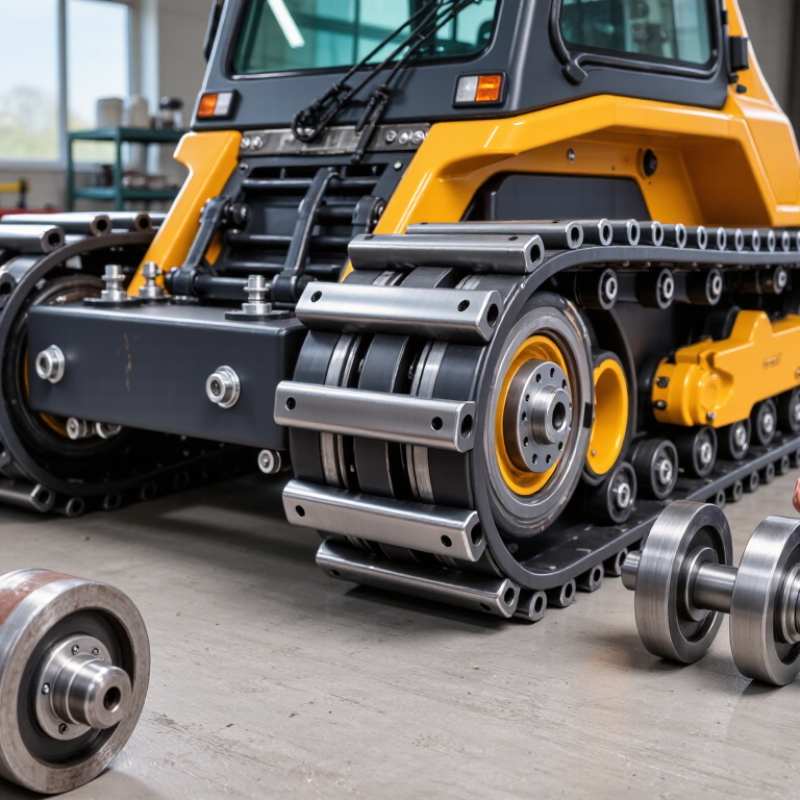
How to Choose a Compact Track Loader Track Roller

Identify Loader Weight, Rated Capacity, and Track-Roller Load Requirements

How to Choose a Compact Track Loader Track Roller

Identify Loader Weight, Rated Capacity, and Track-Roller Load Requirements

Start with the loader’s operating weight, including fuel, operator, attachment, and any counterweights. Then confirm the rated operating capacity (ROC) on the machine’s data plate. ISO 14397-1:2007 provides a method for calculating and verifying loader rated capacity and tipping load. For tracked loaders, ROC is commonly set at 35% of tipping load, but check the machine’s specific rating and configuration. A heavier attachment can change the load significantly.

Track rollers support the undercarriage, but their loads are not shared evenly. Load position, track tension, turns, and impacts over rough ground all affect roller stress. Do not estimate each roller’s load by simply dividing machine weight by the number of rollers. Compare the machine’s weight and working conditions with the roller’s specified load rating, dimensions, and mounting details. A mismatch may cause uneven wear. It is an easy detail to overlook.

Tips: Record the machine’s operating weight, ROC, attachment weight, and typical terrain before ordering. Check the service manual for roller specifications, then inspect for leaks, flat spots, or uneven wear. If the load history is uncertain, be cautious; a simple calculation cannot capture every impact.

Match Roller Diameter, Width, Shaft, and Part Number to OEM Specifications

How to Choose a Compact Track Loader Track Roller

Match Roller Diameter, Width, Shaft, and Part Number to OEM Specifications

A track roller can look right and still be the wrong fit. Check the machine’s parts information using its model and serial details before ordering. Then compare the listed roller diameter and width with the part you are replacing. Measure carefully: wear can reduce the old roller’s diameter, so it may not reflect the original specification. Small differences matter.

Confirm the shaft diameter, overall length, and shoulder locations against the equipment specifications. These dimensions affect how the roller sits between the frame mounts. Also inspect the mounting area for damage or packed dirt before taking measurements. A quick measurement over grime can lead to a poor match. Clean it first.

Use the full part number, including any suffix, and check whether it has been replaced by a newer number. Don’t rely on a seller’s photo or a general description such as “fits compact loaders.” If the catalog and physical measurements disagree, pause and verify with a qualified parts supplier.

I still treat a nearly matching shaft as a warning, not a close enough result. It is easy to focus on diameter and overlook width or mounting details. Verify every dimension before installation.

Check Track Pitch, Roller Count, and Undercarriage Layout

A compact track loader roller must match the undercarriage, not just look similar. Measure track pitch from the center of one pin to the center of the next. Compare that figure with the parts information for the machine. A small mismatch can cause poor engagement and accelerated wear. Check the roller’s width and flange arrangement, too. Details matter.

Count the rollers on each side and note their positions. Some layouts use different roller styles or spacing along the frame. Replacing one roller with the wrong profile may affect how the track sits and carries load. More rollers do not automatically mean better support; the full layout is designed as a system. Verify the machine’s model and serial details before ordering.

Inspect the old roller before measuring. Mud can hide damage, and worn edges can make a tape measurement misleading. Look for oil around the seal, flat spots, or sideways movement. That clue helps. If the undercarriage is dirty, clean the contact area and measure again; even careful checks can miss a worn pin. Compare the new part’s dimensions and mounting points with the original, rather than relying on appearance alone.

Compare Seals, Bearings, and Typical 50–58 HRC Tread Hardness

When choosing a compact track loader track roller, compare the seal design, bearing rating, and tread hardness together. A seal must keep fine grit and water away from the bearing; inspect its contact area for a clear, even lip. A double-lip seal can add protection, but poor installation can still let contamination in. No seal fixes a damaged shaft.

The stated 50–58 HRC tread range is a useful comparison point, not a guarantee of service life. ASTM E18 specifies Rockwell hardness testing, so ask whether the value comes from a consistent test method and where the tread was tested. Very hard steel may resist indentation, yet impact resistance and heat treatment matter too. The number alone is not enough. For bearing comparisons, ISO 281:2007 calculates basic roller-bearing rating life as L10 = (C/P)^(10/3) million revolutions, using dynamic load rating C and equivalent load P. It is a calculated rating, not a promise of field life.

Tips: Check for smooth rotation, even tread wear, and seal damage before installation. Match the bearing rating to expected load and duty cycle. Keep the inspection notes; small differences can be easy to overlook. A hardness reading can mislead if its test location is unclear.

How to Choose a Compact Track Loader Track Roller: Seals, Bearings, and Tread Hardness

The chart compares typical hardness ranges in HRC. Track roller tread hardness is commonly specified around 50–58 HRC; through-hardened bearing steel races are often around 58–64 HRC. Actual specifications vary by design and heat treatment.

Component What to compare Selection check
Seals Seal arrangement, material, and resistance to dirt and water ingress Confirm compatibility with the machine’s operating environment and the roller’s specified seal design. Elastomer hardness is measured on a Shore scale, not HRC.
Bearings Load capacity, lubrication arrangement, and race material Check the roller specification; bearing race hardness depends on bearing type and heat treatment.
Tread Wear resistance and hardness across the contact surface Use the specified 50–58 HRC range as a comparison point, and verify the complete roller specification for your machine.

Compare the seal system, bearing design, and tread specification together rather than choosing by hardness alone. Always confirm fitment and service requirements against the machine manufacturer’s specifications.

Verify Roller Wear Limits and Installation Specs in the Service Manual

How to Choose a Compact Track Loader Track Roller

A compact track loader roller should be selected by fit and condition, not appearance alone. Identify the machine model, serial range, undercarriage configuration, and roller position before ordering. Front and rear rollers may differ. Compare dimensions and mounting points with the service manual or parts illustration. Looks can mislead.

Tips: Use the manual’s wear limit for the exact machine and measurement point. Clear packed mud, then measure the roller diameter with a suitable gauge. Record the reading and compare it with the specified limit. Do not use a threshold from another model. Uneven wear may also point to track tension or neighboring component problems.

Check the installation specifications before fitting the replacement. Confirm fastener torque, seal orientation, and any lubrication requirements in the manual. Use a calibrated torque wrench where specified, and inspect mounting surfaces for damage or debris. Manuals can vary by machine revision, so pause if the listed values seem inconsistent. A common mistake is treating a new roller as a cure for every tracking issue. It may not be. Recheck alignment and related components after installation.

Copyright 2025 Fluidra S.A. | Created by BCM Marketing Agencia Privacy Policy Legal note | Cookie policy |

Technical cookies are strictly necessary for our website to work and you can navigate through it. These types of cookies are those that, for example, allow us to identify you, give you access to certain restricted parts of the page if necessary, or remember different options or services already selected by you, such as your privacy preferences. Therefore, they are activated by default, your authorization not being necessary in this regard. Through the configuration of your browser, you can block or alert the presence of this type of cookies, although such blocking will affect the proper functioning of the different functionalities of our website.


The analysis cookies allow us to study the navigation of the users of our website in general (for example, which sections of the page are the most visited, which services are used most and if they work correctly, etc.). From the statistical information on navigation on our website, we can improve both the operation of the page itself and the different services it offers. Therefore, these cookies do not have an advertising purpose, but only serve to make our website work better, adapting to our users in general. By activating them you will contribute to this continuous improvement. You can enable or disable these cookies by checking the corresponding box, being disabled by default.


Functionality cookies allow us to remember your preferences, to personalize certain characteristics and general options of our website, every time you access it (for example, the language in which the information is presented to you, the sections marked as favorites, your browser type, etc.) Therefore, this type of cookies does not have an advertising purpose, but by activating them you will improve the functionality of the website (for example, adapting to your type of browser) and the customization of it based on your preferences (for example, by presenting the information in the language that you have chosen in previous occasions), which will contribute to the ease, usability and comfort of our page during your navigation. You can enable or disable these cookies by checking the corresponding box, being disabled by default.


Advertising cookies allow us to manage the advertising spaces included in our website based on criteria such as the content shown or the frequency in which the ads are displayed. For example, if you have been shown the same ad several times on our website, and you have not shown a personal interest by clicking on it, it will not appear again. In summary, by activating this type of cookies, the advertising shown on our website will be more useful and diverse, and less repetitive. You can enable or disable these cookies by checking the corresponding box, being disabled by default.


Behavioral advertising cookies allow us to obtain information based on the observation of your browsing habits and behaviors on the web, in order to show you advertising content that best suits your personal tastes and interests. To understand it in a very simple way, we will give you a fictitious example: if your last searches on the web were related to suspense literature, we would show you advertising about suspense books. Therefore, activating this type of cookies, the advertising that we show you on our website will not be generic, but will be oriented to your searches, tastes and interests, therefore adjusting exclusively to you. You can enable or disable these cookies by checking the corresponding box, being disabled by default.
To understand it in a very simple way, we will give you a fictitious example: if your last searches on the web were related to suspense literature, we would show you advertising about suspense books. Therefore, activating this type of cookies, the advertising that we show you on our website will not be generic, but will be oriented to your searches, tastes and interests, therefore adjusting exclusively to you. You can enable or disable these cookies by checking the corresponding box, being disabled by default.

SAVE

We use our own and third-party cookies to ensure the proper functioning of the website and to analyse our services, improve your experience on our website and show you advertisements related to your interests according to profiling based on your browsing habits (e.g. websites visited). You can accept all cookies by clicking "ACCEPT" or set or reject them by clicking here. If you would like to know more about the use of cookies, please see our COOKIE POLICY.


ACCEPT ALL
Reject no essentials


