
How to Choose the Right Carbon Fiber Sheets in 2026?
FLUID HANDLING EXPERTS

Blog, all our news

How to Choose the Right Carbon Fiber Sheets in 2026?

Choosing carbon fiber sheets in 2026 is less about finding the “strongest” panel and more about matching its construction to the job. A decorative sheet for a dashboard has different demands from a structural laminate for a bracket or equipment enclosure. Look closely. Weave pattern, thickness, fiber orientation, resin system, and surface finish can affect stiffness, weight, appearance, and machining behavior. A glossy twill may catch the workshop lights, but its appearance alone cannot confirm that it is suitable for a load-bearing part.

Start with the intended use, then compare manufacturer data for thickness tolerance, laminate construction, and mechanical properties. Check whether the figures describe the same direction and test conditions; carbon fiber is anisotropic, so strength can vary with fiber orientation. Small details matter. A cut edge, mounting hole, or tight bend may expose weaknesses that a flat sample does not reveal. For demanding applications, seek traceable technical documentation and have a qualified engineer assess the design rather than relying on a product description.

Cost also deserves a closer look. A lower-priced sheet may need extra finishing, while a premium surface may add little value to a hidden component. Ask about dimensions, cutting tolerances, storage, and resin compatibility before ordering. If possible, inspect a sample under the lighting and conditions where it will be used. That step is easy to skip. I would not assume every supplier’s “high strength” label means the same thing; clear specifications are more useful than broad claims. This guide outlines practical checks for choosing a sheet that fits your performance needs, budget, and fabrication process.
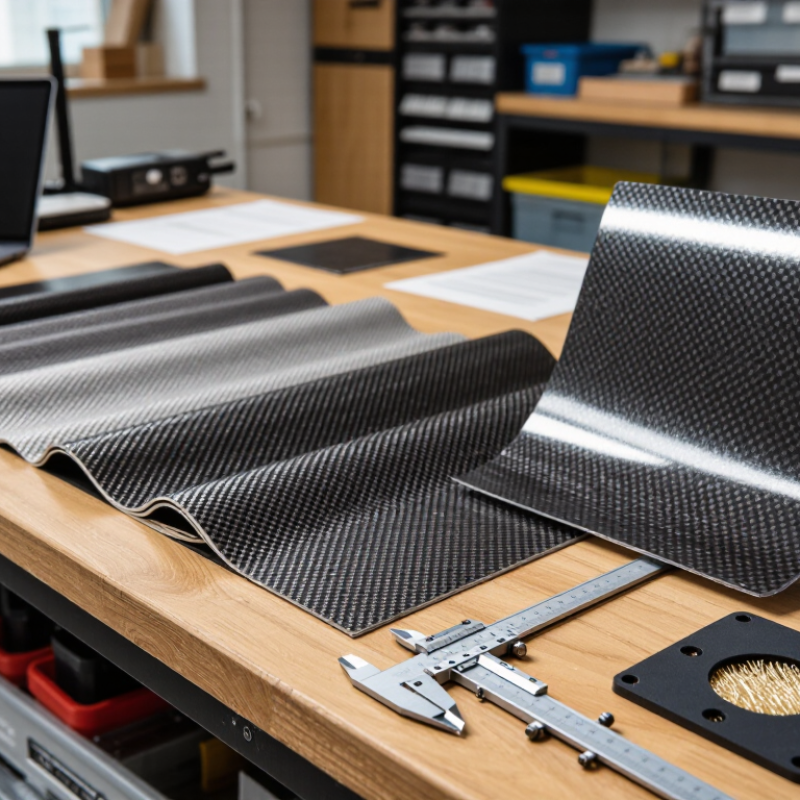
How to Choose the Right Carbon Fiber Sheets in 2026?

Understanding Carbon Fiber Sheets and Their Key Properties

Carbon fiber sheets combine strong carbon filaments with a resin matrix, but their properties depend on how those layers are arranged. Woven sheets often resist loads in two main directions, while unidirectional laminates favor one direction. The visible weave can be attractive. Looks matter. Not enough. A glossy surface does not reveal the sheet’s strength, stiffness, or internal consistency. Check the technical data, including thickness, fiber orientation, and the direction in which performance was measured.

For a practical choice, start with the load the sheet must carry and the space available. A thin panel may save weight, yet flex more than expected; adding thickness can affect fit and cost. Small detail. Compare the stated properties with your actual use, not just a headline strength figure. Moisture, heat, impact, and repeated vibration may also influence performance. If the sheet will be cut, consider edge quality and use suitable dust controls, since cutting composite material creates fine particles. Some product data can be hard to compare because test methods differ. That uncertainty deserves attention, especially when a part must fit closely or carry a critical load.

Matching Sheet Performance to the Intended Application

How to Choose the Right Carbon Fiber Sheets in 2026?

Matching Sheet Performance to the Intended Application

Start with the load, not the finish. A flat panel supporting a camera mount needs different stiffness from a decorative cover. Check the sheet’s thickness, fiber orientation, and stated mechanical properties. Carbon fiber is strongest along its fiber direction, so a woven appearance alone does not reveal how a sheet will perform. Resin system and manufacturing quality matter, too. Ask for test data when loads or safety margins are important. A glossy surface can look convincing. It proves little about structural capacity.

Consider the working environment. Outdoor parts may face moisture, sunlight, and temperature changes; confirm the sheet and coating are suitable. For drilled or cut panels, plan for clean edges and suitable tooling, since fraying can weaken the local area. Electrical conductivity may also matter near sensitive components. There is no universal best sheet. Even a carefully chosen specification can miss real-world vibration or mounting stresses, so prototype the part when practical.

Tips: Compare published data using the same test method. Match fiber direction to the main load, and leave room for fasteners and edge distances. For a small bracket, test-fit a sample before ordering a full sheet. Check supplier documentation. Then inspect the finished part for cracks, delamination, or unexpected flex.

Comparing Fiber Layouts, Thicknesses, and Resin Systems

Choosing carbon fiber sheets starts with fiber layout, not appearance. Unidirectional sheets carry loads efficiently along one axis, while plain-weave cloth handles loads from multiple directions and resists fraying during cutting. For a bracket pulled in one direction, align the fibers with the load. For a panel with changing forces, a balanced layup is usually safer. There is a trade-off: extra layers add weight and may not improve the part where it matters.

Thickness should match the span, support points, and expected impact. A thin sheet can flex noticeably between widely spaced fasteners; a thicker one may crack around a tight hole if poorly supported. Measure the actual part, then test a small coupon. That step is easy to skip. It is also where a weak resin bond or rough cut edge often shows up.

Resin choice affects heat tolerance, toughness, and processing. Epoxy is common for structural sheets, while other resin systems may suit different production needs. Check the temperature rating and confirm the resin is compatible with coatings or adhesives. GWEC’s Global Wind Report 2024 recorded 117 GW of new wind capacity in 2023, underscoring demand for durable composite structures. That figure is not a sheet-selection rule, though. NASA’s Composite Materials Handbook-17 also stresses that laminate performance depends on the full construction, not fiber strength alone. For uncertain loads, compare supplier test data with the finished part’s real support and use conditions.

How to Choose Carbon Fiber Sheets in 2026?

Estimated areal mass by sheet thickness, using a representative cured-laminate density of 1.55 g/cm³.

Areal mass is calculated as density × thickness; actual sheets vary with fiber volume, resin content, and manufacturing. Unidirectional layouts prioritize stiffness along the fiber direction, while woven layouts provide reinforcement in multiple directions. Epoxy is commonly selected for structural laminates; choose the resin and layup for the service temperature, environment, loading direction, and intended use.

Checking Quality Standards, Manufacturing, and Durability

Choosing carbon fiber sheets in 2026 starts with the job they must do. A glossy face is not proof of strength. Check the datasheet for thickness tolerance, fiber orientation, resin type, and test results. Ask whether reported values apply to the finished panel or just the raw fiber. They are not interchangeable. Look for batch-linked reports and named test methods, such as tensile or flexural testing under a recognized standard. Standards and revisions can differ, so compare like with like.

Manufacturing details shape performance. Prepreg panels and wet-laid panels may have different consistency, and neither process alone guarantees quality. Ask how the sheet is cured and inspected. Uneven weave, resin-rich patches, pinholes, or rough edges can signal problems worth investigating. Small flaws matter. Durability depends on the environment: heat, moisture, sunlight, chemicals, and repeated loading can affect the resin and laminate. Choose a panel tested for conditions close to yours, and check its care limits. I once focused too much on stiffness and too little on edge damage; that was a useful, slightly expensive lesson. For critical parts, have a qualified engineer confirm the design and safety margins.

Evaluating Suppliers, Costs, and Purchase Requirements

Choosing a carbon-fiber sheet starts with the job it must do. Record the required thickness, dimensions, weave, resin system, and fiber direction. A panel for a light enclosure may not need the same stiffness or finish as a structural part. Grand View Research estimated the global carbon-fiber market at USD 5.48 billion in 2023 and projected an 11.9% compound annual growth rate from 2024 to 2030. That market forecast signals demand, not a guaranteed price for sheets. Small details matter.

Compare suppliers using the same written specification. Ask for material data sheets, batch traceability, thickness tolerances, and test results relevant to your application. Ask for evidence. If flatness or cosmetic finish matters, request sample panels and inspect the edges, surface, and cut quality under consistent lighting. A neat sample is useful, but it cannot replace documented production controls.

Request itemized quotes covering sheet price, minimum order quantity, cutting, packaging, shipping, and expected scrap. A low unit price can become expensive when the sheet size creates substantial offcuts. Confirm lead time and how substitutions are handled before ordering. For critical parts, consider independent testing against suitable methods, such as ASTM D3039 for tensile properties. I would not assume that two sheets with identical thickness perform alike; resin content and layup can change the result. That assumption is easy to miss.

Copyright 2025 Fluidra S.A. | Created by BCM Marketing Agencia Privacy Policy Legal note | Cookie policy |

Technical cookies are strictly necessary for our website to work and you can navigate through it. These types of cookies are those that, for example, allow us to identify you, give you access to certain restricted parts of the page if necessary, or remember different options or services already selected by you, such as your privacy preferences. Therefore, they are activated by default, your authorization not being necessary in this regard. Through the configuration of your browser, you can block or alert the presence of this type of cookies, although such blocking will affect the proper functioning of the different functionalities of our website.


The analysis cookies allow us to study the navigation of the users of our website in general (for example, which sections of the page are the most visited, which services are used most and if they work correctly, etc.). From the statistical information on navigation on our website, we can improve both the operation of the page itself and the different services it offers. Therefore, these cookies do not have an advertising purpose, but only serve to make our website work better, adapting to our users in general. By activating them you will contribute to this continuous improvement. You can enable or disable these cookies by checking the corresponding box, being disabled by default.


Functionality cookies allow us to remember your preferences, to personalize certain characteristics and general options of our website, every time you access it (for example, the language in which the information is presented to you, the sections marked as favorites, your browser type, etc.) Therefore, this type of cookies does not have an advertising purpose, but by activating them you will improve the functionality of the website (for example, adapting to your type of browser) and the customization of it based on your preferences (for example, by presenting the information in the language that you have chosen in previous occasions), which will contribute to the ease, usability and comfort of our page during your navigation. You can enable or disable these cookies by checking the corresponding box, being disabled by default.


Advertising cookies allow us to manage the advertising spaces included in our website based on criteria such as the content shown or the frequency in which the ads are displayed. For example, if you have been shown the same ad several times on our website, and you have not shown a personal interest by clicking on it, it will not appear again. In summary, by activating this type of cookies, the advertising shown on our website will be more useful and diverse, and less repetitive. You can enable or disable these cookies by checking the corresponding box, being disabled by default.


Behavioral advertising cookies allow us to obtain information based on the observation of your browsing habits and behaviors on the web, in order to show you advertising content that best suits your personal tastes and interests. To understand it in a very simple way, we will give you a fictitious example: if your last searches on the web were related to suspense literature, we would show you advertising about suspense books. Therefore, activating this type of cookies, the advertising that we show you on our website will not be generic, but will be oriented to your searches, tastes and interests, therefore adjusting exclusively to you. You can enable or disable these cookies by checking the corresponding box, being disabled by default.
To understand it in a very simple way, we will give you a fictitious example: if your last searches on the web were related to suspense literature, we would show you advertising about suspense books. Therefore, activating this type of cookies, the advertising that we show you on our website will not be generic, but will be oriented to your searches, tastes and interests, therefore adjusting exclusively to you. You can enable or disable these cookies by checking the corresponding box, being disabled by default.

SAVE

We use our own and third-party cookies to ensure the proper functioning of the website and to analyse our services, improve your experience on our website and show you advertisements related to your interests according to profiling based on your browsing habits (e.g. websites visited). You can accept all cookies by clicking "ACCEPT" or set or reject them by clicking here. If you would like to know more about the use of cookies, please see our COOKIE POLICY.


ACCEPT ALL
Reject no essentials


