
How to Choose the Right Boiler Pump in 2026
FLUID HANDLING EXPERTS

Blog, all our news

How to Choose the Right Boiler Pump in 2026

Choosing the right Boiler Pump in 2026 starts with the heating system, not a catalogue headline. A pump that looks powerful on paper may still deliver too little flow once pipe length, valves, fittings, and boiler resistance are considered. Numbers can mislead. The key is matching the pump’s flow and head to the system’s actual operating point.

Hydronic-heating educator Dan Holohan’s practical guidance, paraphrased, is: “Choose for the system’s real needs, not the biggest number on the nameplate.” That is a useful reminder, not a substitute for calculations. Check the boiler manufacturer’s requirements, system design, fluid temperature, and control strategy. Also consider whether the pump will run continuously or respond to changing demand. A quiet, efficient model can still be the wrong choice if its operating range does not fit the installation.

This guide explains how to compare pump types, read performance curves, and assess efficiency, materials, compatibility, and maintenance needs. It also highlights common selection mistakes, such as relying on motor power alone or overlooking air, dirt, and existing pipework. Details matter. Real systems can be untidy, and specifications do not always tell the whole story. When the design data is incomplete, pause and verify assumptions with a qualified heating professional. The right choice should support reliable circulation, protect equipment, and suit the conditions where it will actually operate.
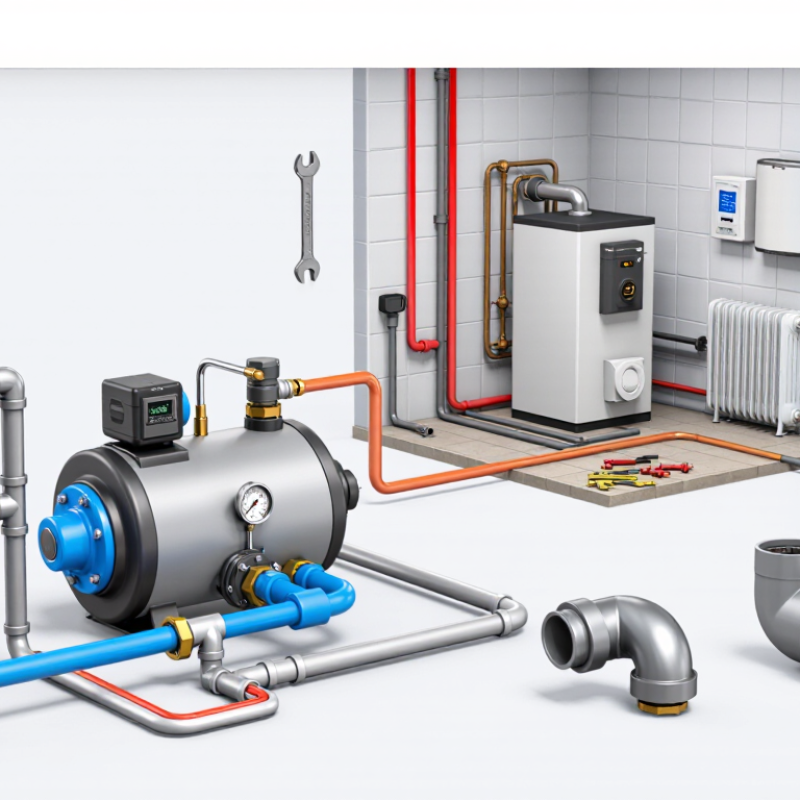
How to Choose the Right Boiler Pump in 2026

Define Boiler Duty and Flow Rate Using Q = 0.86P/ΔT (m³/h)

In 2026, choose a boiler pump by matching its flow to the boiler’s heat duty and the system’s design temperature difference. For water, use Q = 0.86P/ΔT, where Q is flow in m³/h, P is duty in kW, and ΔT is the flow-return temperature difference in °C. A 30 kW duty with a 20°C difference needs about 1.29 m³/h. Check the units. Use the actual design duty, not an assumed maximum, and confirm the boiler’s stated requirements.

Tips: Measure or verify the intended flow and return temperatures. A smaller ΔT means higher required flow for the same duty. For the example above, using 10°C instead of 20°C doubles the calculated flow. Small details matter.

Flow rate alone does not identify the right pump. The pump must deliver that flow against the resistance of pipework, fittings, valves, and heat emitters. Check the circuit layout and pressure-loss data, then compare the required flow and head with the pump’s operating curve. A calculation is only as reliable as its inputs; older systems may contain undocumented changes, so measured conditions can differ from design figures. If the duty or system resistance is uncertain, have a qualified heating professional verify the selection before installation.

How to Choose the Right Boiler Pump in 2026 — Define Boiler Duty and Flow Rate Using Q = 0.86P/ΔT (m³/h)

Estimate the required water flow from boiler heat output and the design temperature difference. In this formula, P is boiler output in kW, ΔT is the water temperature drop across the boiler in °C, and Q is flow in m³/h.

Boiler Duty, P (kW) Design ΔT (°C) Calculation Calculated Flow, Q (m³/h) Pump Duty Consideration
80 20 0.86 × 80 ÷ 20 3.44 Use the calculated flow as the design flow target, then check the system pressure loss.
120 20 0.86 × 120 ÷ 20 5.16 Confirm that the pump can deliver this flow at the calculated circuit head.
250 20 0.86 × 250 ÷ 20 10.75 Include pipework, fittings, control valves, and heat exchanger resistance in the head calculation.
500 20 0.86 × 500 ÷ 20 21.50 Check the pump operating point against both required flow and total system resistance.
750 20 0.86 × 750 ÷ 20 32.25 For multiple circuits, establish the required flow and pressure conditions for each circuit.
1,000 20 0.86 × 1,000 ÷ 20 43.00 Verify the design flow against the boiler manufacturer’s minimum and maximum flow limits.
500 15 0.86 × 500 ÷ 15 28.67 A smaller design ΔT requires a higher flow for the same boiler output.
1,000 15 0.86 × 1,000 ÷ 15 57.33 Confirm pipe sizing and system pressure loss at the higher required flow.
500 10 0.86 × 500 ÷ 10 43.00 Check that the selected system design and boiler controls support this temperature difference.

Selection note: These estimates assume water and use the stated formula as a practical sizing approximation. The formula determines flow, not pump head. Calculate system pressure loss separately and select a pump whose performance curve meets the required flow at that head. For glycol mixtures or other fluids, use fluid-specific properties and design guidance.

Calculate Required Pump Head from Total Circuit Pressure Loss

How to Choose the Right Boiler Pump in 2026

Start with the required flow, then calculate the pressure loss around the complete circuit at that flow. Include pipe, fittings, boiler heat exchangers, valves, and terminal units. For water, convert pressure loss to head using H = ΔP ÷ (ρg). A circuit loss of 45 kPa, for example, is about 4.6 m of water head. ASHRAE Handbook guidance for hydronic systems emphasizes accounting for system resistance when selecting pumps. In a sealed, filled loop, elevation usually does not add to the circulating head; open systems require different treatment. Check the fluid and operating temperature, too. I have seen estimates miss a partly closed control valve—small detail, real impact.

Tips: Use the pressure-drop data for the actual design flow, not a pipe-size shortcut. Add the losses for the full path, then verify the selected pump curve reaches that duty point. The U.S. Department of Energy’s 2006 Improving Pumping System Performance sourcebook estimates that pumping systems account for nearly 20% of global electricity use. That figure covers many applications, not boiler pumps alone, but it shows why avoiding excess head matters. Record assumptions and recheck them on site; drawings can be optimistic.

How to Choose the Right Boiler Pump in 2026

Example circuit pressure losses: boiler heat exchanger 18 kPa, piping 24 kPa, control valves 12 kPa, terminal units 16 kPa, and fittings 10 kPa. The total is 80 kPa. For water, 80 kPa is approximately 8.2 m of pump head, using 1 m of water head ≈ 9.81 kPa.

Select a pump that delivers the required system flow rate at approximately 8.2 m head, then verify the duty point against the pump curve. This illustrative example excludes any additional allowance for site-specific conditions.

Check Fluid Temperature, Glycol Content, and NPSH Requirements

For a 2026 boiler-pump selection, start with the actual fluid temperature and glycol concentration, not the water-only curve. ASHRAE Handbook—Fundamentals fluid-property tables show why: at about 20°C, a 30% propylene-glycol mixture has roughly twice water’s viscosity. Higher viscosity can increase pressure loss and reduce pump flow. Glycol also changes heat capacity, so confirm the system’s required flow using the mixture’s properties at operating temperature. A cold start can behave differently from a warm, steady system.

Then check net positive suction head. Calculate NPSH available from the real suction conditions, including fluid temperature, static head, and suction-pipe losses. Compare it with the selected pump’s NPSH required, using the margin guidance in ANSI/HI 9.6.1. Higher fluid temperature raises vapor pressure and can reduce NPSH available. Small details matter: a partly closed valve or a dirty strainer can erase a comfortable margin. A spreadsheet may miss that.

Tips: Verify glycol percentage with a refractometer, and record the reading with fluid temperature. Use the supplier’s property data for the exact glycol type and concentration. Check suction pressure during commissioning, not only on paper. This step is often skipped. Recheck it after air is removed and strainers are clean.

Select a Pump Near Its Best Efficiency Point and Verify Motor Power

Choose a boiler pump by matching its flow and head requirements to the system, not by pipe size alone. Record the required flow, pressure difference, and expected operating range. Include losses through valves, heat exchangers, and piping; a partly closed valve can shift the actual duty point. Compare these figures with the pump curve and aim to operate near its best efficiency point (BEP). Stay close. If demand changes through the day, check that the pump remains suitable across the likely range, rather than only at one ideal point.

Verify motor power against the pump’s absorbed-power curve at the selected duty point and across plausible operating conditions. Do not assume the motor’s nameplate rating is the power the pump will always use. Account for the hot water’s temperature and density, and leave an appropriate margin without oversizing unnecessarily. An oversized motor does not fix a poorly matched pump. It can hide the mismatch.

Before installation, confirm the curve applies to the selected impeller and speed, and check that the stated head includes the system’s real losses. For a boiler room, record readings at commissioning: flow, suction and discharge pressure, motor current, and water temperature. Compare them with the design values. A small discrepancy may be normal, but it should be investigated rather than explained away. Actual systems are often less tidy than calculations.

Commission the Pump to Design Flow and Check the System’s ΔT (K)

A boiler pump should be selected for the system’s design flow, not simply matched to the boiler’s connection size. For water, a useful estimate is flow (m³/h) = 0.86 × heat output (kW) ÷ design ΔT (K). A 100 kW load at a 20 K temperature difference needs about 4.3 m³/h. Confirm the actual duty against the pump curve and system resistance.

Commission the pump under a representative heating load. Measure flow and supply-and-return temperatures after the system stabilizes; their difference is ΔT. A lower-than-designed ΔT may indicate excess flow, a bypass, or light load, but sensor placement and air can mislead. Don’t diagnose from one reading. The U.S. Department of Energy’s Improving Pumping System Performance sourcebook reports that system optimization can yield 20–50% energy savings in some pumping applications. That is not a guaranteed boiler-room saving, but it shows why measured commissioning matters. Paper calculations look neat; real systems less so.

Tips: Record flow, pump speed, valve positions, and ΔT at handover. Recheck during a cold-weather load, and investigate unexpected readings before changing settings.

Copyright 2025 Fluidra S.A. | Created by BCM Marketing Agencia Privacy Policy Legal note | Cookie policy |

Technical cookies are strictly necessary for our website to work and you can navigate through it. These types of cookies are those that, for example, allow us to identify you, give you access to certain restricted parts of the page if necessary, or remember different options or services already selected by you, such as your privacy preferences. Therefore, they are activated by default, your authorization not being necessary in this regard. Through the configuration of your browser, you can block or alert the presence of this type of cookies, although such blocking will affect the proper functioning of the different functionalities of our website.


The analysis cookies allow us to study the navigation of the users of our website in general (for example, which sections of the page are the most visited, which services are used most and if they work correctly, etc.). From the statistical information on navigation on our website, we can improve both the operation of the page itself and the different services it offers. Therefore, these cookies do not have an advertising purpose, but only serve to make our website work better, adapting to our users in general. By activating them you will contribute to this continuous improvement. You can enable or disable these cookies by checking the corresponding box, being disabled by default.


Functionality cookies allow us to remember your preferences, to personalize certain characteristics and general options of our website, every time you access it (for example, the language in which the information is presented to you, the sections marked as favorites, your browser type, etc.) Therefore, this type of cookies does not have an advertising purpose, but by activating them you will improve the functionality of the website (for example, adapting to your type of browser) and the customization of it based on your preferences (for example, by presenting the information in the language that you have chosen in previous occasions), which will contribute to the ease, usability and comfort of our page during your navigation. You can enable or disable these cookies by checking the corresponding box, being disabled by default.


Advertising cookies allow us to manage the advertising spaces included in our website based on criteria such as the content shown or the frequency in which the ads are displayed. For example, if you have been shown the same ad several times on our website, and you have not shown a personal interest by clicking on it, it will not appear again. In summary, by activating this type of cookies, the advertising shown on our website will be more useful and diverse, and less repetitive. You can enable or disable these cookies by checking the corresponding box, being disabled by default.


Behavioral advertising cookies allow us to obtain information based on the observation of your browsing habits and behaviors on the web, in order to show you advertising content that best suits your personal tastes and interests. To understand it in a very simple way, we will give you a fictitious example: if your last searches on the web were related to suspense literature, we would show you advertising about suspense books. Therefore, activating this type of cookies, the advertising that we show you on our website will not be generic, but will be oriented to your searches, tastes and interests, therefore adjusting exclusively to you. You can enable or disable these cookies by checking the corresponding box, being disabled by default.
To understand it in a very simple way, we will give you a fictitious example: if your last searches on the web were related to suspense literature, we would show you advertising about suspense books. Therefore, activating this type of cookies, the advertising that we show you on our website will not be generic, but will be oriented to your searches, tastes and interests, therefore adjusting exclusively to you. You can enable or disable these cookies by checking the corresponding box, being disabled by default.

SAVE

We use our own and third-party cookies to ensure the proper functioning of the website and to analyse our services, improve your experience on our website and show you advertisements related to your interests according to profiling based on your browsing habits (e.g. websites visited). You can accept all cookies by clicking "ACCEPT" or set or reject them by clicking here. If you would like to know more about the use of cookies, please see our COOKIE POLICY.


ACCEPT ALL
Reject no essentials


