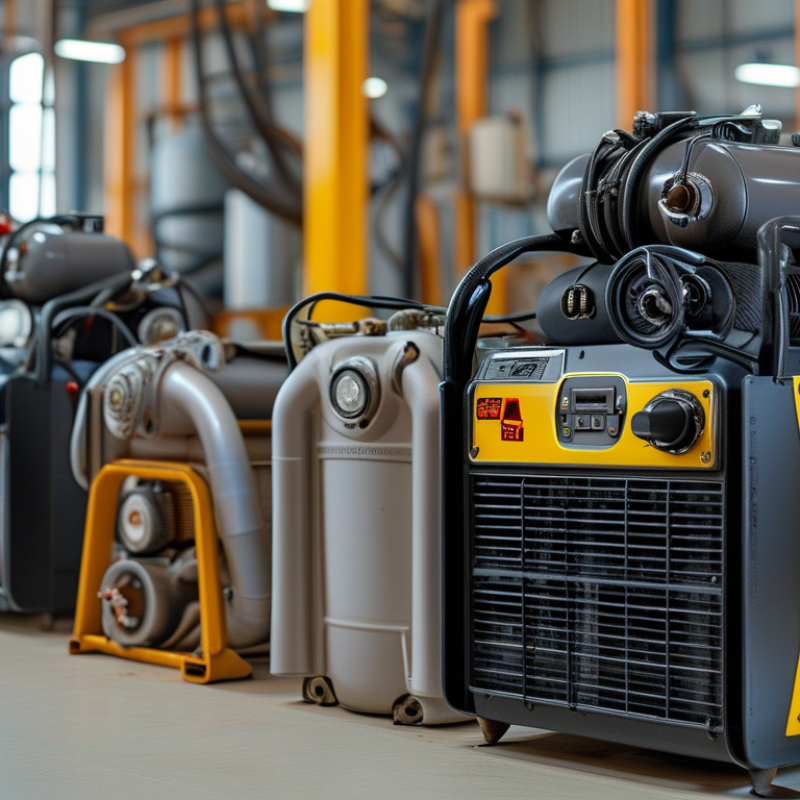
How to Choose the Right Air Compressor for Your Needs?
FLUID HANDLING EXPERTS

Blog, all our news

How to Choose the Right Air Compressor for Your Needs?

Choosing the right Air Compressor can be a daunting task. With various types and specifications available, how do you know what suits your needs? An air compressor is a vital tool for many applications, from DIY projects to industrial tasks.

Understanding your specific requirements helps narrow down your options. Factors such as power source, size, and pressure ratings matter significantly. Remember, a larger compressor doesn’t always mean better performance. Each job has unique demands, and matching your air compressor to these needs is essential for efficiency.

You may also face challenges in selecting the perfect model. Overlooking details such as tank capacity or noise levels can lead to frustration later. Take your time to research and consult reliable sources to make an informed decision. Balancing your needs with available options will lead to a satisfactory choice.

How to Choose the Right Air Compressor for Your Needs?

Understanding Your Air Compressor Requirements

Choosing the right air compressor requires a clear understanding of your specific needs. Start by identifying the tasks you plan to perform. Will you use it for light-duty tasks like inflating tires? Or do you need heavy-duty power for tools like nail guns and spray guns? Knowing your primary applications guides your selection process.

Consider the air pressure and volume you require. This is measured in PSI (pounds per square inch) and CFM (cubic feet per minute). For example, nailers usually need around 90-120 PSI, while paint sprayers may require more volume. If your needs change over time, a versatile compressor can adapt with you.

It's also essential to think about portability and storage. A heavier unit might be more powerful, but it could also limit mobility. Reflect on your workspace and storage options. You may find that a smaller, less powerful model serves you better than a bulky compressor you don’t need. Balancing power with practicality can lead to better long-term satisfaction with your choice.

How to Choose the Right Air Compressor for Your Needs?

Feature Description Suitable Applications Power Source
Portable Lightweight and easy to transport, usually smaller capacity. Inflating tires, powering hand tools. Electric, Gasoline.
Stationary Larger tank for extended use, requires dedicated space. Heavy-duty tasks, automotive work. Electric.
Multistage Compresses air in stages for higher pressure. Industrial applications, sandblasting. Electric.
Single-stage Good for lower pressure applications, simpler design. DIY projects, light air tools. Electric.
Oil-Free Requires less maintenance, clean air output. Painting, food processing. Electric.
Oil-Lubricated More durable, can handle higher loads. Construction, heavy-duty tools. Electric, Gasoline.

Evaluating Different Types of Air Compressors

When selecting the right air compressor, understanding the different types available is crucial. The market features two main categories: portable and stationary compressors. Portable models are ideal for small jobs, providing convenience and ease of transport. They are popular among DIY enthusiasts and in home improvement projects. Stationary compressors, meanwhile, excel in larger applications, offering more power and storage capacity for sustained use.

Compressed air is versatile. According to a report by the Compressed Air and Gas Institute, over 70% of industrial air systems are misused or poorly maintained, often leading to inefficiencies. This highlights the importance of choosing the correct type for your specific needs. For instance, if you require a tool that demands continuous air pressure, a stationary compressor is your best choice. Meanwhile, if you only need occasional use, a portable option suffices.

Tip: Always check the duty cycle of your chosen model to ensure it meets operational demands.

Take some time to evaluate your requirements and potential applications. A compressor that is too small can limit your efficiency. Too large of a model may lead to unnecessary costs and wasted energy. This balance is key.

Tip: Consider energy efficiency ratings. Products with better efficiency save money in the long run.

Key Specifications to Consider: PSI, CFM, and Tank Size

When choosing an air compressor, key specifications greatly influence your decision, particularly PSI, CFM, and tank size. PSI, or pounds per square inch, measures the pressure the compressor can deliver. If you need to operate tools like nail guns or spray paint systems, check the PSI requirements. A higher PSI can be beneficial, but it may come with increased cost and complexity.

CFM, or cubic feet per minute, assesses the airflow delivered by the compressor. Different tools require different CFM levels. For instance, a high-demand tool like a sand blaster will need more CFM than a simple inflator. Evaluate your tools to understand their airflow needs. An incorrect CFM rating can lead to inefficiencies.

Tank size also plays a crucial role. A larger tank holds more air, allowing for longer tool operation without interruption. However, a bigger tank can make the compressor heavier and harder to move. Consider your workspace and how often you will need to transport the unit. Striking a balance between capacity and mobility is key. Ultimately, review your specific needs and usage patterns before finalizing your purchase.

Assessing Portability versus Stationary Use

When deciding between a portable and stationary air compressor, think about your specific needs. Portable air compressors are lightweight and easy to move. They are great for tasks like inflating tires or using power tools at job sites. But, you might find they lack the power required for heavy-duty jobs.

Stationary air compressors, on the other hand, are designed for permanent installation. They usually offer more power and can handle larger pneumatic tools. This choice is ideal for dedicated shops or serious DIY enthusiasts who tackle big projects frequently. You won’t want to switch between locations often with this setup.

**Tips:** If you need to save space, portable compressors are your best bet. Evaluate your workspace and ensure your compressor fits. Consider the noise levels as well. Portable models can be louder, which might be a concern in residential areas. Reflect on how often you’ll use the compressor to guide your decision.

Comparison of Portable vs Stationary Air Compressors

This chart illustrates the average ratings across different criteria for portability and stationary air compressors. It helps in assessing which option may better fit your specific needs based on portability, power, cost, tank size, and noise level.

Budgeting for Your Air Compressor Purchase

Budgeting for your air compressor purchase is crucial. Start by assessing your needs. Consider the type of tasks you will perform. Will you use it for light DIY projects, or for heavy industrial work? Your needs greatly influence cost. Smaller compressors for casual use may range from a few hundred dollars. Industrial models can exceed several thousand.

Next, think about additional costs. Maintenance and repairs can add up over time. Factor in accessories, like hoses and fittings. Overlook these, and you might face unexpected expenses. A lower upfront cost can be tempting, but it's essential to consider long-term value. Sometimes, expensive models come with better durability and efficiency.

Keep in mind the market fluctuations. Prices can vary based on demand and supply. It’s wise to compare options. Research online and visit local stores. Take your time to evaluate different models. Balanced decision-making will help you find the best match, both for your wallet and your specific needs.

Copyright 2025 Fluidra S.A. | Created by BCM Marketing Agencia Privacy Policy Legal note | Cookie policy |

Technical cookies are strictly necessary for our website to work and you can navigate through it. These types of cookies are those that, for example, allow us to identify you, give you access to certain restricted parts of the page if necessary, or remember different options or services already selected by you, such as your privacy preferences. Therefore, they are activated by default, your authorization not being necessary in this regard. Through the configuration of your browser, you can block or alert the presence of this type of cookies, although such blocking will affect the proper functioning of the different functionalities of our website.


The analysis cookies allow us to study the navigation of the users of our website in general (for example, which sections of the page are the most visited, which services are used most and if they work correctly, etc.). From the statistical information on navigation on our website, we can improve both the operation of the page itself and the different services it offers. Therefore, these cookies do not have an advertising purpose, but only serve to make our website work better, adapting to our users in general. By activating them you will contribute to this continuous improvement. You can enable or disable these cookies by checking the corresponding box, being disabled by default.


Functionality cookies allow us to remember your preferences, to personalize certain characteristics and general options of our website, every time you access it (for example, the language in which the information is presented to you, the sections marked as favorites, your browser type, etc.) Therefore, this type of cookies does not have an advertising purpose, but by activating them you will improve the functionality of the website (for example, adapting to your type of browser) and the customization of it based on your preferences (for example, by presenting the information in the language that you have chosen in previous occasions), which will contribute to the ease, usability and comfort of our page during your navigation. You can enable or disable these cookies by checking the corresponding box, being disabled by default.


Advertising cookies allow us to manage the advertising spaces included in our website based on criteria such as the content shown or the frequency in which the ads are displayed. For example, if you have been shown the same ad several times on our website, and you have not shown a personal interest by clicking on it, it will not appear again. In summary, by activating this type of cookies, the advertising shown on our website will be more useful and diverse, and less repetitive. You can enable or disable these cookies by checking the corresponding box, being disabled by default.


Behavioral advertising cookies allow us to obtain information based on the observation of your browsing habits and behaviors on the web, in order to show you advertising content that best suits your personal tastes and interests. To understand it in a very simple way, we will give you a fictitious example: if your last searches on the web were related to suspense literature, we would show you advertising about suspense books. Therefore, activating this type of cookies, the advertising that we show you on our website will not be generic, but will be oriented to your searches, tastes and interests, therefore adjusting exclusively to you. You can enable or disable these cookies by checking the corresponding box, being disabled by default.
To understand it in a very simple way, we will give you a fictitious example: if your last searches on the web were related to suspense literature, we would show you advertising about suspense books. Therefore, activating this type of cookies, the advertising that we show you on our website will not be generic, but will be oriented to your searches, tastes and interests, therefore adjusting exclusively to you. You can enable or disable these cookies by checking the corresponding box, being disabled by default.

SAVE

We use our own and third-party cookies to ensure the proper functioning of the website and to analyse our services, improve your experience on our website and show you advertisements related to your interests according to profiling based on your browsing habits (e.g. websites visited). You can accept all cookies by clicking "ACCEPT" or set or reject them by clicking here. If you would like to know more about the use of cookies, please see our COOKIE POLICY.


ACCEPT ALL
Reject no essentials