
How to Choose the Best Metallized Film Supplier?
FLUID HANDLING EXPERTS

Blog, all our news

How to Choose the Best Metallized Film Supplier?

Choosing the best Metallized Film supplier is not simply a search for the brightest roll or lowest quotation. It is a technical decision that affects barrier performance, sealing, printing, converting, and customer complaints. A reliable supplier should explain the film structure clearly, including the polymer base, metal coating, thickness, and intended application. They should also provide test data for oxygen transmission, water vapor transmission, optical density, adhesion, and tensile strength.

Packaging technologist Dr. Susanne Kaltenbach once said, “A material is only as reliable as the process that produces and verifies it.” This principle matters when comparing Metallized Film manufacturers. Ask how vacuum deposition is controlled. Request recent certificates of analysis. Examine sample rolls for wrinkles, telescoping, pinholes, uneven gloss, and edge damage. Small defects can become large waste on a high-speed packaging line.

Look beyond the sample.

Supplier experience should be visible in practical details. Can the team recommend a suitable film for snacks, pharmaceuticals, insulation, labels, or decorative packaging? Can they match your laminating adhesive, printing ink, and converting equipment? Do they maintain batch traceability and consistent delivery schedules? Certifications can support credibility, but they do not replace independent testing.

Price still matters. It should not lead the decision alone. A cheaper roll may create unstable tension, poor metallization, or repeated production stoppages. Still, no supplier is perfect, and buyers sometimes overlook their own unclear specifications. Define performance targets before requesting quotations. Compare suppliers using measurable evidence, factory communication, trial results, and long-term consistency. The strongest partnership is not always the largest company. It is the one that understands your process and proves its claims.
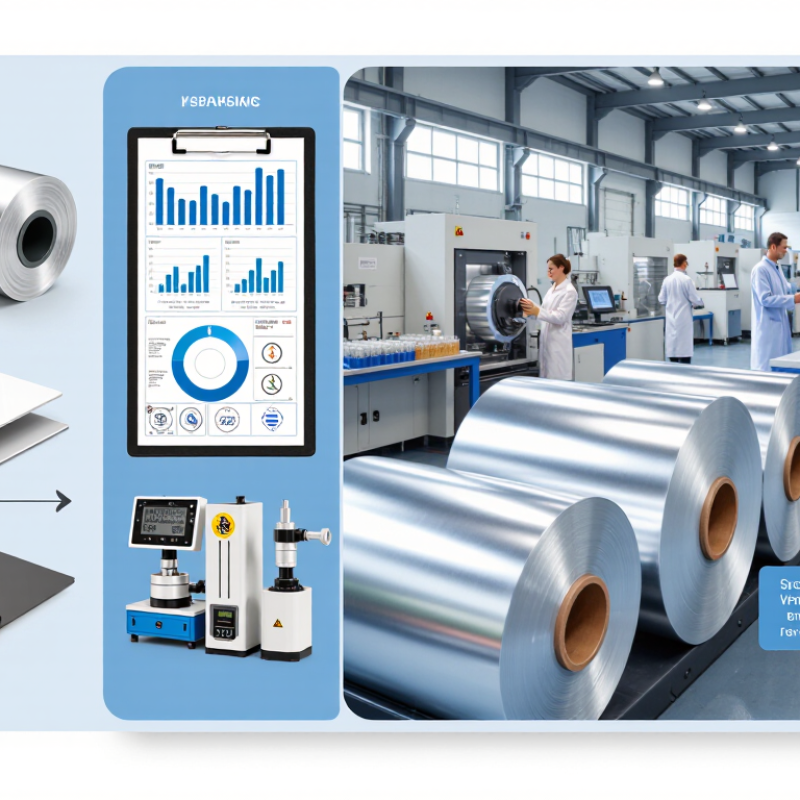
How to Choose the Best Metallized Film Supplier?

Define Film Needs: 12–50 μm Gauge, OTR, WVTR, and Optical Density

How to Choose the Best Metallized Film Supplier?

A reliable supplier begins with your actual film requirements, not a generic product sheet. Define the gauge first, usually between 12 and 50 μm. Thinner film can reduce material use, but it may tear during converting or filling. Thicker film often improves handling, yet it can increase cost and stiffness. Small differences matter.

Measure oxygen transmission rate (OTR) and water vapor transmission rate (WVTR) under stated temperature and humidity conditions. A supplier should provide test methods, sample conditioning, and recent laboratory data. Ask whether values apply to the metallized film alone or the finished laminate. Optical density also deserves attention. It indicates coating uniformity and light-blocking performance. A bright sample is not automatically a consistent sample.

Tips: Request three production samples, not one hand-cut piece. Check gauge variation across the web, coating appearance, roll edges, and seal behavior. Compare certificates with your own testing when possible. I once trusted a clean-looking sample and missed uneven barrier readings near the roll edge. That mistake changed our inspection process. It also reminded me that supplier claims need practical verification. Discuss target ranges, test tolerances, storage conditions, and delivery records with the supplier. A technically strong supplier will explain limitations clearly, including results that are less impressive. That honesty is useful. Supplier selection should consider repeatability, documentation, and technical support, not price alone.

Compare Barrier Data Under ASTM F1249 and ASTM D3985 Test Conditions

How to Choose the Best Metallized Film Supplier?

Barrier performance is not one simple number. ASTM F1249 measures water vapor transmission rate, while ASTM D3985 measures oxygen transmission rate. They examine different gases and different failure risks. A metallized film may show excellent oxygen resistance but weaker moisture protection. The reverse can also happen.

Experienced packaging teams inspect the full test record. Check film thickness, temperature, relative humidity, gas pressure, and conditioning time. These details can change the result significantly. Ask whether testing used the intended laminate structure, not only the base film.

Confirm the units and test direction. A report without these details is incomplete. It may still look professional.

Tips: Request recent laboratory reports and raw data. Compare results only under matching conditions. Check repeatability across several samples. Ask how pinholes, wrinkles, and coating variation were controlled. A supplier should explain unusual results clearly, without hiding behind technical language.

ASTM F1249 data is especially important for products sensitive to moisture, such as powders or crisp snacks. ASTM D3985 data matters when oxygen exposure can reduce freshness or stability. Do not rank suppliers using one impressive value. Review barrier results beside seal strength, thickness tolerance, and converting performance. Production experience matters here. A film can pass laboratory testing yet create trouble on a fast packaging line. We have seen that gap before. It deserves honest discussion.

Audit Coating Quality: 2.0–3.0 Optical Density and Uniformity Control

How to Choose the Best Metallized Film Supplier?

Audit Coating Quality: 2.0–3.0 Optical Density and Uniformity Control

Optical density is a practical starting point when auditing metallized film. A target of 2.0–3.0 usually indicates strong light blocking for many flexible packaging applications. However, the average value can hide weak zones. Request roll maps, not only one laboratory reading.

Measure samples across the web, machine direction, and roll length. Record optical density at the center, edges, beginning, and end. Use calibrated transmission equipment, with test conditions aligned to ISO 5-2 principles. ASTM D1003 can also support related transparency and haze evaluations, although it does not replace an optical-density specification. Keep sampling records traceable to the production batch.

Uniformity matters during printing, laminating, and barrier conversion. A 2024 flexible packaging industry report from Smithers identifies barrier performance and production consistency as major purchasing factors. That finding matches factory experience: small coating variations can create visible shade changes or weak barrier areas. Ask suppliers for tolerance limits, instrument calibration records, and corrective-action reports.

Do not trust a perfect sample.

A supplier may show excellent density on a small sheet, yet struggle across a full roll. Review historical data, retain unopened samples, and compare readings independently. One weakness remains: density alone cannot prove oxygen or moisture barrier performance. Add WVTR and OTR testing, using agreed methods such as ASTM F1249 and ASTM D3985, before approving regular supply.

Verify ISO 9001 Traceability, ASTM D882 Strength, and Defect-Rate Data

How to Choose the Best Metallized Film Supplier?

A credible supplier should connect every roll to verifiable production records. ISO 9001 certification helps, but it does not guarantee consistent metallized film. Request the certificate, scope, audit status, and traceability procedure. Then check whether roll numbers link to resin batches, metallization settings, operators, and inspection results. Ask for the raw trail. That matters.

Mechanical Performance For mechanical performance, require ASTM D882 test reports from recent production lots. Confirm specimen direction, thickness, conditioning, tensile strength, and elongation values. Machine calibration dates should also be available. Compare machine-direction and transverse-direction results because film can behave differently during converting. Three acceptable samples may not represent a full year of output.

Defect-rate data deserves the same scrutiny. Ask how the supplier defines pinholes, streaks, wrinkles, metal skips, and coating marks. Request lot-level rates, inspection length, sampling frequency, and rejection rules. Data without a denominator is nearly useless. A supplier reporting “low defects” sounds reassuring, but the phrase needs measurable context. Review records from several months, not only a polished sample report. An honest supplier should explain variation, corrective actions, and unresolved weaknesses. Some data may be incomplete; that is a reason to investigate, not an automatic rejection. Pair documents with a controlled trial, visual inspection, and performance testing under your actual converting conditions.

Check FDA 21 CFR, EU 1935/2004, REACH, MOQ, Capacity, and Lead Time

How to Choose the Best Metallized Film Supplier?

A reliable supplier should explain how its metallized film meets FDA 21 CFR requirements for your intended food-contact application. Ask for current declarations, migration test results, and details about adhesives, coatings, inks, and substrates. These components may affect compliance, even when the film itself appears suitable. EU Regulation 1935/2004 also requires materials to avoid transferring harmful substances or changing food quality. Request testing that matches your product, temperature, storage period, and contact conditions. Generic documents are not enough.

Check REACH information carefully. The supplier should identify relevant substances and explain whether any SVHC reporting duties apply. Do not accept vague statements such as “fully compliant” without supporting records. I once treated a compliance letter as complete evidence. It was not. The intended use had changed, so additional testing was needed.

Commercial details matter just as much. Compare MOQ against your actual forecast, not an optimistic sales plan. A low MOQ can still hide setup fees or inconsistent production. Review monthly capacity, machine availability, quality controls, and backup plans during peak seasons. Ask for realistic lead times, including raw material preparation, metallization, slitting, inspection, and shipping. Request sample rolls before placing a larger order. Small trials reveal coating defects, weak adhesion, curl, and variable optical density. Leave room for doubt. Production conditions rarely behave exactly like laboratory samples.

How to Choose the Best Metallized Film Supplier? - Check FDA 21 CFR, EU 1935/2004, REACH, MOQ, Capacity, and Lead Time

Evaluation Dimension What to Check Supplier Profile A Supplier Profile B Supplier Profile C Recommended Decision Rule
FDA 21 CFR Compliance Written declaration identifying the applicable food-contact regulations for the base film, metallized layer, coatings, inks, adhesives, and sealant layers. Declaration available
Applicable regulation depends on the complete material structure and intended food-contact use.
Partial documentation
Base-film documents available; adhesive and ink compliance requires confirmation.
To be verified
No complete food-contact file supplied.
Do not accept a general “FDA approved” statement. Request a structure-specific declaration and migration-supporting documents.
EU Framework Regulation Compliance with Regulation (EC) No 1935/2004, including traceability and suitability for the intended food-contact application. Documented
Declaration references the finished multilayer structure and intended use.
Partially documented
Material declaration available; end-use conditions are not fully defined.
To be verified
Supplier has not provided a complete declaration of compliance.
Require a current Declaration of Compliance that covers the finished article or the supplier’s supplied layer, as applicable.
REACH Status SVHC communication, restricted-substance controls, and confirmation that intentionally added substances are disclosed where required. Current statement
SVHC status is reviewed against the latest applicable candidate list.
Annual statement
Update frequency and substance-screening scope must be confirmed.
Unclear
Only a generic “REACH compliant” statement is available.
Request a dated REACH/SVHC declaration and clarify responsibility for inks, coatings, adhesives, and additives.
Film Structure Substrate, metallization side, coating or sealant layer, total thickness, and compatibility with the customer’s converting process. Typical PET, BOPP, or CPP-based structures; structure can be specified by application. Commonly offers standard polyester and polypropylene grades with limited custom coating options. May focus on one or two standard film constructions. Approve only after reviewing the full layer structure, technical data sheet, and production sample.
Barrier Performance OTR, WVTR, optical density, metallization uniformity, and test conditions such as temperature and relative humidity. Can provide lot-based barrier results for qualified grades. Provides typical values; lot-specific reporting must be requested. Barrier data may be limited to brochure values. Compare values only when test methods, film thickness, temperature, and humidity are equivalent.
Minimum Order Quantity Minimum order for standard grades, custom widths, special coatings, and trial orders. Typical market range: 500–2,000 kg Typical market range: 1,000–3,000 kg Typical market range: 200–1,000 kg for selected standard grades Choose the lowest MOQ that still meets quality, slit-width, and packaging requirements. Confirm whether MOQ is per width or per order.
Production Capacity Monthly metallizing capacity, coating capacity, slitting capacity, available machine width, and utilization during peak periods. Indicative tier: medium to high capacity Indicative tier: high capacity for standard grades Indicative tier: small to medium capacity Ask for available capacity for the specific grade and delivery month rather than total company capacity alone.
Lead Time Time from purchase-order confirmation to production completion, slitting, inspection, and dispatch. Typical standard-grade range: 3–5 weeks Typical standard-grade range: 4–6 weeks Typical standard-grade range: 2–4 weeks Obtain a written lead-time commitment and identify separate timing for raw-material procurement, production, and export documentation.
Custom Development Ability to adjust film thickness, optical density, coating, sealability, corona treatment, width, and roll length. Suitable for application-specific development and qualification trials. Best suited to repeat orders using established specifications. May offer faster trials for a narrow range of standard constructions. Evaluate sample cost, development time, tooling or coating charges, and ownership of approved specifications.
Quality Documentation Technical data sheet, certificate of analysis, inspection report, roll identification, traceability, and change-control procedure. Comprehensive package Available on request Basic documentation Make document delivery and change notification part of the purchase specification.
Quality Management Auditable quality system, process controls, calibration, nonconformance handling, and customer complaint response. Suitable for buyers requiring formal supplier qualification. Suitable after an audit or review of quality-system records. Requires additional assessment before approval for critical applications. Request a valid certification scope and verify that it covers film manufacturing, coating, metallizing, or slitting as relevant.
Logistics and Packaging Roll protection, moisture control, pallet configuration, export packing, shipping terms, and damage-claim process. Export-ready packaging and scheduled shipment planning. Standard export packaging; special protection may involve an additional charge. Flexible small-lot shipping; logistics capability should be confirmed for international orders. Confirm core protection, roll orientation, maximum pallet weight, labeling, and responsibility for transit damage.
Overall Suitability Best fit based on regulatory documentation, technical performance, order size, capacity, and delivery requirements. Strong candidate
Best for regulated applications requiring complete documentation and stable supply.
Candidate after verification
Potentially suitable for larger recurring volumes after documentation review.
Candidate for smaller lots
Potentially suitable when MOQ and short lead time are priorities.
Approve only after document review, sample testing, commercial confirmation, and—where necessary—a supplier audit.

Note: MOQ, capacity, and lead-time figures are indicative market-planning ranges rather than commitments from named companies. Regulatory compliance must be verified against the exact film construction, intended food type, contact conditions, processing method, and destination market.

Copyright 2025 Fluidra S.A. | Created by BCM Marketing Agencia Privacy Policy Legal note | Cookie policy |

Technical cookies are strictly necessary for our website to work and you can navigate through it. These types of cookies are those that, for example, allow us to identify you, give you access to certain restricted parts of the page if necessary, or remember different options or services already selected by you, such as your privacy preferences. Therefore, they are activated by default, your authorization not being necessary in this regard. Through the configuration of your browser, you can block or alert the presence of this type of cookies, although such blocking will affect the proper functioning of the different functionalities of our website.


The analysis cookies allow us to study the navigation of the users of our website in general (for example, which sections of the page are the most visited, which services are used most and if they work correctly, etc.). From the statistical information on navigation on our website, we can improve both the operation of the page itself and the different services it offers. Therefore, these cookies do not have an advertising purpose, but only serve to make our website work better, adapting to our users in general. By activating them you will contribute to this continuous improvement. You can enable or disable these cookies by checking the corresponding box, being disabled by default.


Functionality cookies allow us to remember your preferences, to personalize certain characteristics and general options of our website, every time you access it (for example, the language in which the information is presented to you, the sections marked as favorites, your browser type, etc.) Therefore, this type of cookies does not have an advertising purpose, but by activating them you will improve the functionality of the website (for example, adapting to your type of browser) and the customization of it based on your preferences (for example, by presenting the information in the language that you have chosen in previous occasions), which will contribute to the ease, usability and comfort of our page during your navigation. You can enable or disable these cookies by checking the corresponding box, being disabled by default.


Advertising cookies allow us to manage the advertising spaces included in our website based on criteria such as the content shown or the frequency in which the ads are displayed. For example, if you have been shown the same ad several times on our website, and you have not shown a personal interest by clicking on it, it will not appear again. In summary, by activating this type of cookies, the advertising shown on our website will be more useful and diverse, and less repetitive. You can enable or disable these cookies by checking the corresponding box, being disabled by default.


Behavioral advertising cookies allow us to obtain information based on the observation of your browsing habits and behaviors on the web, in order to show you advertising content that best suits your personal tastes and interests. To understand it in a very simple way, we will give you a fictitious example: if your last searches on the web were related to suspense literature, we would show you advertising about suspense books. Therefore, activating this type of cookies, the advertising that we show you on our website will not be generic, but will be oriented to your searches, tastes and interests, therefore adjusting exclusively to you. You can enable or disable these cookies by checking the corresponding box, being disabled by default.
To understand it in a very simple way, we will give you a fictitious example: if your last searches on the web were related to suspense literature, we would show you advertising about suspense books. Therefore, activating this type of cookies, the advertising that we show you on our website will not be generic, but will be oriented to your searches, tastes and interests, therefore adjusting exclusively to you. You can enable or disable these cookies by checking the corresponding box, being disabled by default.

SAVE

We use our own and third-party cookies to ensure the proper functioning of the website and to analyse our services, improve your experience on our website and show you advertisements related to your interests according to profiling based on your browsing habits (e.g. websites visited). You can accept all cookies by clicking "ACCEPT" or set or reject them by clicking here. If you would like to know more about the use of cookies, please see our COOKIE POLICY.


ACCEPT ALL
Reject no essentials


