
Choosing the best Lighted Toggle Switch in 2026 requires more than comparing prices or viewing attractive product photos. The right switch must match the circuit, load, voltage, environment, and installation method. A bright indicator may look impressive, yet it can create confusion if its color does not clearly show the circuit status. Small details matter. Terminal spacing, actuator size, sealing quality, and mounting depth can affect daily reliability.
Electrical engineer and electronics educator Jeremy Blum offers a useful reminder: “A switch is only as good as the circuit it serves.” That principle guides this article. A Lighted Toggle Switch should be selected as part of a complete electrical system, not as an isolated accessory. Buyers should check current ratings, AC or DC compatibility, LED polarity, illumination voltage, and contact configuration. They should also consider heat, vibration, moisture, and limited panel space. A switch used beside a damp control panel needs different protection from one installed inside a clean laboratory enclosure.
There is no perfect choice for every project. Even experienced installers can overlook an indicator circuit or misread a product datasheet. That is worth admitting. Careful selection reduces those mistakes. This guide compares practical features, safety considerations, installation requirements, and long-term value. It also explains when a sealed model, metal body, momentary action, or locking actuator makes sense. The goal is simple: help you choose a dependable Lighted Toggle Switch that remains clear, safe, and functional after thousands of real-world operations.
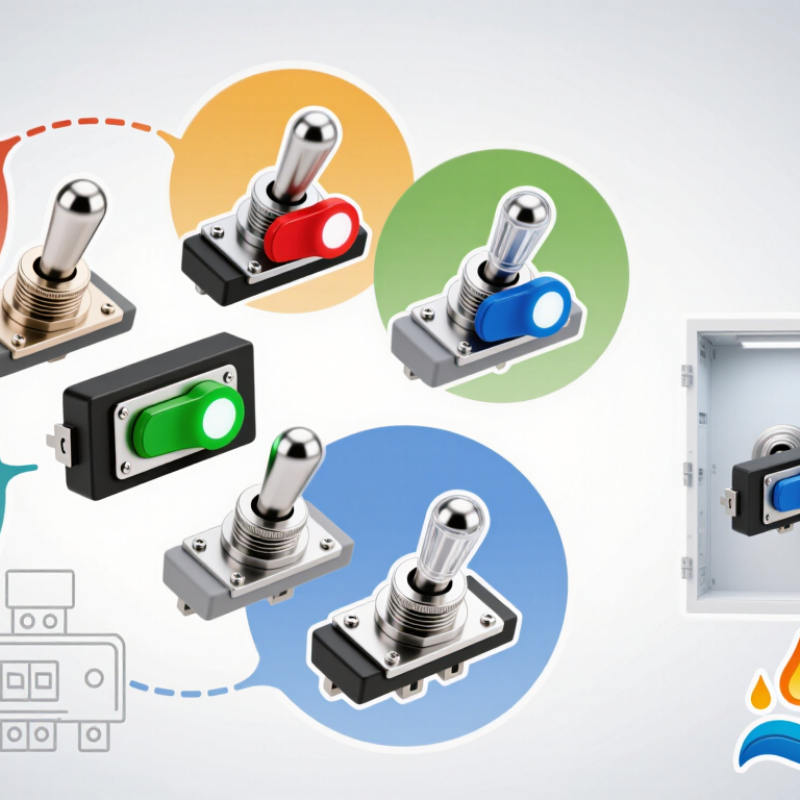
Choosing a lighted toggle switch starts with the application, not appearance. Confirm the circuit voltage first: 12 V DC, 24 V DC, and 120 V AC require different switch designs. The indicator lamp also needs a matching voltage or a suitable resistor. Never assume the switch rating covers the light.
Check steady current and inrush current separately. LED drivers, transformers, and motors may draw sharp startup pulses. A switch rated for 10 A resistive loads may perform poorly with an inductive or capacitive load.
The IEA’s Energy Efficiency 2019 report estimates that lighting uses about 15% of global electricity, so even small control failures can affect large operating systems.
For DC loads, verify polarity and suppression requirements. For AC loads, inspect the voltage, frequency, and load category.
Switching cycles deserve a practical calculation. At 20 operations daily for ten years, the circuit reaches roughly 73,000 cycles. Choose a tested endurance rating above that figure, with margin. IEC 61058-1 provides a useful reference for switch safety and endurance testing.
In real installations, dust, vibration, and hot enclosures reduce service life. I once focused too heavily on electrical ratings and overlooked panel temperature. That was a mistake.
Measure the enclosure temperature, especially near relays or power supplies. Shorter wiring and secure terminals also reduce heat and accidental flicker.

Choosing the best lighted toggle switch in 2026 starts with its electrical rating. A 125 VAC switch may suit smaller equipment, while 250 VAC supports higher-voltage applications. However, voltage alone does not confirm safety. Check the rated current, load type, and switching frequency. Motors and lamps can create higher starting currents than their normal readings suggest. A switch marked 10A at 125 VAC may not provide the same performance at 250 VAC. Read the specification carefully.
LED power deserves equal attention. Integrated indicators may use 6V, 12V, or 24V circuits, and connecting the wrong voltage can damage the lamp. Measure the available supply before ordering. Some LEDs consume only a fraction of a watt, but their brightness varies with the internal resistor design. I once assumed a brighter indicator was automatically better. That assumption was wrong. Excessive brightness can become distracting in a dark control panel.
Contact configuration determines how the switch behaves. SPST designs control one circuit with a simple on-off action. SPDT models transfer power between two circuits, which helps with selection or changeover functions. Momentary contacts return when released, while maintained contacts stay in position. Confirm the terminal layout with a continuity test before installation. It takes seconds. Also inspect the panel cutout, terminal style, insulation, and operating temperature. A well-rated switch can still fail when fit, wiring, or contact selection is overlooked.
Choosing a lighted toggle switch in 2026 requires more than checking voltage and appearance. Verify compliance with UL 61058-1 or IEC 61058-1, depending on the target market. These standards evaluate temperature rise, insulation, mechanical endurance, dielectric strength, and switching performance. A switch may look robust yet fail after repeated operation.
Check the complete test file.
Request the rated current, voltage, load type, cycle count, and temperature range. For illuminated models, inspect the lamp or LED circuit separately. Heat from the indicator can affect insulation and contact reliability. IEC 61058-1 alignment is useful, but it does not automatically prove every regional approval. UL 61058-1 documentation should match the exact switch construction, terminal style, and rating.
RoHS compliance also deserves close attention. The Global E-waste Monitor 2024 reported 62 million tonnes of electronic waste in 2022. Only 22.3% was formally collected and recycled. The report projects 82 million tonnes by 2030. This makes material traceability increasingly important. Ask for a current RoHS declaration covering homogeneous materials, not only the finished housing. Restricted substances include lead, mercury, cadmium, hexavalent chromium, PBB, PBDE, and four phthalates. Typical limits are 0.1%, with cadmium limited to 0.01%. Supplier declarations can contain gaps. Independent laboratory evidence is safer, though not always practical for every batch.
Check UL 61058-1, IEC 61058-1, and RoHS Compliance Requirements
This chart shows the primary compliance focus of each framework. UL 61058-1 and IEC 61058-1 address the safety and performance of switches for appliances, including construction, operation, endurance, insulation, and marking considerations. RoHS addresses the restriction of specified hazardous substances in electrical and electronic products. Confirm the applicable edition, product category, test conditions, and market requirements before approval.
How to Choose the Best Lighted Toggle Switch in 2026?
For indoor and outdoor installations, start with IEC 60529, not appearance. This standard classifies enclosure protection through two digits. The first digit covers solid particles from 0 to 6. The second addresses water protection from 0 to 9K. An IP65 switch is dust-tight and resists water jets. An IP67 switch also tolerates temporary immersion up to one metre, under defined test conditions. More protection is not always better.
Check the real environment. A kitchen control panel may face splashes, grease, and frequent cleaning. IP54 can suit sheltered indoor use, but exposed equipment needs stronger sealing. Outdoor switches may encounter driving rain, dust, and condensation. IP66 is often more appropriate for powerful water jets. IP67 helps where temporary flooding is possible. Think beyond the label.
IEC 60529 also warns that testing does not reproduce every installation condition. Cable entry, gasket compression, and panel orientation can reduce protection. Field inspections often find poorly tightened mounting nuts. That small mistake matters. I would verify the complete assembly, including the illuminated actuator, terminal cover, and wiring route. The switch may carry an IP67 marking, while the installed enclosure performs much worse. Use the manufacturer’s test documentation, inspection records, and the applicable IEC 60529 edition before making a purchase.
A lighted toggle switch should match both your panel and your operating habits. Start with illumination color. Red light suits warning functions, while green often indicates an active circuit. White illumination can improve visibility in dark equipment rooms. However, color meanings vary between workplaces. Confirm your team’s conventions before installation.
Panel fit deserves careful measurement. Check the mounting hole diameter, panel thickness, bushing length, and clearance behind the panel. A switch may fit the hole but still collide with nearby wiring.
Review terminal types, too. Screw terminals support field servicing, while solder terminals can save space. Quick-connect terminals simplify replacement, but only when their size matches the wiring and current rating.
Tips: Test the switch under its real electrical load. Inspect terminal temperature after extended operation. Confirm the lamp’s voltage separately from the switching circuit. Choose a service life above your expected operating cycles. In practical installations, small measurement errors cause the most trouble. I once treated rear clearance as an afterthought, and the enclosure became unnecessarily crowded. That mistake was avoidable. Also, published cycle ratings may reflect controlled laboratory conditions, not vibration, dust, or frequent moisture. Check the technical sheet, installation instructions, and applicable safety requirements before purchasing.

Cepex is the brand for the fluid handling market belonging to the Fluidra group. One of the leading european manufacturer of valves and fittings in thermoplastic materials.
Dedicated to the swimming pool, irrigation and industrial markets, we distribute our products worldwide with the Fluidra commercial network and presence in 46 countries with 136 sales branches.


