
How to Choose the Best Iron Strainer for Global Sourcing?
FLUID HANDLING EXPERTS

Blog, all our news

How to Choose the Best Iron Strainer for Global Sourcing?

Choosing the best Iron Strainer for global sourcing requires more than comparing unit prices. Buyers must examine material grade, mesh consistency, handle strength, surface treatment, packaging, and supplier reliability. A strainer that looks polished in a catalog may warp after repeated heating or arrive with rough casting edges. Small defects become expensive when thousands of units reach different markets.

Industry reports provide useful context. Mordor Intelligence’s cookware market research indicates continued growth in household and commercial cookware demand, driven by food-service expansion and replacement purchases. Grand View Research also identifies durability, safety, and sustainability as important purchasing factors in kitchenware. However, most reports group iron products within broader cookware or kitchenware categories. This creates a sourcing gap. Buyers should not treat broad market figures as direct Iron Strainer sales data.

Cast-iron specialist Mike Otterman, CEO of Lodge Cast Iron, has said, “Cast iron is a product that gets better with age.” That principle matters, but only when the product is properly designed and maintained. A practical evaluation should include salt-spray testing, thermal cycling, load testing, and inspection of coating adhesion. Ask for production samples, factory audit records, food-contact documentation, and packaging drop-test results. Check whether the supplier can keep mesh openings consistent across batches.

The difficult part is accepting that the cheapest quotation may be incomplete. Freight, breakage, rework, and rejected shipments can quietly erase the initial saving. A strong sourcing decision balances verified performance, traceable production, and realistic landed cost. Some assumptions will still be wrong. That is why controlled sampling and honest post-purchase review remain essential.
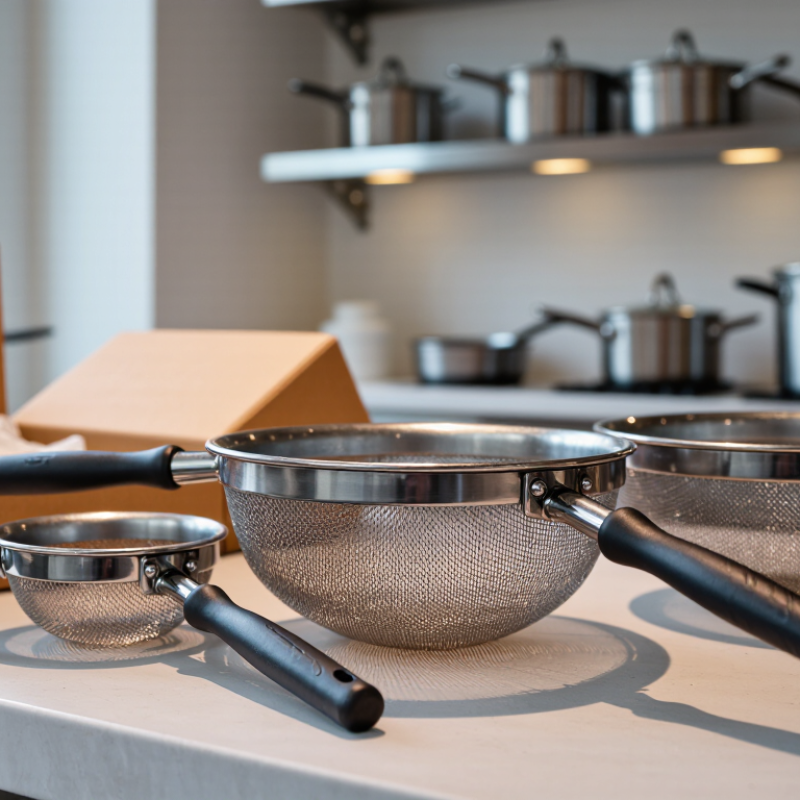
How to Choose the Best Iron Strainer for Global Sourcing?

Define Iron Strainer Requirements: Mesh Sizes, Capacity, and Food-Grade Standards

Choosing an iron strainer for global sourcing starts with a precise requirement sheet. Define the mesh size by opening diameter, not by vague terms like “fine” or “coarse.” A 1–2 mm mesh suits chunky ingredients, while a 0.5 mm mesh filters smaller particles. Always confirm the measurement method with the supplier. Mesh labels can vary between factories.

Capacity also affects daily performance. State the expected volume, liquid weight, and batch frequency. A small kitchen strainer may hold 500 milliliters, while food-service models may handle several liters. Check the frame strength, handle comfort, and drainage speed. I once approved a sample based on capacity alone, but its narrow rim made pouring awkward. That was a useful mistake. Usability matters as much as volume.

Tips: Request a technical drawing, mesh sample, material specification, and food-contact documents before ordering. Confirm whether the iron is coated, stainless, or untreated. Ask for surface-finish details, cleaning guidance, and test reports for relevant food-grade requirements. Requirements differ across destination markets, so verify current documentation with a qualified compliance professional. Include packaging tests, too. A strong strainer can still arrive bent if the carton is weak. Examine production samples under bright light, especially around welds and corners. Small gaps can trap residue and complicate sanitation.

Compare Materials: 304 Stainless Steel Has About 18% Chromium; 316 Adds Molybdenum

How to Choose the Best Iron Strainer for Global Sourcing?

Material selection strongly affects a strainer’s durability, safety, and sourcing value. 304 stainless steel contains about 18% chromium, which helps create a protective surface against rust. It suits dry ingredients, everyday kitchen use, and moderate moisture. However, repeated exposure to salt, acidic foods, or coastal air may challenge its surface over time. I have seen small rust marks appear around poorly finished welds, even when the steel grade was correct.

316 stainless steel adds molybdenum to its composition. This improves resistance to chlorides and aggressive environments. It can be a better choice for seafood processing, salty kitchens, and humid storage areas. The upgrade costs more, though. A buyer should compare the full service life, not only the purchase price. Ask suppliers for material certificates, mesh measurements, handle load tests, and clear photos of weld finishing. Product descriptions can sound precise but remain incomplete.

Tips: Check the steel grade with independent testing when volume is significant. Confirm whether “iron” means carbon steel or stainless steel. Carbon steel may need protective coating and careful drying. Inspect the rim, mesh tension, drainage speed, and packaging before approval. Request samples from different production batches. One sample can mislead. Also, do not assume thicker metal always performs better; excessive weight may reduce handling comfort and raise shipping costs. Supplier audits and written quality standards make comparisons more reliable, although no inspection removes every sourcing risk.

Evaluate Supplier Quality Through ISO 9001, ASTM Testing, and Traceability Records

How to Choose the Best Iron Strainer for Global Sourcing?

A reliable iron strainer starts with a capable supplier, not a polished catalog. Ask for the supplier’s ISO 9001 certificate and verify its issuing body, scope, and validity. ISO 9001 shows controlled processes, but it does not prove every strainer meets your specifications. Review inspection plans for mesh size, weld strength, handle alignment, coating thickness, and edge finishing. These details affect safety and service life.

Request ASTM-based testing when performance matters. Depending on the design, tests may examine corrosion resistance, coating adhesion, tensile strength, or dimensional accuracy. A useful report should show the test method, sample quantity, equipment, date, and laboratory identity. Generic statements are weak evidence. Traceability records should connect raw iron batches to production dates, operators, inspection results, and shipment cartons. During an audit, match one carton label with its material certificate. Small gaps can expose larger problems.

Tips: Ask for a recent sample, then compare it with the approved drawing. Photograph the mesh, weld points, and packaging before approval. Check whether corrective actions are documented, not merely promised. I once treated a clean certificate as sufficient evidence. That was a mistake. Supplier systems need practical verification. When records conflict, pause the order and investigate. Reliability is built through repeated checks, not confident claims.

Check Global Compliance: FDA, EU 1935/2004, REACH, and Food-Contact Requirements

How to Choose the Best Iron Strainer for Global Sourcing?

Before purchasing an iron strainer, verify its food-contact compliance for every target market. FDA requirements depend on the material, coating, food type, temperature, and contact duration. FDA compliance is not always a single universal certificate. Ask for a material declaration and migration-test evidence.

For European sales, check compliance with EU Regulation 1935/2004. The strainer must not release substances that endanger health or change food quality. REACH review is also important, especially for coatings, finishes, pigments, and metal treatments. Request current declarations, substance information, and test reports from qualified laboratories.

Look closely at the mesh, welds, handles, and surface finish. Sharp edges can create safety concerns, while poor coatings may peel after repeated washing. Iron may also rust when exposed to moisture or acidic foods. Small details matter. Confirm traceability, batch records, and the intended temperature range. A report from an ISO/IEC 17025-accredited laboratory offers stronger evidence than a supplier’s simple promise.

In practical sourcing reviews, documents often look complete but lack test conditions. That is a warning sign. Ask whether testing covered the exact production material, not only a similar sample. Requirements can differ by destination, so local regulatory advice remains valuable. I would also review packaging inks, adhesives, and protective oils. These parts are easy to overlook. A careful checklist reduces risk, although no document replaces consistent factory control.

Calculate Total Landed Cost Using MOQ, Incoterms, Freight, Duties, and Lead Time

For an iron strainer, the lowest unit price may hide the highest landed cost. I calculate each offer with this formula: product cost, packaging, origin fees, freight, insurance, duties, customs charges, and inland delivery. MOQ matters immediately. If 5,000 pieces cost $2.20 each, product spend reaches $11,000. Ordering only 1,000 pieces may raise the unit price, but it can reduce storage pressure and obsolete stock.

Incoterms define which costs and risks belong to the buyer. Under FOB, the buyer usually arranges main freight and insurance. Under CIF, freight is included, but destination charges may remain payable. DDP appears simpler, yet I still verify the importer of record, duty calculation, and local tax treatment. Customs classification must be checked against the destination tariff schedule; duty rates are not universal. Do not guess.

Freight deserves a realistic buffer. UNCTAD reports that more than 80% of global merchandise trade by volume moves by sea, so port congestion can affect even small kitchenware shipments. The World Bank’s 2023 Logistics Performance Index, based on 4,090 logistics professionals across 139 countries, highlights differences in customs, infrastructure, and delivery reliability. I convert lead time into money: a 45-day production and transit cycle may require extra inventory, warehouse rent, and working capital. My early estimates are often too optimistic. A missed sailing can erase the apparent savings from a lower MOQ. Always request carton dimensions, gross weight, production capacity, and a written cost breakdown before comparing suppliers.

How to Choose the Best Iron Strainer for Global Sourcing?

Estimated total landed cost by MOQ, Incoterms, freight, duties, and lead time

Sea-based sourcing produces the lowest estimated landed cost at approximately USD 1.67–1.72 per unit, but lead times range from 44 to 51 days. A faster air-freight option reduces lead time to about 12 days while increasing landed cost to approximately USD 2.66 per unit. Costs are illustrative planning estimates per unit at the stated MOQ. Duties depend on the final HS code, customs value, destination market, and country of origin.

Copyright 2025 Fluidra S.A. | Created by BCM Marketing Agencia Privacy Policy Legal note | Cookie policy |

Technical cookies are strictly necessary for our website to work and you can navigate through it. These types of cookies are those that, for example, allow us to identify you, give you access to certain restricted parts of the page if necessary, or remember different options or services already selected by you, such as your privacy preferences. Therefore, they are activated by default, your authorization not being necessary in this regard. Through the configuration of your browser, you can block or alert the presence of this type of cookies, although such blocking will affect the proper functioning of the different functionalities of our website.


The analysis cookies allow us to study the navigation of the users of our website in general (for example, which sections of the page are the most visited, which services are used most and if they work correctly, etc.). From the statistical information on navigation on our website, we can improve both the operation of the page itself and the different services it offers. Therefore, these cookies do not have an advertising purpose, but only serve to make our website work better, adapting to our users in general. By activating them you will contribute to this continuous improvement. You can enable or disable these cookies by checking the corresponding box, being disabled by default.


Functionality cookies allow us to remember your preferences, to personalize certain characteristics and general options of our website, every time you access it (for example, the language in which the information is presented to you, the sections marked as favorites, your browser type, etc.) Therefore, this type of cookies does not have an advertising purpose, but by activating them you will improve the functionality of the website (for example, adapting to your type of browser) and the customization of it based on your preferences (for example, by presenting the information in the language that you have chosen in previous occasions), which will contribute to the ease, usability and comfort of our page during your navigation. You can enable or disable these cookies by checking the corresponding box, being disabled by default.


Advertising cookies allow us to manage the advertising spaces included in our website based on criteria such as the content shown or the frequency in which the ads are displayed. For example, if you have been shown the same ad several times on our website, and you have not shown a personal interest by clicking on it, it will not appear again. In summary, by activating this type of cookies, the advertising shown on our website will be more useful and diverse, and less repetitive. You can enable or disable these cookies by checking the corresponding box, being disabled by default.


Behavioral advertising cookies allow us to obtain information based on the observation of your browsing habits and behaviors on the web, in order to show you advertising content that best suits your personal tastes and interests. To understand it in a very simple way, we will give you a fictitious example: if your last searches on the web were related to suspense literature, we would show you advertising about suspense books. Therefore, activating this type of cookies, the advertising that we show you on our website will not be generic, but will be oriented to your searches, tastes and interests, therefore adjusting exclusively to you. You can enable or disable these cookies by checking the corresponding box, being disabled by default.
To understand it in a very simple way, we will give you a fictitious example: if your last searches on the web were related to suspense literature, we would show you advertising about suspense books. Therefore, activating this type of cookies, the advertising that we show you on our website will not be generic, but will be oriented to your searches, tastes and interests, therefore adjusting exclusively to you. You can enable or disable these cookies by checking the corresponding box, being disabled by default.

SAVE

We use our own and third-party cookies to ensure the proper functioning of the website and to analyse our services, improve your experience on our website and show you advertisements related to your interests according to profiling based on your browsing habits (e.g. websites visited). You can accept all cookies by clicking "ACCEPT" or set or reject them by clicking here. If you would like to know more about the use of cookies, please see our COOKIE POLICY.


ACCEPT ALL
Reject no essentials


