
What Are the Best Cylindrical Fenders in 2026?
FLUID HANDLING EXPERTS

Blog, all our news

What Are the Best Cylindrical Fenders in 2026?

What makes a cylindrical fender the best choice in 2026? Usually, it is not the product with the largest dimensions or the lowest quoted price. Fit matters. UNCTAD’s Review of Maritime Transport 2024 reports that over 80% of global trade by volume is carried by sea. That scale makes reliable berth protection a practical concern for ports, terminals, and vessel operators.

Cylindrical Fenders are used in varied settings, from quay walls and dolphins to vessel sides and workboats. Their simple shape can support flexible installation, but performance depends on more than appearance. PIANC’s Guidelines for the Design of Fender Systems emphasizes assessing berthing energy, reaction force, hull pressure, and site conditions when designing a system. A useful comparison should therefore consider fender dimensions, rubber compound, reinforcement, mounting method, expected vessel approach, and maintenance needs. Small differences matter. A tight tidal range, exposed berth, or uneven contact surface can change what works in practice.

This guide examines the leading cylindrical fender options for 2026 through those application-focused criteria, rather than treating one model as universally superior. It also considers product documentation, manufacturer experience, and the availability of technical support. A specification sheet can look convincing and still leave questions unanswered. Buyers should confirm design assumptions with qualified marine engineers and request project-specific performance data before selecting a system. No shortlist can replace that review. The right fender is the one suited to the berth, the vessel, and the operating conditions—not simply the one with the boldest claims.
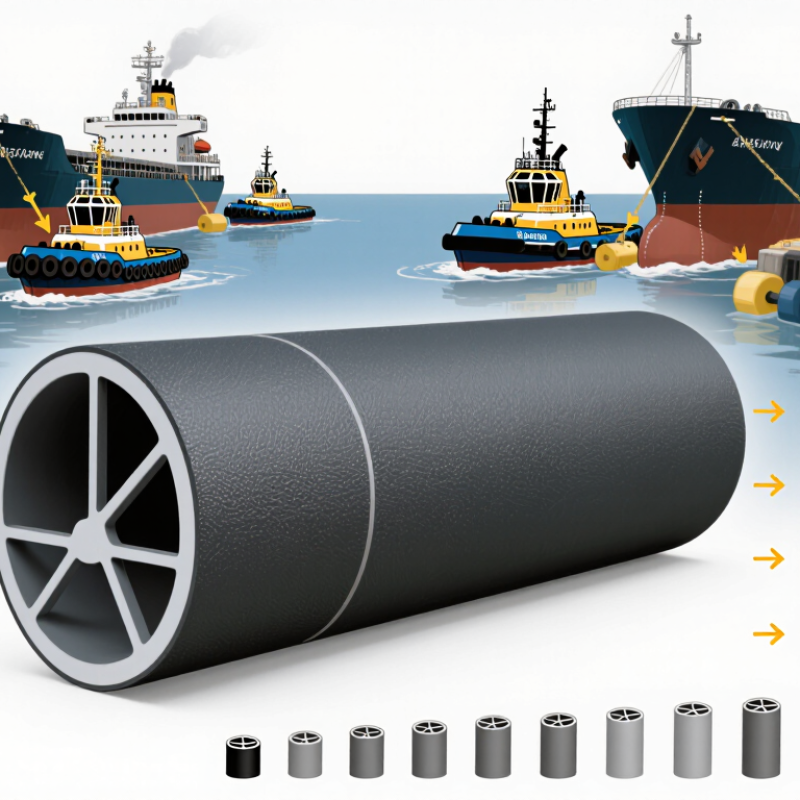
What Are the Best Cylindrical Fenders in 2026?

Cylindrical Fenders Explained: Rubber Body, Bore, Length, and Mounting

A cylindrical fender’s rubber body, bore, length, and mounting all affect how it cushions contact. The bore is not just an empty center: changing its diameter changes the rubber wall and can alter stiffness and compression. Ask for tested energy-absorption and reaction-force curves for the exact size and compound. Appearance alone tells you little.

PIANC’s MarCom Working Group 33 Fender Guidelines (2002) frame selection around berthing energy, including vessel mass and approach speed. For scale, a 5,000-tonne vessel at 0.15 m/s has about 56 kJ of basic kinetic energy before effective-mass and other design factors are applied. This is an illustration, not a final sizing value. Real conditions matter. A longer fender spreads contact along the hull, while the mounting must resist pull-out, wear, and repeated impact. Check the available clearance and backing structure, not only the fender length.

In practice, compare the expected reaction force with the quay’s capacity, then confirm the fender can absorb the design energy. Inspect for cuts, hardening, and uneven compression; small damage can be easy to miss. Still, this is an imperfect shortcut: vessel conditions and installation details can change the result, so a site-specific review is worth doing.

Choosing a Cylindrical Fender in 2026: How Bore Affects Rubber Cross-Section

The chart compares the geometric rubber cross-sectional area for three example cylindrical-fender dimensions. Area is calculated from the outside diameter and bore; it is not an energy-absorption or reaction-force rating.

Example dimensions are shown in outside diameter × bore × length (mm). Actual performance depends on the rubber compound, fender geometry, compression, and installation. Check the required mounting arrangement and available clearance when selecting a fender.

How Performance Is Measured: Energy Absorption (kN·m) and Reaction Force (kN)

For cylindrical fenders, energy absorption and reaction force describe different parts of the same impact. Energy absorption, measured in kN·m, is the work the fender can take in as it compresses. On a test graph, it corresponds to the area beneath the force-versus-deflection curve. Reaction force, measured in kN, is the load passed back to the vessel and berth during compression. One value measures absorbed impact energy; the other helps show how hard the fender pushes against nearby structures.

Numbers need context. A fender rated for high energy absorption may also produce a reaction force that exceeds the berth’s design limit. Compare performance at the same deflection and under the same test conditions, including temperature and loading rate. Then check whether the stated figures apply to one fender or an entire installation. Real berthing is rarely perfectly square: a vessel may contact at an angle, and pressure can concentrate near one edge. That detail matters. Ask for the full force-deflection curve, not only two headline ratings. It gives engineers a clearer basis for matching fender capacity to vessel energy and allowable structural load, though field conditions can still differ from the test.

Apply PIANC WG33 Berthing-Energy Guidance to Match Fenders to Vessels

PIANC WG33 guidance starts with berthing energy, not a fender catalogue. Estimate the vessel’s displacement and approach speed, then account for factors such as added water mass, eccentric contact, and berth geometry. Because energy rises with the square of speed, a small change in approach velocity can matter greatly. Small details matter.

For a cylindrical fender, compare its verified energy absorption and reaction force with the design case. Check that the reaction will not overload the quay structure or create excessive pressure on the vessel’s hull. Fender spacing matters too: a vessel may contact between units, especially when it arrives at an angle. Real calls vary.

Use operating records where available, and test assumptions against the largest design vessel and credible approach conditions. Consider tide range, hull shape, and the fender’s compression limits. A tidy spreadsheet can still hide a poor assumption, particularly when approach speed is guessed rather than measured. WG33 provides a disciplined framework, but site data and engineering review turn that framework into a defensible selection.

What Are the Best Cylindrical Fenders in 2026? - Apply PIANC WG33 Berthing-Energy Guidance to Match Fenders to Vessels

Illustrative screening comparison: Vessel displacements and berthing speeds below are representative planning assumptions, not prescribed PIANC values or data for specific vessels. Uncorrected kinetic energy is calculated as E = ½ × displacement × berthing speed²; with displacement in tonnes, the result is in kilojoules. The screening energy applies an assumed 1.5 multiplier for illustration only. This multiplier is not a PIANC WG33 standard correction factor.

Representative vessel class Illustrative displacement (t) Normal berthing speed (m/s) Uncorrected kinetic energy (kJ) Illustrative screening energy (kJ) Cylindrical-fender selection checks
Coastal workboat 2,000 0.20 40 60 Check hull contact height, fender spacing, local hull pressure, and whether one or more units share the berthing load.
General cargo vessel 10,000 0.15 113 169 Verify rated energy absorption at the permitted deflection and confirm reaction force is within the quay and vessel limits.
Container feeder 25,000 0.15 281 422 Assess the full range of contact elevations, fender-panel or chain details if used, and the effect of berthing angle.
Bulk carrier 60,000 0.12 432 648 Check the governing loaded and ballast conditions, berth geometry, fender-unit load sharing, and allowable structural reaction.
Large tanker 150,000 0.10 750 1,125 Use a site-specific berthing analysis; verify energy capacity, maximum reaction, deflection clearance, and performance at the project temperature.

PIANC WG33 application: Treat these figures as an initial comparison, not a final fender design. A project calculation should establish the design vessel and berthing conditions, then account for relevant effective-mass, eccentricity, berth-configuration, softness, and other applicable factors. Select cylindrical fenders using verified performance data at the specified deflection and temperature, and check both energy absorption and reaction force against the vessel and berth limits. Final sizing and layout require site-specific engineering review.

Compare Solid, Foam-Filled, and Pneumatic Fenders by Use and Maintenance

Choosing a cylindrical fender starts with the berth, vessel size, and frequency of contact. Solid rubber fenders suit fixed quays and work areas where impacts recur and simple upkeep matters. They need no inflation checks, but their weight can make installation and replacement difficult. Their lower cushioning may also be a poor fit for vessels needing greater energy absorption.

Foam-filled fenders combine a resilient core with a protective outer skin. They require no air-pressure adjustments, and a surface puncture may not cause immediate loss of function. Still, inspect the cover for cuts, wear, and water entry. These units can be heavy, too. That detail is easy to overlook during handling plans.

Pneumatic fenders are useful where high energy absorption and lower handling weight are priorities, such as ship-to-ship transfers. Check pressure regularly, inspect valves and outer layers, and watch for leaks after contact. Keep a pressure log. In practice, maintenance depends on exposure, not just the fender type: salt, abrasion, and rough handling all matter. No option is effortless. A sensible choice matches the expected impact, available lifting equipment, and the crew’s inspection routine. Sometimes the best comparison needs real berth measurements; assumptions can be wrong.

2026 Selection Criteria: Check Compression Curves, Hull Pressure (kPa), and Fit

In 2026, compare cylindrical fenders by their compression curves, not diameter alone. A force–deflection curve shows how reaction force rises as the fender compresses; the area beneath it represents absorbed energy. PIANC’s 2002 Guidelines for the Design of Fender Systems treats energy absorption, reaction force, and hull pressure as linked design checks. Ask for test curves at the proposed temperature and compression range. A single peak-force figure hides useful detail.

Hull pressure is usually calculated from reaction force divided by the effective contact area, then checked against the vessel’s allowable pressure. That area can shrink on a curved hull or with poor alignment, raising local pressure. There is no universal safe kPa limit for every vessel. Request the calculation, assumed contact patch, and design margin. Also verify actual clearance, mounting, and fender length against the berth drawings. ISO 17357-1:2014 covers high-pressure pneumatic fenders, so it should not be treated as a performance specification for solid cylindrical fenders.

Tips: Fit matters. Measure the gap at the lowest operating tide, then check whether the fender can compress without bottoming out. Ask for the complete curve and test basis, not just a catalog value. Small caveat: drawings can miss real hull curvature. Review the fit with vessel-specific dimensions.

Copyright 2025 Fluidra S.A. | Created by BCM Marketing Agencia Privacy Policy Legal note | Cookie policy |

Technical cookies are strictly necessary for our website to work and you can navigate through it. These types of cookies are those that, for example, allow us to identify you, give you access to certain restricted parts of the page if necessary, or remember different options or services already selected by you, such as your privacy preferences. Therefore, they are activated by default, your authorization not being necessary in this regard. Through the configuration of your browser, you can block or alert the presence of this type of cookies, although such blocking will affect the proper functioning of the different functionalities of our website.


The analysis cookies allow us to study the navigation of the users of our website in general (for example, which sections of the page are the most visited, which services are used most and if they work correctly, etc.). From the statistical information on navigation on our website, we can improve both the operation of the page itself and the different services it offers. Therefore, these cookies do not have an advertising purpose, but only serve to make our website work better, adapting to our users in general. By activating them you will contribute to this continuous improvement. You can enable or disable these cookies by checking the corresponding box, being disabled by default.


Functionality cookies allow us to remember your preferences, to personalize certain characteristics and general options of our website, every time you access it (for example, the language in which the information is presented to you, the sections marked as favorites, your browser type, etc.) Therefore, this type of cookies does not have an advertising purpose, but by activating them you will improve the functionality of the website (for example, adapting to your type of browser) and the customization of it based on your preferences (for example, by presenting the information in the language that you have chosen in previous occasions), which will contribute to the ease, usability and comfort of our page during your navigation. You can enable or disable these cookies by checking the corresponding box, being disabled by default.


Advertising cookies allow us to manage the advertising spaces included in our website based on criteria such as the content shown or the frequency in which the ads are displayed. For example, if you have been shown the same ad several times on our website, and you have not shown a personal interest by clicking on it, it will not appear again. In summary, by activating this type of cookies, the advertising shown on our website will be more useful and diverse, and less repetitive. You can enable or disable these cookies by checking the corresponding box, being disabled by default.


Behavioral advertising cookies allow us to obtain information based on the observation of your browsing habits and behaviors on the web, in order to show you advertising content that best suits your personal tastes and interests. To understand it in a very simple way, we will give you a fictitious example: if your last searches on the web were related to suspense literature, we would show you advertising about suspense books. Therefore, activating this type of cookies, the advertising that we show you on our website will not be generic, but will be oriented to your searches, tastes and interests, therefore adjusting exclusively to you. You can enable or disable these cookies by checking the corresponding box, being disabled by default.
To understand it in a very simple way, we will give you a fictitious example: if your last searches on the web were related to suspense literature, we would show you advertising about suspense books. Therefore, activating this type of cookies, the advertising that we show you on our website will not be generic, but will be oriented to your searches, tastes and interests, therefore adjusting exclusively to you. You can enable or disable these cookies by checking the corresponding box, being disabled by default.

SAVE

We use our own and third-party cookies to ensure the proper functioning of the website and to analyse our services, improve your experience on our website and show you advertisements related to your interests according to profiling based on your browsing habits (e.g. websites visited). You can accept all cookies by clicking "ACCEPT" or set or reject them by clicking here. If you would like to know more about the use of cookies, please see our COOKIE POLICY.


ACCEPT ALL
Reject no essentials


