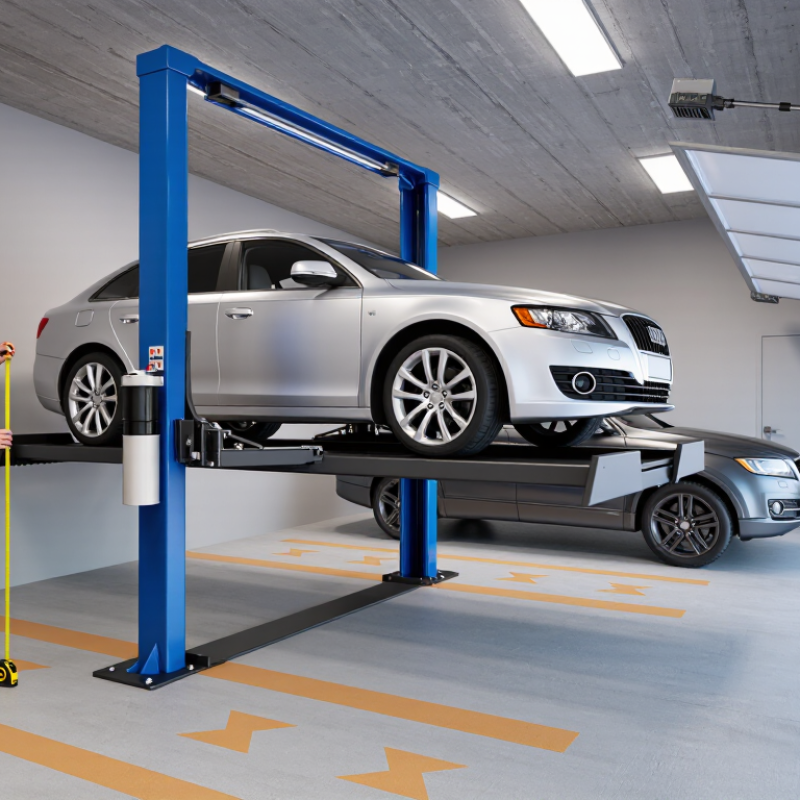
Choosing the right Car Parking Lift begins with the space you actually have, not the model in a brochure. Measure the ceiling, driveway, vehicle height, and available floor area. Check how the lift handles vehicle weight and access. A few centimeters matter. So does the way you plan to use it each day.
A useful engineering rule is: “Choose for the vehicle you own, and the clearance you can verify.” Treat that as a practical principle, not a sourced quotation from a named expert; no expert source was provided. A qualified installer can confirm whether a two-post, four-post, or stacker system suits your site. Ask about platform dimensions, safety locks, power needs, maintenance access, and what happens during a power failure. Watch the lift cycle with a vehicle similar to yours. Listen for unusual noise. Look closely at the anchoring and controls.
This guide explains those trade-offs in plain terms. It will help you compare capacity, footprint, operation, and long-term upkeep. Cheap can be costly. A lift that fits one vehicle may frustrate the next owner—or your future self. I might still choose the simpler system, even when a more automated option looks impressive. The right choice depends on measured constraints, credible technical support, and the small daily details that product photos rarely show.
Parking lifts generally fall into three groups: dependent stackers, independent platforms, and automated systems. A dependent stacker places one car above another, often on a four-post platform. It uses little floor space, but the lower car may need to move before the upper space is accessible. That can be inconvenient in a busy shared garage. Space is tight.
Independent platform lifts let drivers access each vehicle without moving another car. They suit residential garages where daily convenience matters, though they need more room and careful ceiling-height checks. Puzzle systems shift platforms horizontally and vertically, while rotary systems circulate vehicles on a rotating frame. Both can increase capacity on compact sites, but add mechanical complexity. More spaces, more planning.
Vehicle weight deserves attention. The U.S. Environmental Protection Agency’s 2023 Automotive Trends Report puts the average new vehicle at 4,329 pounds for model year 2022. That average is not a safe lift-capacity target: heavier SUVs, accessories, and uneven loading can change requirements. Compare actual vehicle weights with the lift’s rated capacity, platform dimensions, and site measurements. Also check whether the equipment is independently certified to the applicable ANSI/ALI standard. A tidy layout can still be a poor choice if drivers cannot enter, exit, or use it comfortably.
How to Choose the Best Car Parking Lift?
Understand the main types by comparing the typical number of parking levels in common configurations.
Two-post and four-post stackers generally serve two levels, while puzzle systems can combine several levels and automated rotary or tower systems can serve more. These figures are indicative examples, not fixed limits: capacity depends on the system design, site, vehicle dimensions, and local requirements. Compare access, available space, throughput, and maintenance needs before choosing.
Assess Your Space, Vehicle, and Parking Requirements
A car parking lift should fit the vehicle you own, not just the space on a floor plan. Measure the garage’s clear length, width, and ceiling height, including beams, pipes, lights, and the open garage door. Then check your vehicle’s height, wheelbase, width, and weight in its owner’s manual. Measure twice. A roof box or tailgate can change the clearance you need.
Capacity deserves careful attention. The U.S. EPA’s 2024 Automotive Trends Report puts the average new vehicle weight for model year 2023 at about 4,329 pounds. That average is only a reference; SUVs, electric vehicles, and loaded work vehicles may weigh considerably more. Choose a lift rated for the actual vehicle, with suitable allowance for cargo, and confirm compatibility with the lift supplier or a qualified installer. Small details matter. Check whether doors can open safely on the platform, and whether the lift’s posts leave room to walk around the car.
Think about how parking works each day. A two-post arrangement may offer easier access underneath, while a platform-style lift can suit storage where quick access is less important. Consider how often you move each vehicle, who operates the equipment, and where power and controls will sit. Paper plans can mislead. A taped outline on the floor can reveal awkward door swings or tight turning space before installation. It may feel fussy, but missing an inch can matter.
Compare Lift Capacity, Dimensions, and Configuration
How to Choose the Best Car Parking Lift?
Compare the lift’s rated capacity with the heaviest vehicle you expect to park, including cargo and accessories. A small safety margin is sensible; guessing from a car’s model name is not. Check the manufacturer’s load specifications and confirm that the rating suits your intended use. Also measure the vehicle’s length, width, and height, then compare them with the platform and usable clearance. A roof box or wide mirrors can change the fit.
Room dimensions matter just as much. Measure ceiling height, doorway width, and the available floor area, allowing space for ramps and vehicle access. Then consider the configuration: a single-post lift may leave more room around the vehicle, while a two-post or four-post design may better suit different storage needs. Dependent systems can restrict access to one vehicle until another is moved. That trade-off is easy to overlook. Have a qualified installer assess the slab, clearances, and operating requirements before purchase.
Tips: Measure twice. Use the vehicle’s actual dimensions, not brochure estimates. Keep a written record of measurements, and recheck them if the parking area has beams, pipes, or sloped flooring.
How to Choose the Best Car Parking Lift? — Compare Lift Capacity, Dimensions, and Configuration
Lift Configuration
Typical Rated Capacity
Typical Platform Size (W × L)
Planning Space and Clearance
Parking Arrangement
Best Suited For
Two-post parking lift
About 2,700–3,200 kg per platform
About 2.3–2.6 m × 4.7–5.2 m
Allow roughly 2.6–3.0 m of bay width. Required ceiling height depends on vehicle height and the lift’s maximum rise.
One vehicle is raised above another; the lower vehicle may need to be moved before the upper vehicle can be accessed.
Private garages and sites needing a relatively compact footprint for two vertically stacked vehicles.
Four-post parking lift
About 3,000–4,000 kg per platform
About 2.4–2.8 m × 5.0–5.6 m
Allow roughly 2.8–3.2 m of bay width, plus room for ramps and vehicle approach. Check overhead clearance at the raised position.
Two vehicles are stacked on a drive-on platform; the arrangement is commonly dependent.
Garages, storage areas, and locations where a drive-on platform and higher vehicle capacity are useful.
Scissor-type parking lift
About 2,000–3,000 kg per platform
About 2.3–2.7 m × 4.8–5.4 m
Surface-mounted models need space for the lift structure and ramps. Pit-mounted models require a designed pit and suitable drainage.
Raises a vehicle vertically; available layouts include dependent stacking and paired or multi-level systems.
Projects where a low-profile appearance, reduced visible structure, or a pit-mounted installation is preferred.
Multi-level puzzle parking system
Often about 2,000–2,500 kg per parking platform
Commonly about 2.3–2.6 m × 4.8–5.3 m per vehicle platform
Overall dimensions depend on the number of levels, bays, and access aisle. Confirm the full system layout and required headroom before planning.
Platforms move vertically and horizontally to bring a selected vehicle to the access level; some spaces may be temporarily blocked.
Residential or commercial projects seeking to increase parking capacity within a defined site area.
Planning note: Dimensions and capacities shown are indicative ranges for comparison, not guaranteed specifications. Confirm the actual vehicle weight, wheelbase, track width, overall height, platform size, ceiling height, floor capacity, access clearance, and local code requirements with the lift supplier and project engineer before selection.
Evaluate Safety Features, Installation, and Maintenance
A car parking lift should fit the vehicle and the site, not just the available floor space. Check the rated capacity, platform dimensions, ceiling height, and required clearance before comparing options. Safety features matter. Look for secure mechanical locks, clear operating controls, and an emergency-lowering procedure explained in the manual. Ask how the lift responds if power fails, and never treat a warning light as a substitute for inspection.
Installation conditions deserve equal attention. A qualified installer should assess the floor’s strength, level, and condition before work begins. Cracks or uneven surfaces can affect stability. Confirm that the proposed location leaves room for doors, walking paths, and routine access to the controls. It is easy to focus on the lift itself and overlook how people will move around it every day.
Maintenance keeps small issues from becoming serious ones. Follow the service schedule, check cables, hoses, locks, and visible fasteners, and keep the platform free of oil and loose objects. Keep records. They help reveal recurring wear, even when each problem seems minor. If the lift moves unevenly, makes a new noise, or shows damage, stop using it and arrange an assessment by a qualified technician. A little inconvenience now is better than guessing later.
Verify Compliance, Warranty, and Total Cost of Ownership
A car parking lift should fit both the vehicle and the site’s requirements. Before comparing prices, ask for documentation showing that the model meets applicable local building, electrical, and safety standards. Confirm who performs installation and inspection, and request records for load capacity, emergency stops, and maintenance procedures. A stamped document matters more than a confident sales promise.
Tips: Check the warranty in writing. Note its term, covered parts, labor costs, response times, and exclusions. Ask whether routine servicing is required to keep coverage valid. Keep a copy of inspection and maintenance records.
Compare total cost of ownership, not just the purchase price. Include delivery, site preparation, electrical work, scheduled servicing, replacement parts, and possible downtime. For example, a lift that needs frequent servicing may disrupt daily parking, even if its upfront quote looks attractive. Ask for a realistic maintenance schedule and typical part availability. A spreadsheet can make estimates look precise, but actual repair costs may vary; leave room for that uncertainty. If possible, have a qualified installer review the site dimensions and floor conditions before you commit.
Cepex is the brand for the fluid handling market belonging to the Fluidra group. One of the leading european manufacturer of valves and fittings in thermoplastic materials.
Dedicated to the swimming pool, irrigation and industrial markets, we distribute our products worldwide with the Fluidra commercial network and presence in 46 countries with 136 sales branches.
Your data will be processed by CEPEX S.A., with address at C. Lluís Companys, 51-53, 08400, Granollers (Barcelona), and C.I.F. nº A-08928707, to send you communications about our products based on your interests. You can consult more information about the processing of your data and how to exercise your rights as described in the Privacy Policy.
Technical cookies are strictly necessary for our website to work and you can navigate through it. These types of cookies are those that, for example, allow us to identify you, give you access to certain restricted parts of the page if necessary, or remember different options or services already selected by you, such as your privacy preferences. Therefore, they are activated by default, your authorization not being necessary in this regard. Through the configuration of your browser, you can block or alert the presence of this type of cookies, although such blocking will affect the proper functioning of the different functionalities of our website.
The analysis cookies allow us to study the navigation of the users of our website in general (for example, which sections of the page are the most visited, which services are used most and if they work correctly, etc.). From the statistical information on navigation on our website, we can improve both the operation of the page itself and the different services it offers. Therefore, these cookies do not have an advertising purpose, but only serve to make our website work better, adapting to our users in general. By activating them you will contribute to this continuous improvement. You can enable or disable these cookies by checking the corresponding box, being disabled by default.
Functionality cookies allow us to remember your preferences, to personalize certain characteristics and general options of our website, every time you access it (for example, the language in which the information is presented to you, the sections marked as favorites, your browser type, etc.) Therefore, this type of cookies does not have an advertising purpose, but by activating them you will improve the functionality of the website (for example, adapting to your type of browser) and the customization of it based on your preferences (for example, by presenting the information in the language that you have chosen in previous occasions), which will contribute to the ease, usability and comfort of our page during your navigation. You can enable or disable these cookies by checking the corresponding box, being disabled by default.
Advertising cookies allow us to manage the advertising spaces included in our website based on criteria such as the content shown or the frequency in which the ads are displayed. For example, if you have been shown the same ad several times on our website, and you have not shown a personal interest by clicking on it, it will not appear again. In summary, by activating this type of cookies, the advertising shown on our website will be more useful and diverse, and less repetitive. You can enable or disable these cookies by checking the corresponding box, being disabled by default.
Behavioral advertising cookies allow us to obtain information based on the observation of your browsing habits and behaviors on the web, in order to show you advertising content that best suits your personal tastes and interests. To understand it in a very simple way, we will give you a fictitious example: if your last searches on the web were related to suspense literature, we would show you advertising about suspense books. Therefore, activating this type of cookies, the advertising that we show you on our website will not be generic, but will be oriented to your searches, tastes and interests, therefore adjusting exclusively to you. You can enable or disable these cookies by checking the corresponding box, being disabled by default. To understand it in a very simple way, we will give you a fictitious example: if your last searches on the web were related to suspense literature, we would show you advertising about suspense books. Therefore, activating this type of cookies, the advertising that we show you on our website will not be generic, but will be oriented to your searches, tastes and interests, therefore adjusting exclusively to you. You can enable or disable these cookies by checking the corresponding box, being disabled by default.
We use our own and third-party cookies to ensure the proper functioning of the website and to analyse our services, improve your experience on our website and show you advertisements related to your interests according to profiling based on your browsing habits (e.g. websites visited). You can accept all cookies by clicking "ACCEPT" or set or reject them by clicking here. If you would like to know more about the use of cookies, please see our COOKIE POLICY.