
How to Choose the Best Blade Antenna for UAVs?
FLUID HANDLING EXPERTS

Blog, all our news

How to Choose the Best Blade Antenna for UAVs?

Choosing the right antenna can shape a UAV’s communication reliability, range, and flight performance. A Blade Antenna For Uav may suit a compact airframe, but its shape alone does not guarantee a strong link. Frequency band, polarization, gain, and radiation pattern all affect how well it performs in the air. Small mismatches matter.

This guide explains how to compare blade antennas against a UAV’s radio system and operating needs. It looks at connector type, cable loss, antenna weight, mounting position, and clearance from carbon-fiber structures or other electronics. A few millimeters can change the fit. The best choice depends on the complete installation, not a product label or a headline gain figure.

Reliable selection starts with verified specifications and practical checks. Compare the antenna’s stated frequency range with the transmitter and receiver, then consider the flight orientation and expected link direction. Review manufacturer data, and test the installed system under controlled conditions before relying on it in the field. Results can vary with the airframe and setup. That is worth remembering. No single antenna is ideal for every UAV, and published figures may not reflect real flight conditions. By weighing measurable performance against weight, durability, and mounting constraints, readers can make a more informed choice and avoid preventable signal problems.
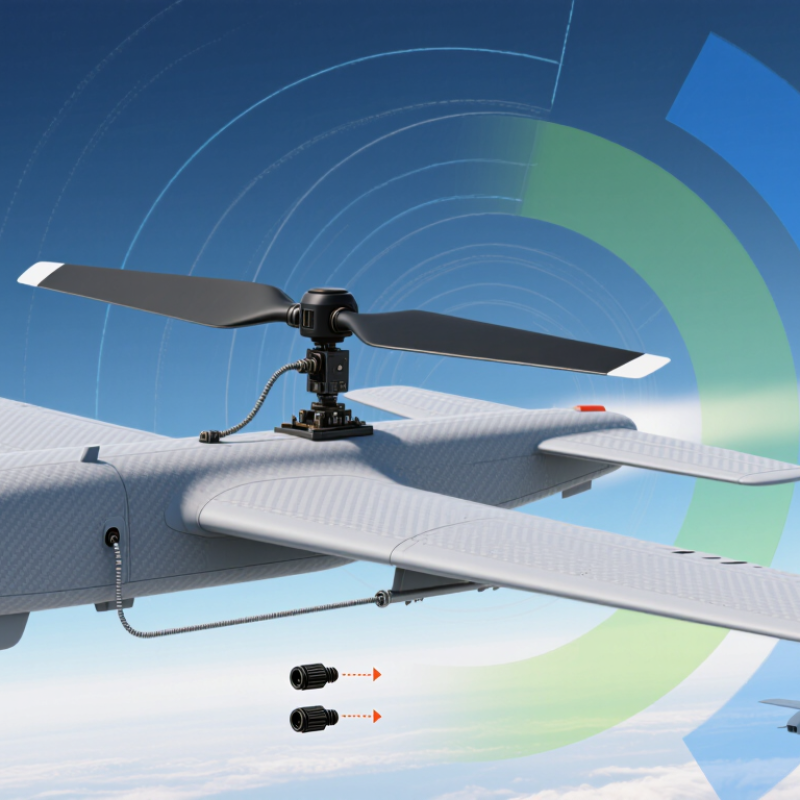
How to Choose the Best Blade Antenna for UAVs?

Understanding Blade Antennas and Their Role in UAVs

Blade antennas are low-profile radiators that can suit UAVs where a tall whip may snag during handling or flight. Their shape alone does not guarantee good performance. Many designs rely on a conductive ground plane, and the airframe can change the antenna’s tuning and radiation pattern. Carbon-fiber panels are especially worth checking because they can obstruct or detune nearby radiators.

On a UAV, blade antennas may carry command, telemetry, or navigation signals, depending on their frequency and design. Placement matters: mounting one close to a battery, motor, or metal fastener can affect the link. Keep its active element clear of obstructions, then test the installed aircraft—not just the antenna on a bench. Small details count. A tilted antenna can also create polarization mismatch when the aircraft banks.

The FAA’s 2024 UAS registration statistics report roughly 1.2 million registered drones in the United States, reflecting the range of platforms that need dependable radio links. That figure does not predict any individual aircraft’s requirements. Match the antenna’s operating band, connector, and polarization to the radio system, and compare measured gain and radiation-pattern data. One practical weakness remains: a blade that fits neatly may still perform poorly in the final airframe.

Defining the UAV’s Communication and Navigation Requirements

How to Choose the Best Blade Antenna for UAVs?
Defining the UAV’s Communication and Navigation Requirements

Start with the aircraft’s actual tasks, not the antenna’s appearance. List each radio link, its operating frequency, expected range, data rate, and flight environment. A short-range command link over open fields has different needs from telemetry near buildings or terrain. Note where the aircraft will fly and how it turns. The airframe can block signals during a bank. Small details matter.

Separate communication needs from navigation needs. A blade antenna may serve a particular radio link, while satellite navigation may require a different antenna type and placement. Check the equipment’s frequency range, impedance, polarization, and connector requirements against the radio specifications. Then consider mounting: carbon-fiber structures, batteries, and wiring can affect performance. Keep the antenna clear of nearby conductive parts where practical. Test the installed setup, not just the antenna on a bench. Bench results can be misleading.

Tips: Sketch the airframe and mark antenna locations, cables, and likely obstructions. Confirm the required bands with the radio documentation, then test link quality through representative flight orientations. Record signal readings. If results vary more than expected, revisit placement before choosing a higher-gain antenna; gain and coverage patterns involve trade-offs. I would not assume one layout works for every UAV, even if the frames look similar.

How to Choose the Best Blade Antenna for UAVs? – Defining the UAV’s Communication and Navigation Requirements

Start by identifying the link’s frequency band, required coverage, polarization, airframe constraints, and installation environment. The figures below are typical planning considerations, not guaranteed performance specifications; verify them against the antenna datasheet and the complete installed system.

UAV Requirement Typical Frequency Range Blade Antenna Characteristics to Check Installation and Integration Priorities Selection Guidance
Command and control Commonly 433 MHz, 868 MHz, 915 MHz, or licensed bands, depending on region and system Band coverage, impedance match, polarization, radiation pattern, and transmitter power handling. A vertical, near-omnidirectional pattern is often useful for changing UAV headings. Keep the antenna clear of carbon-fiber structures, batteries, wiring, and other radiating antennas. Confirm the feed connector and coaxial-cable loss. Choose an antenna designed for the exact authorized band. Check local spectrum rules and test link performance in the installed airframe orientation.
Telemetry and data link Often 868/915 MHz or 2.4 GHz, depending on the radio and operating region Operating bandwidth, realized gain, polarization, efficiency, and coverage around the aircraft. Higher gain can narrow coverage in some directions. Assess interference from onboard electronics and nearby radios. Maintain suitable spacing between antennas and avoid placing the antenna close to conductive surfaces. Prioritize consistent coverage over peak gain when the UAV frequently changes direction or banks. Validate the complete radio link, not the antenna in isolation.
Video transmission Commonly 2.4 GHz or 5.8 GHz, subject to equipment and regional regulations Bandwidth, polarization compatibility, gain pattern, and performance across the channel range. At higher frequencies, the link is more sensitive to obstruction and installation effects. Separate from GNSS and control antennas where practical. Check cable length, connector losses, airframe shadowing, and the antenna’s exposure to the ground station. Match the airborne antenna’s polarization to the receiving system. For demanding video links, evaluate the link budget and test during turns and changes in altitude.
GNSS navigation and timing GPS L1: 1575.42 MHz; GPS L2: 1227.60 MHz; GPS L5: 1176.45 MHz. Other GNSS constellations use additional nearby bands. GNSS antennas typically require right-hand circular polarization (RHCP), suitable band coverage, and an appropriate low-noise amplifier or receiver interface. Many ordinary communication blade antennas are linearly polarized and are not GNSS substitutes. Place the GNSS antenna with a clear view of the sky and away from high-power transmitters, switching electronics, and reflective structures. Follow the receiver’s bias-power requirements. Use a purpose-designed GNSS antenna when navigation accuracy matters. Confirm constellation and frequency support; a conventional blade antenna may not meet GNSS polarization or reception requirements.
Combined communication and navigation payload Multiple bands, such as sub-GHz control, 2.4/5.8 GHz data, and GNSS L1/L2/L5 Independent antenna elements or a qualified multiband design, isolation between ports, matching across each band, and compatibility with the relevant radios. Plan antenna placement as a system. Check coupling, cable routing, ground-plane effects, receiver desensitization, and simultaneous-transmission behavior. Do not assume one blade covers every function. Use separate, purpose-matched antennas unless a multiband antenna has verified performance for all required bands.
Airframe, payload, and environmental constraints Determined by the selected radio and navigation equipment Mass, dimensions, mounting method, connector type, environmental rating, vibration resistance, and acceptable operating temperature. Check the manufacturer’s mounting instructions and the airframe material. Carbon fiber can significantly affect RF performance; verify the antenna after installation. Compare the installed mass and required clearance with the UAV’s payload budget. Prefer a mechanically secure, weather-appropriate design and confirm performance through flight testing.

Practical check: Before flight, verify the antenna’s frequency range, polarization, connector, impedance, and mounting requirements, then test the assembled UAV in representative operating orientations and conditions.

Matching Frequency, Polarization, and Radiation Pattern

Choosing a blade antenna starts with the UAV radio’s operating band, not the antenna’s appearance. Check the specified frequency range against every channel you plan to use. A unit tuned near the band center may perform poorly at its edges. That margin matters. The airframe, mounting plate, and nearby wiring can also shift measured performance, so verify the antenna in its intended position.

Polarization should match the ground station whenever possible. If the aircraft banks or pitches, its antenna orientation changes relative to the receiver. A vertically polarized setup can still lose signal during a steep turn. Small installation details count. Keep the blade clear of carbon-fiber structures and large metal parts, which can distort the signal or block it. Perfect alignment is rarely maintained in flight.

Radiation pattern describes where the antenna sends and receives energy. A broad pattern often suits a UAV that changes attitude, while a directional pattern may favor a predictable flight path. Look beyond peak gain: a strong signal in one direction can mean weaker coverage elsewhere. Compare measured patterns with the aircraft’s likely orientations. I would not treat a clean test-bench plot as a guarantee; the airframe can change it. Some uncertainty remains until the complete installation is tested.

Assessing Antenna Size, Weight, Mounting, and Durability

Choose a blade antenna only after measuring the available airframe space and payload budget. The FAA’s Part 107 rule defines a small unmanned aircraft as weighing less than 55 pounds, including everything onboard or attached. That ceiling is not a useful antenna target: a few extra grams can still reduce flight time or displace a sensor. Check the antenna’s full length, cable bend radius, and connector clearance against the actual fuselage. Small details matter.

Mounting affects performance as much as the antenna’s published gain. Carbon-fiber plates and batteries can block or detune a nearby radiator, so keep the blade clear of conductive surfaces and test it in its final position. RTCA DO-160G describes environmental qualification methods for airborne equipment, including vibration and temperature testing. Use those test categories as a durability reference, not as proof that every UAV installation is qualified. Inspect the base, fasteners, and coaxial connector for loosening after flight tests.

Tips: Compare installed weight, not just antenna weight. Secure the cable so it cannot tug on the connector during vibration. Test range with the airframe assembled, in expected flight orientations. A tidy mount may still create a blind spot; measure before committing. The trade-off is not always obvious.

How to Choose the Best Blade Antenna for UAVs?

Free-space quarter-wave length provides a useful first reference when comparing antenna size across common UAV radio frequencies.

How to use this chart: The lengths are calculated as the speed of light divided by four times the frequency. They are theoretical radiator references—not guaranteed blade dimensions. Antenna loading, the airframe, ground plane, and enclosure can change the final size and performance. When choosing a blade antenna, also check its actual mass, mounting clearance, connector and cable arrangement, and resistance to vibration, moisture, and impact.

Testing Antenna Performance on the UAV Platform

How to Choose the Best Blade Antenna for UAVs?
Testing Antenna Performance on the UAV Platform

A blade antenna that performs well on a bench may behave differently once mounted on an airframe. Test it on the actual UAV, with its battery, wiring, payload, and access panels installed. Carbon-fiber structures and nearby cables can detune the antenna or block parts of its radiation pattern. Small changes matter. Record the antenna’s position, orientation, and distance from conductive parts so results can be repeated.

Measure return loss across the intended operating band, then check radiation patterns and link quality during real flight. Compare hover, climb, turns, and changes in aircraft orientation. Log received signal strength, packet loss, and dropouts alongside altitude and distance. The 3GPP technical report TR 36.777, Enhanced LTE Support for Aerial Vehicles, examines aerial-user performance at altitudes up to 300 metres. That figure is useful context, not a guarantee of antenna range or UAV safety. Test at the altitudes and distances your operation actually requires.

Repeat flights with the antenna in more than one mounting position, and test under realistic payload conditions. Use consistent routes and keep a ground reference; otherwise, a stronger signal may simply reflect a closer pass. IEEE Std 149-2021 describes established antenna measurement practices that can help make lab comparisons more repeatable. Still, flight testing can be messy. Weather, motor noise, and imperfect positioning can cloud the results, so keep those limitations in the test record.

Copyright 2025 Fluidra S.A. | Created by BCM Marketing Agencia Privacy Policy Legal note | Cookie policy |

Technical cookies are strictly necessary for our website to work and you can navigate through it. These types of cookies are those that, for example, allow us to identify you, give you access to certain restricted parts of the page if necessary, or remember different options or services already selected by you, such as your privacy preferences. Therefore, they are activated by default, your authorization not being necessary in this regard. Through the configuration of your browser, you can block or alert the presence of this type of cookies, although such blocking will affect the proper functioning of the different functionalities of our website.


The analysis cookies allow us to study the navigation of the users of our website in general (for example, which sections of the page are the most visited, which services are used most and if they work correctly, etc.). From the statistical information on navigation on our website, we can improve both the operation of the page itself and the different services it offers. Therefore, these cookies do not have an advertising purpose, but only serve to make our website work better, adapting to our users in general. By activating them you will contribute to this continuous improvement. You can enable or disable these cookies by checking the corresponding box, being disabled by default.


Functionality cookies allow us to remember your preferences, to personalize certain characteristics and general options of our website, every time you access it (for example, the language in which the information is presented to you, the sections marked as favorites, your browser type, etc.) Therefore, this type of cookies does not have an advertising purpose, but by activating them you will improve the functionality of the website (for example, adapting to your type of browser) and the customization of it based on your preferences (for example, by presenting the information in the language that you have chosen in previous occasions), which will contribute to the ease, usability and comfort of our page during your navigation. You can enable or disable these cookies by checking the corresponding box, being disabled by default.


Advertising cookies allow us to manage the advertising spaces included in our website based on criteria such as the content shown or the frequency in which the ads are displayed. For example, if you have been shown the same ad several times on our website, and you have not shown a personal interest by clicking on it, it will not appear again. In summary, by activating this type of cookies, the advertising shown on our website will be more useful and diverse, and less repetitive. You can enable or disable these cookies by checking the corresponding box, being disabled by default.


Behavioral advertising cookies allow us to obtain information based on the observation of your browsing habits and behaviors on the web, in order to show you advertising content that best suits your personal tastes and interests. To understand it in a very simple way, we will give you a fictitious example: if your last searches on the web were related to suspense literature, we would show you advertising about suspense books. Therefore, activating this type of cookies, the advertising that we show you on our website will not be generic, but will be oriented to your searches, tastes and interests, therefore adjusting exclusively to you. You can enable or disable these cookies by checking the corresponding box, being disabled by default.
To understand it in a very simple way, we will give you a fictitious example: if your last searches on the web were related to suspense literature, we would show you advertising about suspense books. Therefore, activating this type of cookies, the advertising that we show you on our website will not be generic, but will be oriented to your searches, tastes and interests, therefore adjusting exclusively to you. You can enable or disable these cookies by checking the corresponding box, being disabled by default.

SAVE

We use our own and third-party cookies to ensure the proper functioning of the website and to analyse our services, improve your experience on our website and show you advertisements related to your interests according to profiling based on your browsing habits (e.g. websites visited). You can accept all cookies by clicking "ACCEPT" or set or reject them by clicking here. If you would like to know more about the use of cookies, please see our COOKIE POLICY.


ACCEPT ALL
Reject no essentials


