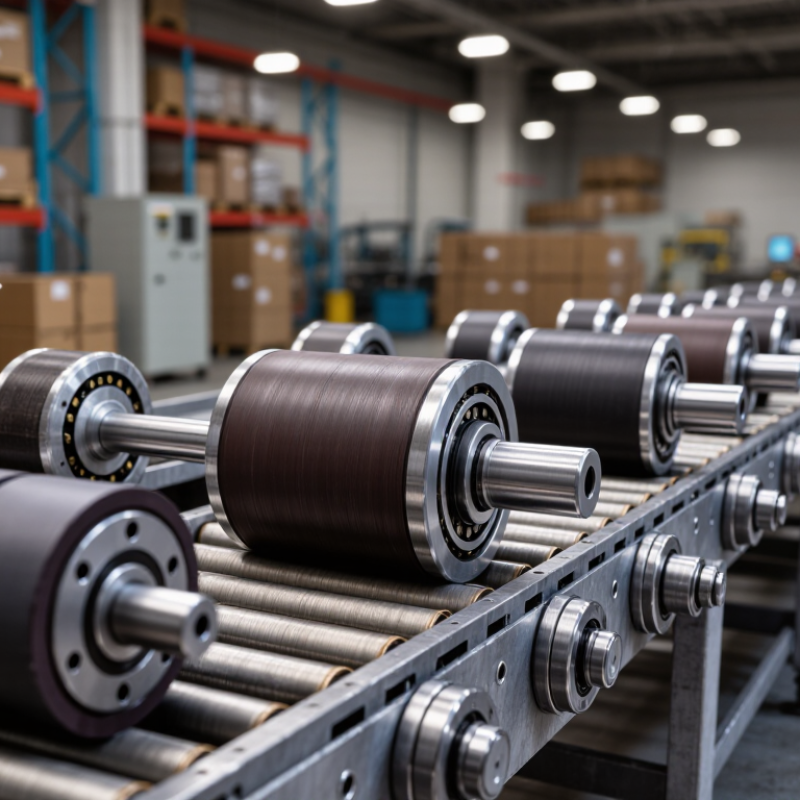
How to Choose the Best Belt Conveyor Roller Manufacturers?
Choosing the right Belt Conveyor Roller Manufacturers can influence throughput, maintenance costs, and workplace reliability. A roller is not merely a rotating steel tube. It carries load, controls belt alignment, and works through dust, moisture, impact, and temperature changes.
Industry demand supports careful supplier evaluation. Grand View Research valued the global conveyor systems market at approximately USD 7.1 billion in 2022. Its Conveyor Systems Market report projects continued growth through 2030. MarketsandMarkets also forecasts steady expansion, driven by warehousing, mining, logistics, and manufacturing automation. These figures show opportunity, but they do not prove that every manufacturer offers dependable rollers.
Look closer.
A credible supplier should explain tube thickness, shaft material, bearing type, sealing performance, runout tolerance, and expected service life. Ask for test records, inspection procedures, and references from sites with similar loads. CEMA guidance can support technical comparisons, especially for conveyor components and operating conditions. ISO 9001 certification may indicate process control, but certification alone cannot guarantee field performance.
Real experience often appears in small details. Does the manufacturer calculate radial load at your belt speed? Can it recommend a rubber-disc roller for sticky material? Will it replace a failed bearing under documented warranty terms? These questions expose practical capability.
Reports sometimes use different market definitions, so their figures should be treated as directional rather than absolute. That is an important limitation. Your final decision should combine published evidence, factory audits, sample testing, and lifecycle cost analysis. The cheapest quotation may become expensive when seized rollers stop a production line at 2 a.m. Reliable Belt Conveyor Roller Manufacturers provide data, traceability, and honest technical guidance before the purchase order is signed.
Choosing the best belt conveyor roller manufacturer starts with a precise operating profile. According to Grand View Research’s Conveyor Systems Market report, the global market reached approximately USD 11 billion in 2023. That growth reflects broader demand, but it does not make every roller suitable. Your conveyor width, belt speed, load per roller, troughing angle, and material type must be recorded first. A 108 mm roller may suit a moderate bulk load, while a smaller diameter could suffer excessive deflection. Measure the actual conditions. Guesswork is expensive.
Specify the environment, too. Dust, moisture, salt, temperature, and washdown chemicals influence bearing seals and shell materials. Request test data for rotational resistance, runout, balance, coating thickness, and service life. Confirm whether the manufacturer follows relevant CEMA or ISO practices. Ask for traceability documents and dimensional tolerances. A polished catalogue is not proof of performance. Field feedback matters more. Sometimes, the initial specification is simply wrong.
Tips: Build a one-page roller requirement sheet. Include belt width, roller diameter, shaft size, load, speed, temperature, and cleaning method. Ask manufacturers to explain their calculations, not just their prices. Compare warranty terms, replacement lead times, and inspection procedures. If the supplier avoids specific answers, pause. A cheaper roller can increase energy use, belt wear, and unplanned maintenance. The overlooked detail may be the costly one.
Comparing Roller Materials, Designs, and Performance Standards
How to Choose the Best Belt Conveyor Roller Manufacturers?
Roller materials strongly influence service life, noise, and maintenance frequency. Carbon steel suits heavy loads and controlled indoor environments. Stainless steel performs better where moisture or cleaning chemicals are present. Polymer rollers reduce noise, but their load limits need careful checking. Material choice is rarely simple.
Roller design also affects belt tracking and energy use. Sealed bearings help block dust and water. Labyrinth seals can support demanding industrial conditions. A crowned roller may improve tracking, although poor alignment can still damage the belt. I have found that small runout errors become obvious during long operating shifts. Ask for measured runout, bearing ratings, shaft dimensions, and dynamic load results.
Performance standards provide a useful comparison between manufacturers. Request testing based on relevant ISO, EN, or CEMA guidance. Check radial load capacity, rotational resistance, noise, temperature range, and corrosion performance. Test reports should identify equipment, methods, and acceptance limits. A certificate alone proves little. Traceability matters more. Review ISO 9001-based quality controls, inspection records, and sample consistency. Field references can reveal weaknesses that factory brochures omit. One overlooked detail is cleaning access. If maintenance crews cannot reach the bearing area, even a strong design may become expensive.
Evaluating Manufacturer Experience and Production Capabilities
A manufacturer’s years in business can offer useful context, but age alone proves little. Ask about projects involving similar belt widths, loads, speeds, and operating conditions. A roller used in a dusty aggregate plant faces different demands from one handling parcels indoors. Request drawings, material specifications, and examples of comparable production. Details matter.
Production capability should match the scale and variability of your order. Check whether the factory forms, welds, machines, and assembles key parts in-house, or relies on several outside suppliers. That distinction can affect lead times and consistency. Ask how the team controls shaft straightness, bearing fit, and roller runout. These are measurable checks, not marketing language. A sample inspection report or a factory visit can reveal how quality is handled on an ordinary production day.
Capacity is more than the number of machines on the floor. Ask how the manufacturer schedules repeat orders, manages peak demand, and responds when specifications change. Confirm that testing covers the conditions your system will face, such as load, rotation, and exposure to moisture. References from customers with comparable equipment can help verify performance over time. Still, references are only part of the picture; maintenance practices and installation also influence service life. I would not treat a polished sample as proof of every batch. Check how production records link each order to its materials and inspection results.
Checking Quality Control, Certifications, and Testing Procedures
When comparing belt conveyor roller manufacturers, examine the controls behind each production batch, not just a polished certificate. Ask for inspection records covering tube diameter, shaft alignment, weld condition, and bearing fit. A roller may look straight on a bench yet vibrate under load. Good suppliers document measurement methods, calibration dates, and batch traceability, so a defect can be traced to its source. Check whether quality procedures are independently audited, and confirm that the certificate applies to the actual manufacturing site.
Testing should reflect the roller’s working conditions: load, belt speed, dust, moisture, and operating temperature. Request test results for rotation resistance, runout, noise, and bearing temperature, along with clear pass criteria. ISO 281 provides a useful bearing-life reference: its basic rating life is the life that 90% of a sufficiently large group of identical bearings are expected to reach under stated conditions. That is a statistical estimate, not a promise for every roller. Ask how the manufacturer accounts for contamination and misalignment, which can shorten service life. Still, paperwork can mislead. A witnessed sample test or a review of raw readings may reveal more than a certificate alone.
How to Choose the Best Belt Conveyor Roller Manufacturers
Check quality-control records, verify current certifications such as ISO 9001, and ask for documented roller and bearing test results.
Illustrative calculation using the ISO 281 basic rating life equation for ball bearings: L10 = (C/P)3 million revolutions, where C is dynamic load rating and P is equivalent dynamic load. These are calculated examples, not manufacturer test results; request test data for the specific roller and operating conditions.
Reviewing Pricing, Customization, Delivery, and After-Sales Support
Choosing a belt conveyor roller manufacturer requires more than comparing unit prices. A 2024 MHI Annual Industry Report found that 55% of supply-chain professionals planned to increase technology investment. This pressure makes reliable conveyor components more valuable. Ask for a landed-cost breakdown, including bearings, shafts, surface treatment, packaging, testing, and freight. A cheap roller is not a cheap conveyor. My early comparisons focused too heavily on quotations and missed replacement costs.
Customization should begin with operating conditions, not appearance. Provide load, belt speed, material, temperature, moisture, shaft dimensions, and installation drawings. Experienced engineers should explain tolerance limits and sealing choices clearly. Request prototype samples and inspection records before approving volume production. According to a 2024 MarketsandMarkets report, the conveyor system market is expected to grow steadily through 2028. That growth increases supplier demand, but it does not guarantee technical accuracy. Small specification errors can create noise, belt tracking problems, or premature bearing failure.
Delivery promises need measurable dates. Confirm drawing approval, production, inspection, shipping, and spare-parts timelines separately. After-sales support should include a written warranty, response-time commitment, troubleshooting guidance, and accessible replacement parts. Ask how failures are recorded and analyzed. A manufacturer that shares corrective-action reports demonstrates stronger engineering discipline. Still, support claims deserve testing. Send a few practical questions before purchase and measure the response. Silence after the quotation is a warning sign.
Cepex is the brand for the fluid handling market belonging to the Fluidra group. One of the leading european manufacturer of valves and fittings in thermoplastic materials.
Dedicated to the swimming pool, irrigation and industrial markets, we distribute our products worldwide with the Fluidra commercial network and presence in 46 countries with 136 sales branches.
Your data will be processed by CEPEX S.A., with address at C. Lluís Companys, 51-53, 08400, Granollers (Barcelona), and C.I.F. nº A-08928707, to send you communications about our products based on your interests. You can consult more information about the processing of your data and how to exercise your rights as described in the Privacy Policy.
Technical cookies are strictly necessary for our website to work and you can navigate through it. These types of cookies are those that, for example, allow us to identify you, give you access to certain restricted parts of the page if necessary, or remember different options or services already selected by you, such as your privacy preferences. Therefore, they are activated by default, your authorization not being necessary in this regard. Through the configuration of your browser, you can block or alert the presence of this type of cookies, although such blocking will affect the proper functioning of the different functionalities of our website.
The analysis cookies allow us to study the navigation of the users of our website in general (for example, which sections of the page are the most visited, which services are used most and if they work correctly, etc.). From the statistical information on navigation on our website, we can improve both the operation of the page itself and the different services it offers. Therefore, these cookies do not have an advertising purpose, but only serve to make our website work better, adapting to our users in general. By activating them you will contribute to this continuous improvement. You can enable or disable these cookies by checking the corresponding box, being disabled by default.
Functionality cookies allow us to remember your preferences, to personalize certain characteristics and general options of our website, every time you access it (for example, the language in which the information is presented to you, the sections marked as favorites, your browser type, etc.) Therefore, this type of cookies does not have an advertising purpose, but by activating them you will improve the functionality of the website (for example, adapting to your type of browser) and the customization of it based on your preferences (for example, by presenting the information in the language that you have chosen in previous occasions), which will contribute to the ease, usability and comfort of our page during your navigation. You can enable or disable these cookies by checking the corresponding box, being disabled by default.
Advertising cookies allow us to manage the advertising spaces included in our website based on criteria such as the content shown or the frequency in which the ads are displayed. For example, if you have been shown the same ad several times on our website, and you have not shown a personal interest by clicking on it, it will not appear again. In summary, by activating this type of cookies, the advertising shown on our website will be more useful and diverse, and less repetitive. You can enable or disable these cookies by checking the corresponding box, being disabled by default.
Behavioral advertising cookies allow us to obtain information based on the observation of your browsing habits and behaviors on the web, in order to show you advertising content that best suits your personal tastes and interests. To understand it in a very simple way, we will give you a fictitious example: if your last searches on the web were related to suspense literature, we would show you advertising about suspense books. Therefore, activating this type of cookies, the advertising that we show you on our website will not be generic, but will be oriented to your searches, tastes and interests, therefore adjusting exclusively to you. You can enable or disable these cookies by checking the corresponding box, being disabled by default. To understand it in a very simple way, we will give you a fictitious example: if your last searches on the web were related to suspense literature, we would show you advertising about suspense books. Therefore, activating this type of cookies, the advertising that we show you on our website will not be generic, but will be oriented to your searches, tastes and interests, therefore adjusting exclusively to you. You can enable or disable these cookies by checking the corresponding box, being disabled by default.
We use our own and third-party cookies to ensure the proper functioning of the website and to analyse our services, improve your experience on our website and show you advertisements related to your interests according to profiling based on your browsing habits (e.g. websites visited). You can accept all cookies by clicking "ACCEPT" or set or reject them by clicking here. If you would like to know more about the use of cookies, please see our COOKIE POLICY.