
How to Choose the Best Anchor Drill Rig for Your Project?
FLUID HANDLING EXPERTS

Blog, all our news

How to Choose the Best Anchor Drill Rig for Your Project?

Choosing the best Anchor Drill Rig begins with the ground, not the brochure. A rig that performs well in fractured rock may struggle in loose soil, weathered layers, or a narrow work zone. Ground conditions matter. So do anchor depth, drilling angle, required torque, and the space available for setup. A machine that looks powerful on paper can still be the wrong fit beside a retaining wall or beneath low overhead clearance.

The geotechnical engineer Karl Terzaghi is often associated with this principle: “Theoretical soil mechanics is the art of using the simplest methods to solve the most complicated problems.” It offers a useful reminder for equipment selection. Start with a site investigation and the project’s anchor design, then compare rigs by drilling method, feed force, rotation speed, mobility, and compatibility with the chosen tools. Ask how the rig handles water, cuttings, and changing strata. Small details count. A hose routing issue or awkward rod-handling setup can slow a crew across a full shift.

This guide explains how to match rig capacity to actual site demands, assess access and transport, and compare operating costs beyond the purchase price. It also covers safety features, maintenance support, and questions to ask suppliers. There is no universal “best” rig. Even experienced teams can misjudge a site from limited records; conditions deserve verification before a final choice. The right decision balances performance with practical constraints—and leaves room for uncertainty underground.
How to Choose the Best Anchor Drill Rig for Your Project?

Identify the Project Requirements and Ground Conditions

Before comparing anchor drill rigs, define the anchor layout, required capacity, drilling diameter, depth, and available working space. A rig that reaches the design depth on paper may still fail on a steep slope or beneath low overhead clearance. Check the planned drilling angle, mast reach, feed force, torque, and access route against the actual site drawings. Small details matter.

Ground conditions should guide the drilling method. Review borehole logs, SPT results, rock-core recovery, groundwater levels, and nearby excavation records. Loose fill, cobbles, fractured rock, and flowing groundwater can each change the required tooling or casing. The Federal Highway Administration’s Ground Anchors and Anchored Systems report (FHWA-IF-99-015) uses proof-test loads up to 1.33 times the design load for many anchor applications. That figure does not size the rig, but it highlights why anchor loads and ground investigation must be considered together.

Walk the site if possible. Look for soft patches, buried utilities, overhead obstructions, and places where spoil or flushing water could collect. A tidy bore log can still miss a boulder lens. I would treat uncertain layers as a real selection risk, not a minor footnote. Match the rig’s operating envelope to the best available ground data, then confirm the choice with the geotechnical engineer and anchor designer. The first estimate may be wrong. Better to leave room for adjustment.

Compare Anchor Drill Rig Types and Their Applications

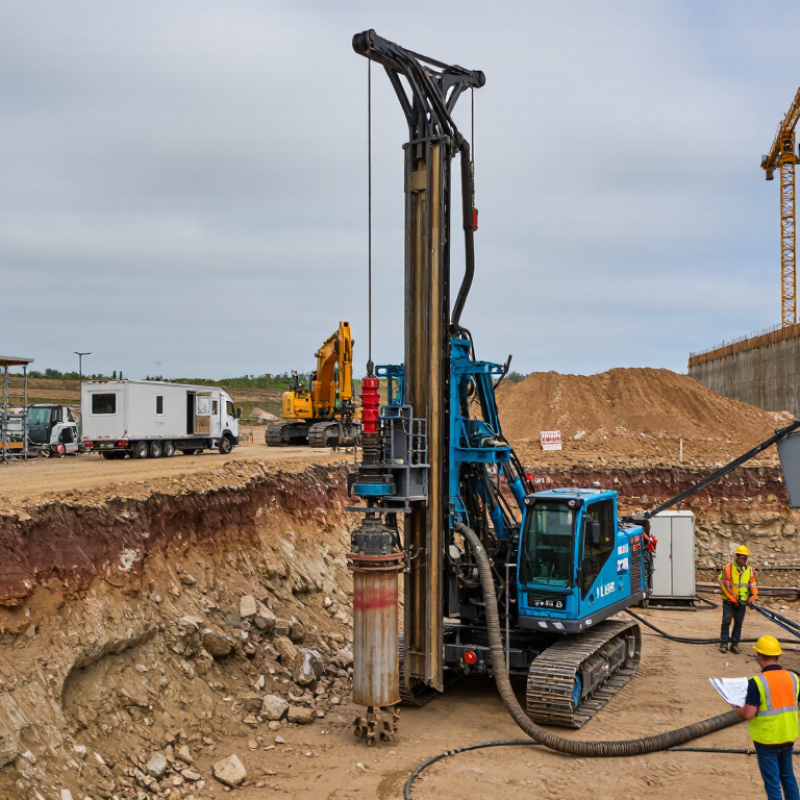
Anchor drill rigs are not interchangeable; the right type depends on ground conditions, access, and the anchor design. Crawler-mounted rigs provide a stable platform on uneven or sloping sites. They are often suited to retaining walls, highway cuttings, and remote slopes where trucks cannot work close to the drilling point. Their tracks can leave marks, though, and tight urban sites may limit their movement.

Truck-mounted rigs travel quickly between accessible work areas and can reduce setup time on larger projects. They work well where roads, overhead clearance, and firm ground allow the vehicle to reach each position. Check the planned drilling angle and working radius before choosing one. A rig that arrives quickly may still struggle to position its mast beside a narrow wall. That matters.

Compact or skid-mounted rigs fit restricted spaces, such as basements, courtyards, and sites with low overhead clearance. Their smaller footprint can mean less drilling power or slower progress in hard rock. The drilling method matters too: rotary systems handle varied ground, while down-the-hole hammer systems can be effective in competent rock. Not always. Ask about expected hole diameter, depth, flushing needs, and ground variability. I would not choose by rated capacity alone; real site access is easy to underestimate.

Evaluate Drilling Capacity, Reach, and Site Compatibility

Choosing an anchor drill rig starts with the hole, not the machine. Confirm the required diameter, depth, drilling method, and expected ground conditions. A rig that reaches the target depth in loose soil may struggle in dense gravel or fractured rock. Check rated torque and feed force against the toughest expected layer, then allow capacity for wear and changing conditions. More capacity is useful, but excess size can limit access.

Reach must match the anchor layout and the space available for setup. The FHWA’s Ground Anchors and Anchored Systems (1999) guidance specifies a 15-foot minimum unbonded length for permanent anchors. That design length is not the total drilling depth, but it shows why tendon geometry and rig reach must be checked together. Measure mast clearance, working height, ground slope, and room to position the rig. A tidy site plan can still miss a low canopy or soft shoulder.

Tips: Mark overhead obstructions and measure the narrowest access route before delivery. Ask the operator to verify setup dimensions on site. A spec sheet can mislead. Soil logs, a test hole, and the crew’s feedback may reveal that the planned rig is too large—or simply not suited to the ground.

Assess Power, Mobility, Safety, and Maintenance Needs

Choose a rig by matching power to the ground, not just the largest torque figure on a specification sheet. Compare rotary torque, feed force, and mast reach with the anchor design and expected soil or rock conditions. FHWA’s Geotechnical Engineering Circular No. 7 on soil nail walls emphasizes that drilling methods must suit ground and groundwater conditions. That guidance matters for anchors, too: a rig that performs well in dry, firm ground may struggle in fractured rock or wet soil. Check transport width, operating weight, turning space, and ground-bearing capacity at the actual site. Check the access route.

Safety and upkeep belong in the same decision. The U.S. Bureau of Labor Statistics recorded 1,075 fatal work injuries in the construction industry in 2023; this figure is not specific to drilling, but it shows why safe setup cannot be an afterthought. Confirm that the rig offers stable leveling, clear emergency controls, guarded moving parts, and practical dust-control connections. Ask how technicians reach filters, hoses, and service points, then compare required service intervals with your crew’s schedule. One trade-off is easy to miss: a compact rig may reach tight sites, yet leave little room for routine maintenance. I would verify that access before purchase, even if the check feels tedious.

How to Choose the Best Anchor Drill Rig for Your Project

Compare the project-fit priorities below when assessing power, mobility, safety, and maintenance needs.

Example project: remote rock anchoring with limited service access. Ratings are illustrative planning scores from 1 (lower priority) to 5 (higher priority), not measured industry data or ratings of specific rigs. Adjust them to match your site conditions, anchor design, and applicable safety requirements.

Match the Rig to Your Budget and Project Timeline

An anchor drill rig should fit both the ground conditions and the time you have to finish. Start with the required hole depth, diameter, and expected geology. A compact rig may cost less and reach a tight site, but it can lose time if the ground demands more torque or flushing capacity. A larger rig may work faster, yet transport, setup, and access can raise the total cost. That matters.

Tips: Compare the full job cost, not just the daily rental rate. Include delivery, setup, operator hours, tooling, fuel, and likely downtime. Ask how soon the rig is available, and confirm its working dimensions against your site plan. Keep a small schedule allowance for weather or difficult drilling; estimates are rarely perfect.

For a short project with predictable ground, renting a suitable rig can avoid a large purchase commitment. For repeated work, ownership may make sense if maintenance, storage, and trained operators are already in place. Check how the rig’s rated capacity compares with the anchor design, and have a qualified drilling professional review the match. A spreadsheet can still miss a muddy access road or a delayed delivery. Those details can shift the schedule by a day, sometimes more.

Article Source:

Copyright 2025 Fluidra S.A. | Created by BCM Marketing Agencia Privacy Policy Legal note | Cookie policy |

Technical cookies are strictly necessary for our website to work and you can navigate through it. These types of cookies are those that, for example, allow us to identify you, give you access to certain restricted parts of the page if necessary, or remember different options or services already selected by you, such as your privacy preferences. Therefore, they are activated by default, your authorization not being necessary in this regard. Through the configuration of your browser, you can block or alert the presence of this type of cookies, although such blocking will affect the proper functioning of the different functionalities of our website.


The analysis cookies allow us to study the navigation of the users of our website in general (for example, which sections of the page are the most visited, which services are used most and if they work correctly, etc.). From the statistical information on navigation on our website, we can improve both the operation of the page itself and the different services it offers. Therefore, these cookies do not have an advertising purpose, but only serve to make our website work better, adapting to our users in general. By activating them you will contribute to this continuous improvement. You can enable or disable these cookies by checking the corresponding box, being disabled by default.


Functionality cookies allow us to remember your preferences, to personalize certain characteristics and general options of our website, every time you access it (for example, the language in which the information is presented to you, the sections marked as favorites, your browser type, etc.) Therefore, this type of cookies does not have an advertising purpose, but by activating them you will improve the functionality of the website (for example, adapting to your type of browser) and the customization of it based on your preferences (for example, by presenting the information in the language that you have chosen in previous occasions), which will contribute to the ease, usability and comfort of our page during your navigation. You can enable or disable these cookies by checking the corresponding box, being disabled by default.


Advertising cookies allow us to manage the advertising spaces included in our website based on criteria such as the content shown or the frequency in which the ads are displayed. For example, if you have been shown the same ad several times on our website, and you have not shown a personal interest by clicking on it, it will not appear again. In summary, by activating this type of cookies, the advertising shown on our website will be more useful and diverse, and less repetitive. You can enable or disable these cookies by checking the corresponding box, being disabled by default.


Behavioral advertising cookies allow us to obtain information based on the observation of your browsing habits and behaviors on the web, in order to show you advertising content that best suits your personal tastes and interests. To understand it in a very simple way, we will give you a fictitious example: if your last searches on the web were related to suspense literature, we would show you advertising about suspense books. Therefore, activating this type of cookies, the advertising that we show you on our website will not be generic, but will be oriented to your searches, tastes and interests, therefore adjusting exclusively to you. You can enable or disable these cookies by checking the corresponding box, being disabled by default.
To understand it in a very simple way, we will give you a fictitious example: if your last searches on the web were related to suspense literature, we would show you advertising about suspense books. Therefore, activating this type of cookies, the advertising that we show you on our website will not be generic, but will be oriented to your searches, tastes and interests, therefore adjusting exclusively to you. You can enable or disable these cookies by checking the corresponding box, being disabled by default.

SAVE

We use our own and third-party cookies to ensure the proper functioning of the website and to analyse our services, improve your experience on our website and show you advertisements related to your interests according to profiling based on your browsing habits (e.g. websites visited). You can accept all cookies by clicking "ACCEPT" or set or reject them by clicking here. If you would like to know more about the use of cookies, please see our COOKIE POLICY.


ACCEPT ALL
Reject no essentials


