
How to Choose a Top China Generator Factory?
FLUID HANDLING EXPERTS

Blog, all our news

How to Choose a Top China Generator Factory?

Choosing a dependable China generator factory is not just a search for the lowest quotation. The right partner should be able to explain how its generators are designed, assembled, and tested. Look for clear product specifications, consistent quality checks, and staff who can answer technical questions directly. Ask whether the factory builds the models it sells or relies on outside production. That distinction can affect lead times and accountability.

Real evidence matters. Request test reports, sample documents, and references for comparable projects. Check that claimed certifications match the product and destination market. A factory’s production capacity should also fit your order size, rather than simply sound impressive. Small details count, too: inspect wiring, labels, packaging, and spare-parts availability. They reveal how carefully routine work is handled.

A factory visit can help confirm what brochures cannot. If travel is impractical, request a live video walkthrough and recent production or inspection records. Compare quotations by checking what each includes, such as testing, packaging, and warranty support. Discuss service response times before placing an order, especially if the generator will support essential operations. No supplier can remove every risk, and a polished presentation is not proof of reliability. Treat unanswered questions as a reason to investigate further. A careful review helps you choose a partner on evidence, not promises.
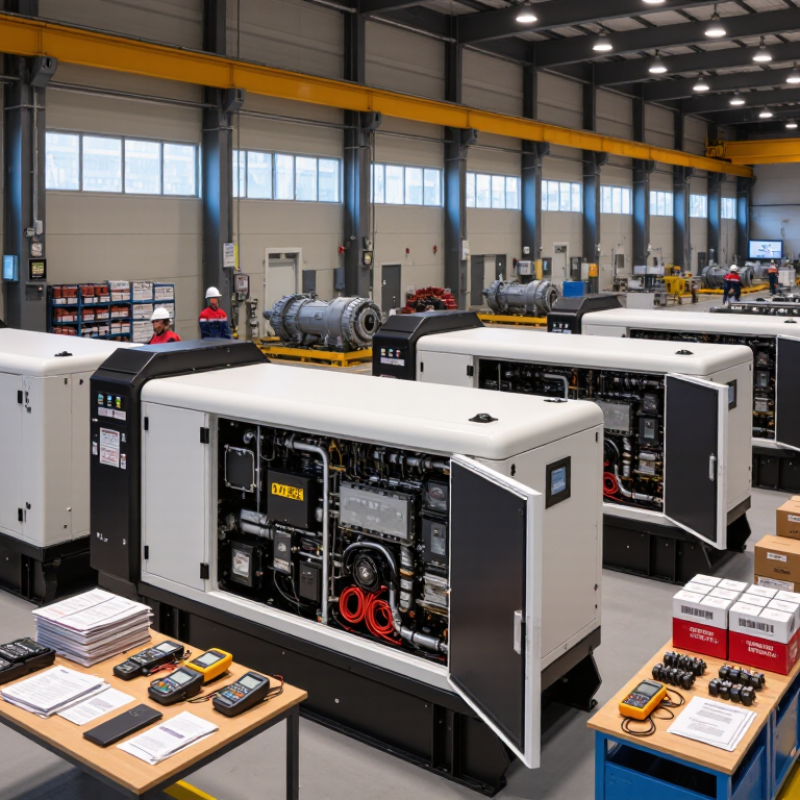
How to Choose a Top China Generator Factory?

Define Your Generator Requirements and Operating Conditions

Before requesting quotations, list what the generator must power: continuous and peak kilowatts, voltage, phase, frequency, and allowable voltage dip. Separate essential loads from equipment that can wait. Record motor-starting current, UPS rectifier behavior, and simultaneous starts. A pump may use modest running power yet dictate alternator size during startup. Not interchangeable. Define whether the set is for standby, prime, or continuous duty; compare ratings using ISO 8528-1 and consistent load assumptions.

Describe the site as carefully as the load. Note temperature extremes, elevation, humidity, dust, salt exposure, enclosure location, fuel, and annual operating hours. High heat and altitude can reduce output, so request a corrected rating rather than relying on a headline figure. The IEA’s Electricity 2025 report says global electricity demand grew 4.3% in 2024, a reminder that old load forecasts can become outdated. Share interval-meter data and a load-step schedule with prospective factories, then request documented test results at your specified voltage and frequency. Include planned expansion, but avoid sizing around vague hopes: prolonged low-load operation can affect efficiency and maintenance. One forecast will be wrong. Recheck it.

Verify the Factory’s Credentials, Capacity, and Manufacturing Expertise

A reliable generator factory should be verified on the production floor, not judged by a polished showroom. Request its business registration, quality-management certificates, product test records, and references for comparable projects. Ask for proof. Check that certificate details match the factory’s legal name and actual production site.

Capacity is more than a brochure figure. Review recent output records, shift schedules, equipment lists, and the availability of load-bank testing. The International Energy Agency’s Electricity 2024 report projected global electricity demand growth of about 4% in 2024. China’s National Bureau of Statistics reported 5.0% growth in manufacturing value added in 2023. These figures describe market and sector activity, not an individual supplier’s performance. Look closer.

During a visit, inspect welding areas, assembly stations, parts storage, and finished-unit test bays. Ask operators how they document inspection results and handle failed tests. A factory should explain its process clearly, from incoming components to final load testing. One caveat: tidy paperwork does not guarantee consistent production. Compare records with what you see, and request a live test on a unit similar to yours. I would leave room for doubt until the evidence aligns.

Assess Generator Quality, Testing Standards, and Compliance

Choosing a generator factory means looking beyond polished photographs and quoted output. Ask how the factory verifies the rated power, voltage, and frequency of each unit. A witnessed load-bank test can show performance at different load levels. Check whether the report identifies the generator’s serial number and records operating conditions.

Standards matter, but their scope matters too. ISO 8528 covers performance and testing for generating sets; ask which requirements apply to the model and intended use. Confirm that electrical safety, emissions, and noise documentation matches the destination market. ISO 9001 may indicate a quality management system, but it does not certify every generator. Ask for current, model-specific evidence. Details matter.

Look for records of insulation checks, protection-device operation, and temperature readings after sustained running. Ask how failed tests are handled and whether corrective actions are documented. A neat report is reassuring, yet it can leave gaps if the test conditions are unclear. Request a sample report before ordering. If possible, visit the test area and observe a unit under load. The process may not be perfect; transparent records and specific answers are more useful than broad promises.

Compare Customization, Lead Times, and After-Sales Support

How to Choose a Top China Generator Factory?
Compare Customization, Lead Times, and After-Sales Support

A capable factory should adapt the generator to your site, not just offer a larger catalog. Share the required voltage, load profile, ambient temperature, and installation conditions. Then ask for a written configuration drawing. Check details such as the control panel, enclosure, cable access, and fuel-tank capacity. Small changes can affect fit and maintenance access. I have seen specifications look complete on paper, yet leave awkward service clearance.

Compare lead times by milestone, not by one promised delivery date. Ask when design approval, component sourcing, assembly, and factory testing occur. Confirm which parts may cause delays, and request updates if those dates shift. A clear schedule is more useful than a very short estimate. It may still change.

After-sales support deserves equal attention. Ask who handles commissioning, how quickly technical staff respond, and which spare parts are stocked locally. The U.S. Department of Energy’s Operations & Maintenance Best Practices guide estimates that maintenance can represent 60–80% of a building’s life-cycle cost. That figure is not generator-specific, but it shows why service planning matters. Request sample maintenance records and a realistic response-time commitment. A polished factory tour proves little on its own.

How to Choose a Top China Generator Factory? - Compare Customization, Lead Times, and After-Sales Support

The comparison below uses illustrative supplier profiles and practical planning ranges, not verified quotes from specific factories. Actual lead times, warranty terms, and customization scope depend on the generator specification, order quantity, component availability, and contract.

Supplier profile Customization capability Typical production lead time After-sales support to confirm Best suited for Key checks before ordering
Standard-model focused Usually offers established models with limited options, such as enclosure color, outlet configuration, or control-panel settings. Often around 2–4 weeks for available configurations; special requirements can add time. Ask for written warranty coverage, spare-parts availability, and a named contact for technical questions. Buyers seeking common specifications and a relatively straightforward purchase. Confirm the exact engine, alternator, controller, voltage, frequency, and included accessories.
OEM-capable production supplier May support private-label packaging, control-panel changes, enclosure options, and selected electrical or mechanical configurations. Commonly around 3–6 weeks after specification approval; customized parts may extend the schedule. Check warranty start date, claim procedure, diagnostic support, and whether parts can be supplied for the product’s service life. Importers and distributors needing a defined product configuration or private-label presentation. Request an approved specification sheet, sample or reference build, and a written list of included tests.
Engineering-led custom supplier Can assess application-specific requirements such as special enclosure design, integration, control logic, or site conditions, subject to engineering review. Allow roughly 4–8 weeks or more for a first custom build; repeat orders may be faster once the design is approved. Confirm access to application engineers, commissioning guidance, troubleshooting escalation, and replacement-part lead times. Projects with non-standard operating conditions or technical integration needs. Agree on drawings, acceptance criteria, change control, and responsibility for local approvals before production.
Export-oriented supplier Often provides a mix of standard and configurable models, with export packaging and documentation options depending on the destination market. A planning range of about 3–6 weeks is common for configured orders; shipping and inspection time are additional. Ask how service requests are handled across time zones and whether manuals, parts lists, and troubleshooting materials are available in English. Buyers who need export coordination and destination-market documentation. Verify applicable certifications for the exact model and destination; request copies and check their scope and validity.

Practical comparison tip: Request the same specification, order quantity, inspection requirements, delivery term, and warranty questions from every shortlisted factory. Compare confirmed written commitments rather than headline lead times or verbal assurances.

Evaluate Total Cost and Select the Best-Fit Factory

Choosing a China generator factory on purchase price alone can hide substantial costs. Compare each quotation on a landed, operating-cost basis: equipment, testing, packing, freight, duties, installation, fuel, maintenance, and spare parts. Request fuel-consumption figures at 50%, 75%, and full load, then calculate annual fuel use from your expected operating hours. Small details matter. Confirm that the stated output is prime or standby power, and ask for a witnessed load-bank test and written parts support. A low quote is not automatically a good deal.

Fuel assumptions need a location-specific check. The U.S. Energy Information Administration reported an average on-highway diesel price of about $4.21 per gallon in 2023; this is a benchmark, not a forecast for your site. UNCTAD’s Review of Maritime Transport 2024 also documented sharp container freight-rate swings during shipping disruptions. Build a freight contingency into landed-cost comparisons, and refresh quotes before ordering. Prices move.

Factory fit matters as much as the spreadsheet. Ask for drawings, component specifications, routine test records, delivery schedules, and examples of similar output configurations. Compare warranty exclusions and response times in writing. A common mistake is treating every promised service as equal; vague support can become expensive when a unit stops. I would also challenge my own comparison if it ignored local fuel prices or assumed every operating hour runs at full load. Use realistic load profiles, and keep the assumptions visible for review.

Copyright 2025 Fluidra S.A. | Created by BCM Marketing Agencia Privacy Policy Legal note | Cookie policy |

Technical cookies are strictly necessary for our website to work and you can navigate through it. These types of cookies are those that, for example, allow us to identify you, give you access to certain restricted parts of the page if necessary, or remember different options or services already selected by you, such as your privacy preferences. Therefore, they are activated by default, your authorization not being necessary in this regard. Through the configuration of your browser, you can block or alert the presence of this type of cookies, although such blocking will affect the proper functioning of the different functionalities of our website.


The analysis cookies allow us to study the navigation of the users of our website in general (for example, which sections of the page are the most visited, which services are used most and if they work correctly, etc.). From the statistical information on navigation on our website, we can improve both the operation of the page itself and the different services it offers. Therefore, these cookies do not have an advertising purpose, but only serve to make our website work better, adapting to our users in general. By activating them you will contribute to this continuous improvement. You can enable or disable these cookies by checking the corresponding box, being disabled by default.


Functionality cookies allow us to remember your preferences, to personalize certain characteristics and general options of our website, every time you access it (for example, the language in which the information is presented to you, the sections marked as favorites, your browser type, etc.) Therefore, this type of cookies does not have an advertising purpose, but by activating them you will improve the functionality of the website (for example, adapting to your type of browser) and the customization of it based on your preferences (for example, by presenting the information in the language that you have chosen in previous occasions), which will contribute to the ease, usability and comfort of our page during your navigation. You can enable or disable these cookies by checking the corresponding box, being disabled by default.


Advertising cookies allow us to manage the advertising spaces included in our website based on criteria such as the content shown or the frequency in which the ads are displayed. For example, if you have been shown the same ad several times on our website, and you have not shown a personal interest by clicking on it, it will not appear again. In summary, by activating this type of cookies, the advertising shown on our website will be more useful and diverse, and less repetitive. You can enable or disable these cookies by checking the corresponding box, being disabled by default.


Behavioral advertising cookies allow us to obtain information based on the observation of your browsing habits and behaviors on the web, in order to show you advertising content that best suits your personal tastes and interests. To understand it in a very simple way, we will give you a fictitious example: if your last searches on the web were related to suspense literature, we would show you advertising about suspense books. Therefore, activating this type of cookies, the advertising that we show you on our website will not be generic, but will be oriented to your searches, tastes and interests, therefore adjusting exclusively to you. You can enable or disable these cookies by checking the corresponding box, being disabled by default.
To understand it in a very simple way, we will give you a fictitious example: if your last searches on the web were related to suspense literature, we would show you advertising about suspense books. Therefore, activating this type of cookies, the advertising that we show you on our website will not be generic, but will be oriented to your searches, tastes and interests, therefore adjusting exclusively to you. You can enable or disable these cookies by checking the corresponding box, being disabled by default.

SAVE

We use our own and third-party cookies to ensure the proper functioning of the website and to analyse our services, improve your experience on our website and show you advertisements related to your interests according to profiling based on your browsing habits (e.g. websites visited). You can accept all cookies by clicking "ACCEPT" or set or reject them by clicking here. If you would like to know more about the use of cookies, please see our COOKIE POLICY.


ACCEPT ALL
Reject no essentials


