
How to Choose a DC Planetary Gear Motor in 2026?
FLUID HANDLING EXPERTS

Blog, all our news

How to Choose a DC Planetary Gear Motor in 2026?

Choosing a Dc Planetary Gear Motor in 2026 requires more than comparing catalog prices. The correct choice begins with the machine’s real operating conditions. Measure load torque, starting torque, required speed, voltage, duty cycle, and available installation space. A motor that performs well on a test bench may overheat inside a sealed enclosure.

Practical experience shows that gearbox ratio often determines success. A higher ratio can increase output torque, but it may reduce speed and efficiency. Check the rated torque, peak torque, backlash, shaft load, and permissible radial force. Confirm whether the motor can tolerate repeated starts, sudden reversals, or continuous operation. Small details matter. A two-millimeter mounting error can create noise and premature bearing wear.

Reliable selection also depends on evidence. Review manufacturer datasheets, efficiency curves, thermal limits, insulation ratings, and test conditions. Ask whether published performance uses a fully charged battery or a regulated power supply. The difference can affect actual results. Encoder feedback, sealed construction, and low-noise gearing may justify higher costs in precision equipment. However, advanced features are not automatically necessary.

Avoid choosing only by maximum torque. That number may describe a brief peak, not continuous performance. Real applications are less forgiving. I have seen motors fail because engineers ignored heat buildup and duty cycles. That mistake is easy to repeat. A sound evaluation compares several Dc Planetary Gear Motor options, then validates the preferred model under realistic load, temperature, and voltage conditions. The best decision is not always the most powerful one. It is the most dependable match for the complete system.
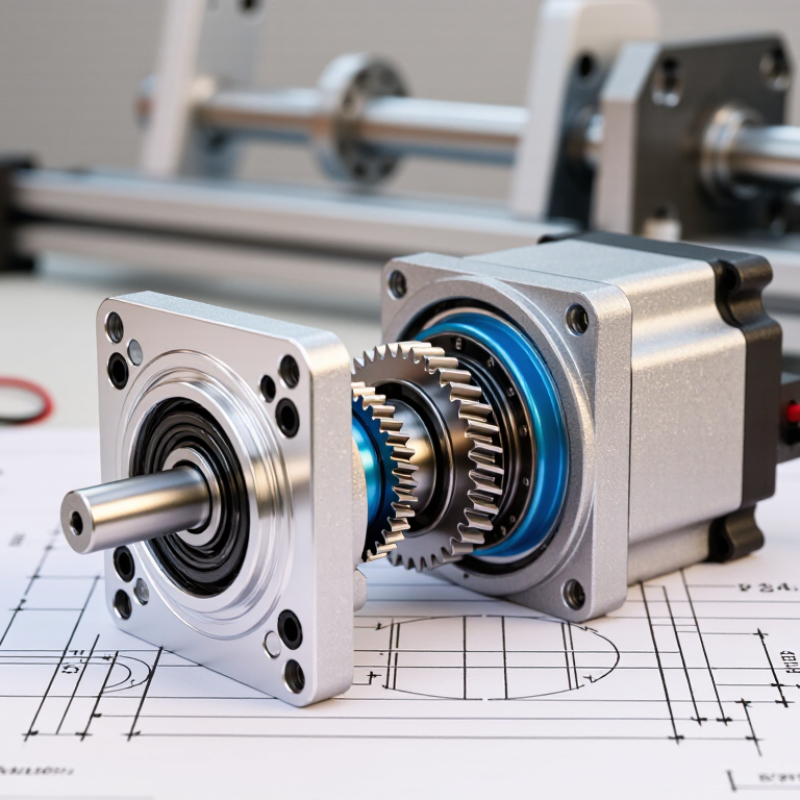
How to Choose a DC Planetary Gear Motor in 2026?

Define the Operating Requirements for a DC Planetary Gear Motor

How to Choose a DC Planetary Gear Motor in 2026?

Define the Operating Requirements for a DC Planetary Gear Motor

Start with the real load, not the catalog headline. Record continuous torque, peak torque, output speed, voltage, acceleration, and daily operating hours. Include startup resistance and short stalls. These details often decide the gearbox size. A practical estimate is T_required = T_load × service factor. Use a service factor between 1.3 and 2.0 when shocks or uncertain loads exist. The correct value depends on the mechanism and duty cycle.

Measure the available space carefully. Note shaft direction, mounting pattern, radial load, axial load, and allowable backlash. A compact planetary gearbox can deliver high torque, but its bearings still have limits. The IEA Energy Efficiency 2024 report states that electric motor systems consume more than half of global electricity. Small efficiency losses therefore matter during continuous operation. Check motor current, gearbox efficiency, heat generation, and controller compatibility together. A motor that meets torque on paper may overheat inside a sealed housing.

Environmental requirements need equal attention. Define ambient temperature, dust, moisture, vibration, and cleaning exposure. IEC 60034-1 provides general rotating-machine requirements, while ISO 281 helps evaluate bearing life. I have seen selections fail because engineers measured only the running load. The unpleasant detail is startup load. Test it. Also question the assumed service factor; it may be generous, or completely inadequate. A short prototype test under the heaviest real load can reveal noise, backlash, temperature rise, and unstable speed before production.

Match Motor Voltage, Speed, Torque, and Power to the Application

Choosing a DC planetary gear motor in 2026 starts with the load, not the catalog headline. Measure the real operating cycle: starting torque, running torque, speed, stops, and daily hours. Record friction and incline effects. These details often expose an undersized motor.

Match the motor voltage to the available power system and controller. A 24 V motor may perform poorly with unstable supply voltage. Check continuous current, startup current, and driver limits. Then select the gearbox ratio for loaded output speed, not no-load speed. A conveyor requiring 60 rpm may run at 45 rpm under material load. Verify both figures. Torque must cover the working load and acceleration peak. A practical margin of 25% to 50% is useful, but excessive margin can increase cost and reduce control sensitivity. Keep margin.

Power connects these choices. Use P = T × ω, while allowing for gearbox and electrical losses. For example, an 8 Nm load at 60 rpm needs roughly 50 watts mechanically, before losses and acceleration. Thermal limits matter. A motor may meet the torque requirement briefly, then overheat during repeated cycles. Check duty rating, ambient temperature, enclosure, and mounting heat transfer.

I have seen selection errors caused by ignoring backlash and shaft loading. Test the assembled mechanism, not only the motor. Listen for gear noise, measure case temperature, and confirm speed after thirty minutes. The first calculation is rarely perfect. Revise it when real measurements disagree.

How to Choose a DC Planetary Gear Motor in 2026?

Match the motor’s nominal voltage, output speed, continuous torque, and mechanical power to the application. The chart shows representative selection targets calculated from real motor-output relationships.

Mechanical output power is calculated as P = T × n / 9.549, where P is power in watts, T is torque in newton-metres, and n is speed in revolutions per minute. Select a motor with additional torque and thermal margin for starting loads, duty cycles, and efficiency losses.

Select the Gear Ratio, Gear Material, and Reduction Stage

How to Choose a DC Planetary Gear Motor in 2026?

Start with the gear ratio, not the motor’s advertised speed. Divide the required motor speed by the output speed. A 3,000 rpm motor needing 100 rpm output requires about a 30:1 ratio. Confirm the gearbox can deliver the needed torque continuously, not only during short tests. The IEA’s Energy Efficiency 2023 report states that electric motor systems use about half of global electricity. Small efficiency losses can therefore become expensive in continuous applications. I have seen prototypes fail because engineers sized torque correctly but ignored acceleration and stall conditions.

Gear material affects noise, wear, and service life. Hardened steel gears suit frequent starts, shock loads, and compact designs. Powder-metal gears can reduce cost and mass, but their limits need careful verification. Plastic gears may work in light-duty mechanisms, yet temperature and humidity can change their behavior. Reduction stage count also matters. More stages can provide higher ratios, but each stage adds friction, length, and possible backlash. Use the supplier’s measured efficiency curves. Do not trust a single catalog number.

Tips: Compare continuous and peak torque at the actual duty cycle. Check radial-load capacity at the shaft. Ask for test conditions, lubricant type, and temperature limits. The U.S. Department of Energy’s Motor Systems guidance recommends evaluating motors as complete systems, not isolated components. That principle is easy to overlook. A smaller motor may appear efficient, but poor gearing can waste energy and shorten operating life. Recheck your assumptions after testing; real loads are rarely perfectly smooth.

Evaluate Efficiency, Duty Cycle, Noise, and Thermal Performance

Choosing a DC planetary gear motor in 2026 requires more than matching voltage and output speed. Efficiency, duty cycle, noise, and thermal performance often decide whether a motor survives real service. Start with the load profile, including starting torque, running torque, speed changes, and stopping frequency. A motor rated for continuous operation may still overheat during repeated acceleration.

Measure efficiency at the actual operating point, not only at the rated load. Record input voltage, current, output torque, and speed after the motor reaches a stable temperature. Small losses become significant in battery-powered equipment. I have seen motors perform well on a bench, then lose speed under a warm enclosure. The difference was airflow.

Duty cycle deserves careful calculation. A 30-second run followed by a 30-second rest is not identical to continuous operation. Check peak torque, average torque, and gearbox limits separately. Thermal testing should include the expected ambient temperature and mounting surface. Use a temperature sensor near the winding or motor housing. Heat tells the truth.

Noise testing also needs realistic conditions. Gear alignment, mounting stiffness, lubrication, and resonance can change the sound dramatically. Compare measurements at the same distance and speed. A low-noise motor may still create harsh vibration through a thin metal bracket. Datasheets help, but they are not the whole answer. Allow safety margin, then question whether it is enough.

Compare Mounting Options, Controls, Protection, and Long-Term Reliability

Choose the mounting interface before comparing torque. Measure shaft height, bolt spacing, pilot diameter, and available clearance. A face-mounted gearbox suits compact conveyors, while a foot-mounted unit simplifies retrofits. That small mismatch can force a costly redesign.

Controls deserve equal attention. Confirm the motor’s voltage, rated current, startup current, encoder feedback, and braking requirements. The IEA estimates that motor-driven systems consume about 46% of global electricity, so poor control settings can create substantial waste. Closed-loop control improves speed accuracy, but it also adds wiring, software, and failure points. Keep that trade-off visible.

Protection should match the actual environment, not a hopeful specification sheet. Select an appropriate IP rating under IEC 60529, then check dust, washdown exposure, ambient temperature, shock, and duty cycle. The 2024 World Robotics report recorded 541,302 industrial robot installations in 2023, reflecting the growing demand for repeatable motion and dependable uptime. For long-term reliability, review thermal limits, bearing loads, gearbox backlash, lubrication, and overload behavior. Test repeated starts, reversals, and stalled conditions before approval. I still distrust perfect laboratory numbers. Real machines vibrate, operators change settings, and maintenance arrives late. A motor that survives those imperfect moments is usually the better choice.

Copyright 2025 Fluidra S.A. | Created by BCM Marketing Agencia Privacy Policy Legal note | Cookie policy |

Technical cookies are strictly necessary for our website to work and you can navigate through it. These types of cookies are those that, for example, allow us to identify you, give you access to certain restricted parts of the page if necessary, or remember different options or services already selected by you, such as your privacy preferences. Therefore, they are activated by default, your authorization not being necessary in this regard. Through the configuration of your browser, you can block or alert the presence of this type of cookies, although such blocking will affect the proper functioning of the different functionalities of our website.


The analysis cookies allow us to study the navigation of the users of our website in general (for example, which sections of the page are the most visited, which services are used most and if they work correctly, etc.). From the statistical information on navigation on our website, we can improve both the operation of the page itself and the different services it offers. Therefore, these cookies do not have an advertising purpose, but only serve to make our website work better, adapting to our users in general. By activating them you will contribute to this continuous improvement. You can enable or disable these cookies by checking the corresponding box, being disabled by default.


Functionality cookies allow us to remember your preferences, to personalize certain characteristics and general options of our website, every time you access it (for example, the language in which the information is presented to you, the sections marked as favorites, your browser type, etc.) Therefore, this type of cookies does not have an advertising purpose, but by activating them you will improve the functionality of the website (for example, adapting to your type of browser) and the customization of it based on your preferences (for example, by presenting the information in the language that you have chosen in previous occasions), which will contribute to the ease, usability and comfort of our page during your navigation. You can enable or disable these cookies by checking the corresponding box, being disabled by default.


Advertising cookies allow us to manage the advertising spaces included in our website based on criteria such as the content shown or the frequency in which the ads are displayed. For example, if you have been shown the same ad several times on our website, and you have not shown a personal interest by clicking on it, it will not appear again. In summary, by activating this type of cookies, the advertising shown on our website will be more useful and diverse, and less repetitive. You can enable or disable these cookies by checking the corresponding box, being disabled by default.


Behavioral advertising cookies allow us to obtain information based on the observation of your browsing habits and behaviors on the web, in order to show you advertising content that best suits your personal tastes and interests. To understand it in a very simple way, we will give you a fictitious example: if your last searches on the web were related to suspense literature, we would show you advertising about suspense books. Therefore, activating this type of cookies, the advertising that we show you on our website will not be generic, but will be oriented to your searches, tastes and interests, therefore adjusting exclusively to you. You can enable or disable these cookies by checking the corresponding box, being disabled by default.
To understand it in a very simple way, we will give you a fictitious example: if your last searches on the web were related to suspense literature, we would show you advertising about suspense books. Therefore, activating this type of cookies, the advertising that we show you on our website will not be generic, but will be oriented to your searches, tastes and interests, therefore adjusting exclusively to you. You can enable or disable these cookies by checking the corresponding box, being disabled by default.

SAVE

We use our own and third-party cookies to ensure the proper functioning of the website and to analyse our services, improve your experience on our website and show you advertisements related to your interests according to profiling based on your browsing habits (e.g. websites visited). You can accept all cookies by clicking "ACCEPT" or set or reject them by clicking here. If you would like to know more about the use of cookies, please see our COOKIE POLICY.


ACCEPT ALL
Reject no essentials


