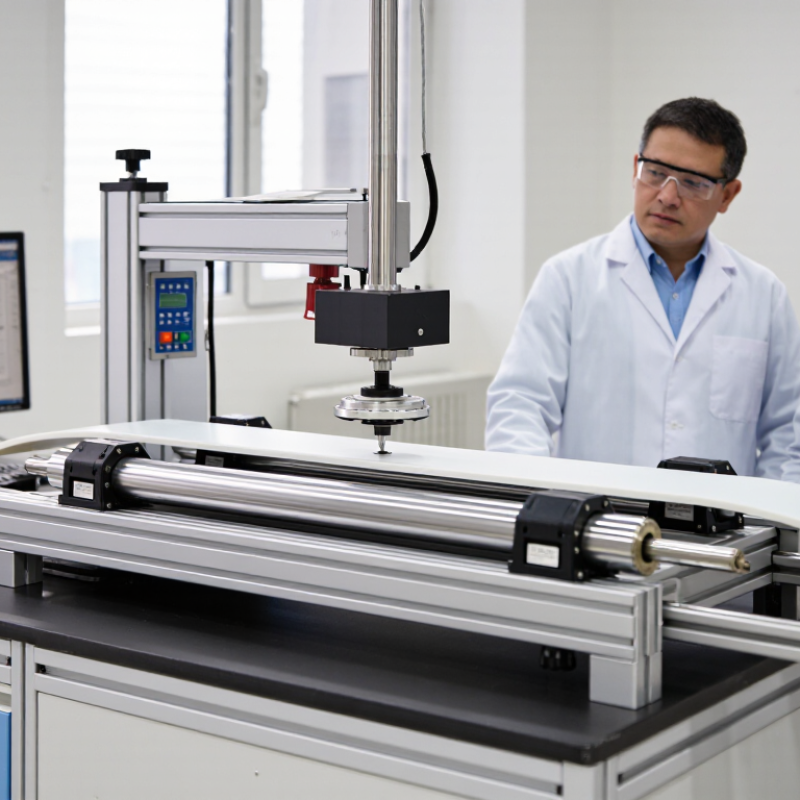
How to Choose a 3 Point Bending Tensile Testing Machine?
Choosing a 3-Point Bending Tensile Testing Machine requires more than comparing load capacities and prices. The correct system must match your material, specimen geometry, testing standard, and laboratory workflow. A machine designed for rigid plastics may not deliver reliable results for foam, composites, rubber, or thin films.
Measurement comes first. Lord Kelvin, a renowned measurement expert, stated, “When you can measure what you are speaking about, and express it in numbers, you know something about it.” His principle remains practical today. Check the required force range, crosshead speed, displacement accuracy, fixture span, and calibration records. A 5 kN frame may suit small polymer samples, while reinforced composites can demand much higher capacity.
Look closely at the details.
A stable three-point fixture should hold the specimen without visible slipping. The rollers should remain aligned during loading. Software should record force, deflection, flexural strength, and failure position clearly. Compatibility with ASTM D790 or ISO 178 may also matter, depending on your application.
Do not overlook operator experience. A technically advanced machine can still produce weak results when setup instructions are unclear. I have seen laboratories focus on maximum force, then discover that fixture alignment caused inconsistent breaks. That mistake is easy to repeat. It is also worth admitting that no single machine fits every testing program. Reviewing sample dimensions, expected failure modes, environmental conditions, and future workload will help you choose a system that is accurate, maintainable, and genuinely useful.
Understanding 3-Point Bending and Tensile Testing Requirements
How to Choose a 3 Point Bending Tensile Testing Machine?
Understanding the test method comes before comparing machine specifications. Three-point bending measures flexural strength, stiffness, and deflection. Tensile testing measures strength, elongation, and failure behavior. These results are not interchangeable. ISO 178 specifies flexural testing for plastics, while ISO 527 covers tensile properties. ASTM D790 uses defined spans, specimen sizes, and loading rates. Small setup changes can alter the result.
Choose a frame with enough force capacity, travel, and stiffness for your largest specimen. A practical reserve of 20% to 30% above the expected peak load reduces overload risk. The force system should meet ISO 7500-1 Class 1 or ASTM E4 verification requirements, generally within ±1% of the indicated force. Select interchangeable bending fixtures, tensile grips, and extensometers. Alignment matters. A slightly tilted grip can create uneven stress across the specimen. For composites, consider a wider span and video strain measurement. For plastics, environmental control may be necessary because temperature changes elongation. A 2024 materials-testing industry report projects market growth above 5% annually, driven partly by stricter quality control and lightweight materials. That figure sounds persuasive, but market forecasts vary considerably. Verify the original report, test standard, and uncertainty budget before purchasing.
How to Choose a 3 Point Bending Tensile Testing Machine?
Understanding 3-Point Bending and Tensile Testing Requirements
This chart compares the calculated engineering stress produced by identical loads in tensile and 3-point bending tests. The calculation uses a 12.7 mm wide × 3.2 mm thick bending specimen with a 51.2 mm support span, and a 13 mm × 3.2 mm tensile cross-section. The results help identify the required load-cell capacity, measurement range, and machine stiffness. These values are calculated examples, not material strength data.
Identifying Material, Specimen, and Test Standard Requirements
How to Choose a 3 Point Bending Tensile Testing Machine?
Identifying Material, Specimen, and Test Standard Requirements
Choosing a three-point bending machine starts with the material, not the frame size. Plastics, composites, wood, and ceramics respond differently under flexural loading. A polymer may need controlled temperature. A ceramic may need higher stiffness and careful alignment. Calling this a tensile machine can also cause confusion. The specimen is usually bent, while tensile stress develops on its lower surface.
Check the required standard before purchasing equipment. ASTM D790 and ISO 178 commonly guide plastic flexural tests. Ceramic applications may follow different procedures, such as ASTM C1161. Each standard can specify specimen length, width, thickness, support span, loading nose radius, and test speed. A small dimensional error can change the calculated strength. Measure several specimens with a calibrated gauge. Do not rely on nominal drawings alone.
Match the load cell to the expected force range. Excessive capacity can reduce measurement resolution. Insufficient capacity creates a safety and accuracy problem. Confirm the machine can control crosshead speed steadily. Deflection measurement also matters, especially for flexible specimens. Record temperature and humidity when the material is sensitive. Verify calibration records, alignment, software traceability, and emergency stopping functions. In practice, operators sometimes select a fixture first and review the standard later. That approach seems convenient, but it can produce unusable data. A short trial with real specimens may reveal unexpected slipping, crushing, or uneven contact.
Comparing Machine Capacity, Accuracy, and Control Features
Choosing a 3 point bending tensile testing machine requires more than matching the maximum load to a sample’s strength. Select a capacity that exceeds the expected peak force by about 10–20%. This margin reduces overload risk and leaves room for unusual specimens. However, an oversized load cell may reduce measurement resolution. That trade-off is easy to overlook.
Accuracy depends on the complete testing system, not only the load cell. Check force accuracy, displacement resolution, frame stiffness, and fixture alignment. A slight contact offset can create uneven stress across the specimen. Calibration should be traceable, documented, and repeated at planned intervals. Inspectors should also review test results from low, medium, and high loads. One point is not enough. Real materials rarely behave perfectly.
Control features strongly affect repeatability. Closed-loop speed control helps maintain consistent loading during bending. Adjustable preload, automatic return, and programmable hold times can reduce operator variation. Clear software should record force, displacement, speed, and failure position. Data export matters when results require independent review. A touchscreen may look convenient, but reliable alarms and simple menus are more valuable. In practice, operators sometimes choose advanced features they never use. That is a costly weakness. Run a trial with your actual specimen size, fixture, and testing standard before purchase. The machine should feel controlled, not merely powerful.
Evaluating Fixtures, Software, Safety, and Calibration
Choosing a 3 point bending tensile testing machine starts with the fixture, not the frame. The support span, loading nose radius, and alignment must match the applicable test method. ASTM D790, for example, uses span-to-depth ratios that strongly affect flexural strength and modulus. A small radius can create local stress concentrations. I have seen clean-looking specimens fail because the supports were uneven. Fixture stiffness matters too.
Software should record force, displacement, specimen dimensions, test speed, and raw data. Audit trails and user permissions improve traceability, especially under ISO/IEC 17025 laboratory practices. Avoid systems that only export polished graphs. Raw files matter. According to ISO 7500-1, a Class 1 force-measuring system permits a maximum error of ±1% of the indicated force. That limit is not a substitute for regular verification. ASTM E4 provides widely used force-verification procedures for testing machines.
Safety features deserve physical inspection. Look for interlocked guards, emergency stops, overload protection, and controlled crosshead movement. ISO 13849-1 emphasizes safety-related control performance, but software alone cannot prevent every pinch hazard. Calibration records should identify the technician, reference standard, uncertainty, date, and next due date. Calibration intervals are often set annually, yet heavy daily use may require shorter checks. This is where many specifications become too simplistic. A machine can pass calibration and still produce biased results if the fixture is worn, the specimen is misaligned, or the operator skips dimensional checks.
Selecting the Best Machine for Your Laboratory and Applications
How to Choose a 3 Point Bending Tensile Testing Machine?
Selecting the Best Machine for Your Laboratory and Applications
Choosing a three-point bending machine starts with the materials you test most often. Plastics, metals, wood, and composites may require different force ranges and fixtures. Check the expected load before selecting the load cell. A machine operating near its maximum capacity can produce less reliable measurements. A wider capacity range is useful, but excessive capacity may reduce sensitivity. That trade-off is easy to overlook.
The fixture should provide stable supports, accurate spacing, and smooth contact surfaces. Adjustable spans help laboratories follow different testing standards, including relevant ASTM or ISO methods. Check whether the software records force, displacement, flexural strength, and modulus automatically. Good software also protects raw data and creates traceable reports. Calibration certificates matter. So does local service support. In practice, a machine with impressive specifications may still frustrate technicians if setup instructions are unclear. This is where many purchasing decisions need more reflection.
Tips: Match the machine to your specimen size, load range, testing temperature, and daily workload. Ask for a demonstration using a material similar to yours. Inspect the frame, emergency stop, alignment, and fixture replacement process. Leave room for future applications. You may later test thicker composites or higher-strength materials. Also, verify measurement accuracy at low loads, not only at full capacity. Small details often decide whether results remain dependable.
Cepex is the brand for the fluid handling market belonging to the Fluidra group. One of the leading european manufacturer of valves and fittings in thermoplastic materials.
Dedicated to the swimming pool, irrigation and industrial markets, we distribute our products worldwide with the Fluidra commercial network and presence in 46 countries with 136 sales branches.
Your data will be processed by CEPEX S.A., with address at C. Lluís Companys, 51-53, 08400, Granollers (Barcelona), and C.I.F. nº A-08928707, to send you communications about our products based on your interests. You can consult more information about the processing of your data and how to exercise your rights as described in the Privacy Policy.
Technical cookies are strictly necessary for our website to work and you can navigate through it. These types of cookies are those that, for example, allow us to identify you, give you access to certain restricted parts of the page if necessary, or remember different options or services already selected by you, such as your privacy preferences. Therefore, they are activated by default, your authorization not being necessary in this regard. Through the configuration of your browser, you can block or alert the presence of this type of cookies, although such blocking will affect the proper functioning of the different functionalities of our website.
The analysis cookies allow us to study the navigation of the users of our website in general (for example, which sections of the page are the most visited, which services are used most and if they work correctly, etc.). From the statistical information on navigation on our website, we can improve both the operation of the page itself and the different services it offers. Therefore, these cookies do not have an advertising purpose, but only serve to make our website work better, adapting to our users in general. By activating them you will contribute to this continuous improvement. You can enable or disable these cookies by checking the corresponding box, being disabled by default.
Functionality cookies allow us to remember your preferences, to personalize certain characteristics and general options of our website, every time you access it (for example, the language in which the information is presented to you, the sections marked as favorites, your browser type, etc.) Therefore, this type of cookies does not have an advertising purpose, but by activating them you will improve the functionality of the website (for example, adapting to your type of browser) and the customization of it based on your preferences (for example, by presenting the information in the language that you have chosen in previous occasions), which will contribute to the ease, usability and comfort of our page during your navigation. You can enable or disable these cookies by checking the corresponding box, being disabled by default.
Advertising cookies allow us to manage the advertising spaces included in our website based on criteria such as the content shown or the frequency in which the ads are displayed. For example, if you have been shown the same ad several times on our website, and you have not shown a personal interest by clicking on it, it will not appear again. In summary, by activating this type of cookies, the advertising shown on our website will be more useful and diverse, and less repetitive. You can enable or disable these cookies by checking the corresponding box, being disabled by default.
Behavioral advertising cookies allow us to obtain information based on the observation of your browsing habits and behaviors on the web, in order to show you advertising content that best suits your personal tastes and interests. To understand it in a very simple way, we will give you a fictitious example: if your last searches on the web were related to suspense literature, we would show you advertising about suspense books. Therefore, activating this type of cookies, the advertising that we show you on our website will not be generic, but will be oriented to your searches, tastes and interests, therefore adjusting exclusively to you. You can enable or disable these cookies by checking the corresponding box, being disabled by default. To understand it in a very simple way, we will give you a fictitious example: if your last searches on the web were related to suspense literature, we would show you advertising about suspense books. Therefore, activating this type of cookies, the advertising that we show you on our website will not be generic, but will be oriented to your searches, tastes and interests, therefore adjusting exclusively to you. You can enable or disable these cookies by checking the corresponding box, being disabled by default.
We use our own and third-party cookies to ensure the proper functioning of the website and to analyse our services, improve your experience on our website and show you advertisements related to your interests according to profiling based on your browsing habits (e.g. websites visited). You can accept all cookies by clicking "ACCEPT" or set or reject them by clicking here. If you would like to know more about the use of cookies, please see our COOKIE POLICY.