
How to Choose the Best Optical Sorting System?
FLUID HANDLING EXPERTS

Blog, all our news

How to Choose the Best Optical Sorting System?

Choosing the right Optical Sorting Systems solution begins with the material, not the machine brochure. A line sorting mixed produce may need to detect bruises and foreign material, while a recycling plant may focus on resin type, color, or particle size. The right choice depends on what must be removed, the required throughput, and the quality standard for the final product. Small details matter: belt speed, lighting, dust, washdown routines, and the space available for maintenance.

Before comparing models, ask suppliers to run representative samples under realistic conditions. Request measured results for detection accuracy, usable throughput, false rejects, and product loss. Check how quickly operators can adjust recipes and how local service teams handle faults. A demonstration with clean sample material can look impressive. Your own feedstock may behave differently. That deserves a hard look.

I can’t responsibly provide a named expert’s quotation without a verifiable source. For a reliable introduction, share an article or expert reference, and the quotation can be included with accurate attribution.
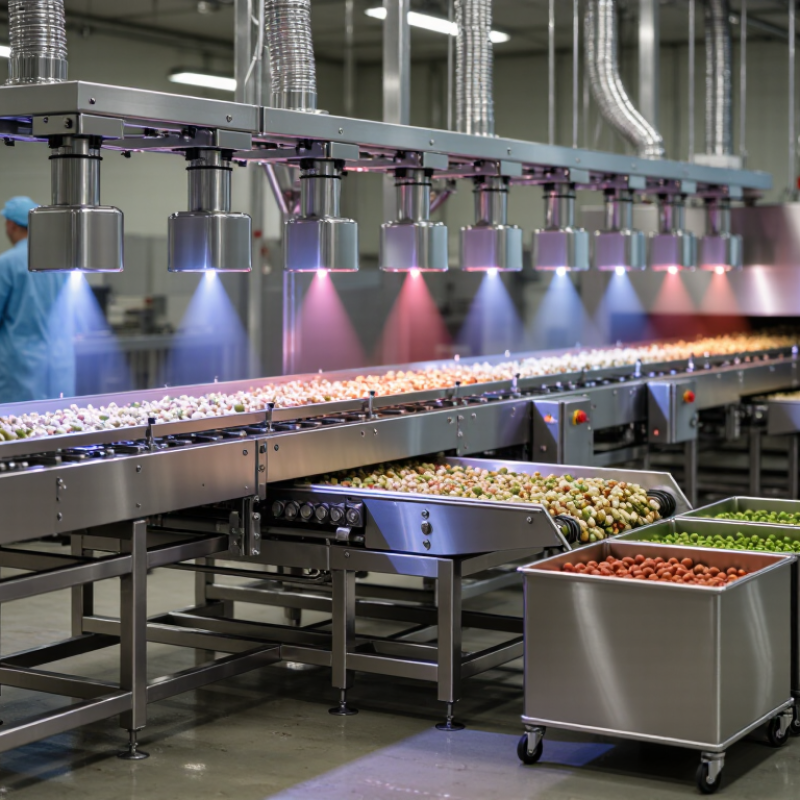
How to Choose the Best Optical Sorting System?

Define Your Sorting Goals and Performance Requirements

Before comparing optical sorting systems, define the material you need to separate and the outcome that matters most. Is the priority higher product purity, better recovery, or fewer manual inspection hours? Set a baseline using representative samples, including mixed sizes, surface moisture, and seasonal variation. Measure real samples.

For food operations, the scale of loss makes precise targets important. FAO’s 2019 State of Food and Agriculture estimated that about 14% of food is lost between harvest and retail. UNEP’s Food Waste Index Report 2024 estimated 1.05 billion tonnes of food waste in 2022. These figures describe different stages, not sorting performance. They show why plants should track usable yield and rejected material separately.

Specify throughput in tonnes per hour, acceptable defect levels, recovery rate, and false-reject limits. Test the system at normal speed, not only with carefully prepared samples. Record results by product type and operating condition. Ask how frequently settings need adjustment, and who will verify performance after installation. A clean test lot can hide a difficult feed stream. I would be wary of a single headline accuracy number; it may not reflect your line. Then test again. Make sure the acceptance criteria reflect actual production, including brief stoppages and changing input quality.

How to Choose the Best Optical Sorting System? - Define Your Sorting Goals and Performance Requirements

Sorting Goal Performance Requirement to Define How to Measure It Example Starting Point
Remove unwanted material Specify the contaminants to reject, including their appearance, size, and frequency in the feed. Count or weigh contaminants in representative feed and sorted-product samples. List each reject category separately, such as discolored pieces, foreign materials, or off-spec products.
Meet product-purity requirements Set the maximum acceptable amount of unwanted material in the accepted product. Measure the composition of samples collected from the accepted-product stream. Set a trial target based on the product specification and customer requirements; confirm it with testing on actual material.
Protect recovery of saleable product Define how much acceptable material may be lost with the reject stream. Compare the mass or count of acceptable material in the input and reject samples. Establish a recovery target alongside the purity target, since increasing rejection can also increase good-product loss.
Achieve the required line capacity Specify the required feed rate and the expected operating conditions, including feed consistency. Record sustained throughput during a production-representative trial, not only a short peak run. Use the required production rate as the minimum design basis and test with the expected material mix and feed presentation.
Sort within a defined particle-size range State the minimum and maximum dimensions of material to be sorted, including expected size variation. Measure representative particles and check sorting performance across the size range. Document the size distribution of the real feed; confirm that the proposed machine configuration supports it.
Detect visually distinguishable defects Identify the color, shape, surface, or other detectable differences between accepted and rejected material. Test representative examples of each defect under the intended lighting, belt speed, and material orientation. Provide samples that include normal variation, borderline cases, and the least-visible defects.
Maintain stable operation Define the operating hours, cleaning intervals, changeovers, and acceptable downtime for the application. Track availability, stoppages, cleaning time, and performance over a representative production period. Include routine cleaning and planned maintenance when estimating usable production time.
Integrate with the existing process Specify available floor space, conveyor interfaces, utilities, material flow, and reject handling. Review the line layout and confirm that accepted and rejected streams can be collected without disrupting production. Document upstream and downstream equipment, installation constraints, and required control-system connections.
Verify performance before purchase Agree on test materials, sampling methods, operating conditions, and acceptance criteria. Run a controlled trial using representative feed and independently check the resulting product and reject streams. Evaluate purity, recovery, throughput, and operating stability together rather than relying on a single metric.

Note: Performance targets depend on the material, defect characteristics, feed presentation, and operating conditions. Treat the examples as planning guidance and confirm final requirements through representative testing.

Analyze the Material, Its Variability, and Operating Conditions

How to Choose the Best Optical Sorting System?
Analyze the Material, Its Variability, and Operating Conditions

Start with the material, not the machine’s headline specifications. Identify the features that separate acceptable pieces from rejects: color, shape, size, or surface defects. A pale flaw on a glossy part may be easy to detect, while a similar mark on a dusty, uneven surface may disappear. Record normal variation between batches, too. One sample rarely tells the whole story.

Tips: Test representative samples, including borderline pieces. Note moisture, dust, feed depth, and belt speed during each run. These details can change sorting performance.

A useful trial measures more than detection accuracy. Track throughput, false rejects, and missed defects under the conditions your line actually faces. Uneven feeding can hide pieces, and fast operation can challenge the timing of air jets or mechanical gates. Ask how operators will clean sensors and adjust settings when material changes. Consider maintenance access and staff training, not just initial performance. Even a careful test can miss a seasonal shift in material quality; that deserves a second look. Compare results across several runs before choosing a system.

Compare Optical Sensors and Sorting Technologies

Choosing an optical sorting system starts with the material, not the sensor catalogue. RGB cameras detect visible differences such as color, shape, and surface marks. They work well when defects contrast clearly with good product. Near-infrared sensors identify differences in material composition, even when two pieces look alike. Their performance can drop when items overlap or carry moisture. That matters.

Hyperspectral systems capture many narrow wavelength bands, revealing subtle material differences. They can offer more detailed classification, but require careful setup and may process less material per second. Laser-based sensors measure surface or structural features, which helps when color alone is misleading. No sensor sees everything. A sample test with dusty, wet, and mixed-size material can expose blind spots before installation.

The sorting mechanism also changes results. Air jets suit lightweight items moving freely on a fast belt; mechanical diverters may handle heavier pieces with less airborne movement. Compare detection accuracy, throughput, compressed-air use, and the distance between sensing and ejection. Ask how the system handles borderline objects, since false rejects can quietly reduce yield. Specifications are useful, but a short production trial often reveals more. It is easy to overvalue a clean laboratory result. The plant floor is less tidy.

Evaluate Throughput, Accuracy, Integration, and Maintenance Needs

Choosing an optical sorter starts with real production data, not the advertised peak rate. Measure the heaviest hourly feed and note product size, moisture, and belt loading. FAO’s 2019 report, The State of Food and Agriculture, estimated that 14% of food was lost between harvest and retail. That figure is not a sorter-performance claim; it shows why reject settings and recovery rates deserve careful testing. Ask suppliers to run your own samples, then compare good-product loss and defect removal. Small test batches can mislead.

Accuracy depends on more than camera resolution. Dust, changing light, and overlapping items can alter detection. Check performance across clean and worn conditions, and agree how false rejects will be measured. Fast, but selective. For integration, confirm conveyor speed, product spacing, PLC signals, and where rejected material goes. A sorter that cannot keep pace with upstream equipment may create a bottleneck, even if its laboratory rate looks impressive.

Maintenance affects usable capacity. Request service intervals, cleaning steps, spare-part lead times, and operator training requirements. UNEP’s Food Waste Index Report 2024 estimated 1.05 billion tonnes of food waste in 2022 across households, food service, and retail; it does not attribute that waste to sorting failures. Still, it reinforces the value of tracking usable output, rejects, and downtime together. One uncomfortable question: who records misses during night shifts? If nobody owns that log, your accuracy figures may look better than reality.

Assess Supplier Support, Total Cost, and System Scalability

Choosing an optical sorting system means looking beyond detection accuracy. Supplier support can determine whether that accuracy holds during a busy shift. Ask who responds when a camera drifts or a reject gate jams, and how quickly a technician can help. Request a sample service schedule, training plan, and list of stocked spare parts. Test the handoff. A polished demonstration is useful, but it does not show how support works at 2 a.m.

Calculate total cost across the system’s working life, not just its purchase price. Include installation, operator training, lighting and belt replacements, software updates, energy use, and planned downtime. Ask for a trial using your own material, then compare usable throughput with the quoted rate. A spreadsheet can still lie if it ignores messy inputs. That part is easy to miss.

Scalability matters when product volumes or sorting needs change. Check whether the system can add lanes, handle new product recipes, or connect with existing production data. Ask how long a changeover takes, and whether your team can make routine adjustments without waiting for outside help. More capacity sounds reassuring. Yet adding modules may require floor space, power, and extra maintenance, so confirm those needs before choosing.

Copyright 2025 Fluidra S.A. | Created by BCM Marketing Agencia Privacy Policy Legal note | Cookie policy |

Technical cookies are strictly necessary for our website to work and you can navigate through it. These types of cookies are those that, for example, allow us to identify you, give you access to certain restricted parts of the page if necessary, or remember different options or services already selected by you, such as your privacy preferences. Therefore, they are activated by default, your authorization not being necessary in this regard. Through the configuration of your browser, you can block or alert the presence of this type of cookies, although such blocking will affect the proper functioning of the different functionalities of our website.


The analysis cookies allow us to study the navigation of the users of our website in general (for example, which sections of the page are the most visited, which services are used most and if they work correctly, etc.). From the statistical information on navigation on our website, we can improve both the operation of the page itself and the different services it offers. Therefore, these cookies do not have an advertising purpose, but only serve to make our website work better, adapting to our users in general. By activating them you will contribute to this continuous improvement. You can enable or disable these cookies by checking the corresponding box, being disabled by default.


Functionality cookies allow us to remember your preferences, to personalize certain characteristics and general options of our website, every time you access it (for example, the language in which the information is presented to you, the sections marked as favorites, your browser type, etc.) Therefore, this type of cookies does not have an advertising purpose, but by activating them you will improve the functionality of the website (for example, adapting to your type of browser) and the customization of it based on your preferences (for example, by presenting the information in the language that you have chosen in previous occasions), which will contribute to the ease, usability and comfort of our page during your navigation. You can enable or disable these cookies by checking the corresponding box, being disabled by default.


Advertising cookies allow us to manage the advertising spaces included in our website based on criteria such as the content shown or the frequency in which the ads are displayed. For example, if you have been shown the same ad several times on our website, and you have not shown a personal interest by clicking on it, it will not appear again. In summary, by activating this type of cookies, the advertising shown on our website will be more useful and diverse, and less repetitive. You can enable or disable these cookies by checking the corresponding box, being disabled by default.


Behavioral advertising cookies allow us to obtain information based on the observation of your browsing habits and behaviors on the web, in order to show you advertising content that best suits your personal tastes and interests. To understand it in a very simple way, we will give you a fictitious example: if your last searches on the web were related to suspense literature, we would show you advertising about suspense books. Therefore, activating this type of cookies, the advertising that we show you on our website will not be generic, but will be oriented to your searches, tastes and interests, therefore adjusting exclusively to you. You can enable or disable these cookies by checking the corresponding box, being disabled by default.
To understand it in a very simple way, we will give you a fictitious example: if your last searches on the web were related to suspense literature, we would show you advertising about suspense books. Therefore, activating this type of cookies, the advertising that we show you on our website will not be generic, but will be oriented to your searches, tastes and interests, therefore adjusting exclusively to you. You can enable or disable these cookies by checking the corresponding box, being disabled by default.

SAVE

We use our own and third-party cookies to ensure the proper functioning of the website and to analyse our services, improve your experience on our website and show you advertisements related to your interests according to profiling based on your browsing habits (e.g. websites visited). You can accept all cookies by clicking "ACCEPT" or set or reject them by clicking here. If you would like to know more about the use of cookies, please see our COOKIE POLICY.


ACCEPT ALL
Reject no essentials


