
China Top 10 3D Printer Accessory Suppliers
FLUID HANDLING EXPERTS

Blog, all our news

China Top 10 3D Printer Accessory Suppliers

A dependable 3D Printer Accessory can make the difference between a clean first layer and a failed print. Nozzle wear, uneven build plates, and damp filament can all affect results. Yet accessories receive less attention than printers themselves. Their market boundaries also vary across reports, so supplier comparisons need careful, product-level checks.

The broader industry offers useful context. Wohlers Report 2024 estimated that the global additive manufacturing industry generated $20.035 billion in 2023, an 11.1% increase from 2022. That figure covers the industry as a whole, not accessories alone. Terry Wohlers, a veteran additive manufacturing analyst, has emphasized that additive manufacturing complements conventional production rather than simply replacing it. His point matters here: accessories help users make a printer more reliable and suitable for specific jobs.

This guide examines ten China-based suppliers of 3D printer accessories, including hotends, nozzles, build surfaces, and filament-handling products. It considers product range, manufacturing capabilities, quality controls, and export experience. Look closely. A polished catalog is not proof of consistent performance. Buyers should request specifications, sample parts, and clear warranty terms before placing larger orders. No supplier is perfect, and the right choice depends on your printer, materials, and production needs.
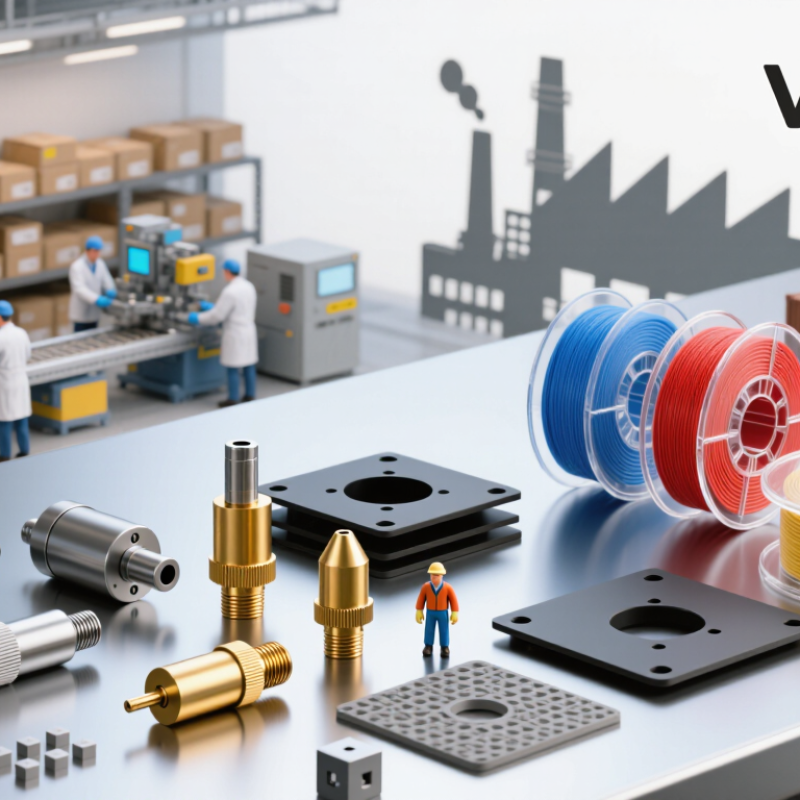
China Top 10 3D Printer Accessory Suppliers

Define 3D Printer Accessories Under ISO/ASTM 52900:2021 Terminology

ISO/ASTM 52900:2021 establishes shared terminology for additive manufacturing. It does not define “3D printer accessories” as a formal product category. This distinction matters when comparing China’s top 10 suppliers. A nozzle, heated build plate, or calibration gauge may support printing, but each has a different function.

For sourcing, describe an accessory by its role in the workflow. A nozzle deposits material; a build surface supports the first layer; a gauge helps check alignment. Some products are replacement parts, while others support process control. The standard helps buyers use consistent manufacturing terms, but it does not verify a product’s performance. Check dimensions, material compatibility, temperature range, and test data. Small details matter.

Supplier listings should separate technical descriptions from broad marketing claims. Request drawings, tolerances, and clear intended-use information. Compare each item with the printer’s process and documented requirements. “Universal” can be too vague: a different thread pitch or connector may affect fit. A catalog photo may not reveal that. Clear terminology helps, but it cannot replace sample inspection or independent quality checks.

Classify Core Parts: Nozzles, Hot Ends, Build Plates, and Filtration

China’s 3D printer accessory suppliers often focus on distinct core parts rather than offering equal depth across every category. A useful comparison separates nozzles, hot ends, build plates, and filtration components. Nozzles control the filament path and affect flow consistency. Brass suits many general-purpose jobs, while hardened materials can better tolerate abrasive filament. Small details matter. Check nozzle diameter tolerances, thread dimensions, and whether specifications match the intended printer.

Hot ends combine a heater block, heat break, thermistor, and nozzle. Their temperature range and assembly quality influence extrusion stability. Ask suppliers for material specifications and sample inspection records, not just a broad compatibility claim. Build plates also vary: spring steel, glass, and coated surfaces differ in grip, flatness, and removal behavior. A smooth first layer is useful evidence, but it does not prove long-term coating durability.

Filtration accessories may include enclosures, fans, ducts, and replaceable filter media. Compare airflow, fit, noise, and filter replacement availability; a filter label alone says little about real performance. Supplier evaluations can include production consistency, packaging protection, and response to dimensional questions. A tidy specification sheet can still omit a critical tolerance. That gap is worth discussing before ordering. Teams should test small batches under their own printing conditions, since results can vary with material, temperature, and machine setup.

Compare 10 Chinese Suppliers by Product Range, Certifications, and Capacity

China Top 10 3D Printer Accessory Suppliers

A useful comparison of ten Chinese suppliers should examine product range, documentation, and production capacity together. Accessory coverage may include hotends, nozzles, extruders, build plates, filament dryers, and motion components. Broad catalogs are convenient, but they do not prove consistent quality. Check whether each supplier lists compatible materials, dimensions, and operating temperatures. Small details matter: a nozzle’s stated tolerance can affect fit and print flow.

Review certifications carefully. Ask for current documents, issuing bodies, and the sites or product categories they cover. A quality-management certificate is not the same as a safety approval for every accessory. For capacity, request typical lead times, minimum order quantities, monthly output, and sample-production options. Paper claims can look tidy; real batch consistency is harder to judge. Compare sample parts for surface finish, dimensional fit, and packaging before relying on large-volume estimates.

Tips: Request the same sample specifications from each supplier. Compare actual lead times, not just catalog promises. Keep a record of revisions and test results. No table captures everything; supplier performance may change with order size, materials, and production schedules.

China Top 10 3D Printer Accessory Suppliers

A comparison framework for product range, certifications, and production capacity

Verified supplier-level data was not provided

Product range, certification status, and production capacity vary by supplier and require verifiable company records. Values are left blank rather than estimated or presented as factual.

Benchmark Quality with ISO 9001 and Published Tolerance and Lifetime Data

For China’s top 10 3D printer accessory suppliers, ISO 9001 is a useful starting point, not a product guarantee. It indicates a documented quality management system; it does not certify that every nozzle, bearing, or heated-bed component meets a stated tolerance. A certificate alone is not proof. Ask for a current certificate and the scope of its coverage, then check whether inspection records are traceable to the supplied part and production batch. The Wohlers Report 2024 estimated that the global additive manufacturing industry reached $20.0 billion in 2023, growing 11.1% that year. That growth makes comparable supplier evidence more valuable, though it does not establish accessory quality.

Look for published dimensional tolerances with measurement methods, sample sizes, and inspection conditions. A tolerance without a datum or temperature is hard to compare. For lifetime claims, request the tested load, operating temperature, duty cycle, failure definition, and number of samples. NIST’s Measurement Science Roadmap for Metal-Based Additive Manufacturing identifies measurement and process variability as important technical challenges; the same discipline helps buyers assess accessory data, even though the report focuses on metal production. Ask suppliers for dated test reports and revision histories. Data can still be incomplete. That is worth noting, not hiding.

Wohlers Report 2024: Global AM Revenue Reached $20.0B in 2023

Wohlers Report 2024 estimates that global additive manufacturing revenue reached $20.0 billion in 2023. This figure covers a broad industry, including printers, materials, software, and related services. It signals substantial commercial activity, but it does not mean every segment expanded at the same pace. Revenue is only one measure. The report’s estimate is useful context, not a complete picture of day-to-day demand.

For buyers assessing 3D printer accessories, this wider market matters because accessories can affect print consistency, machine upkeep, and workflow. A replacement nozzle, build plate, or filtration component may seem minor beside an industrial printer, yet it can shape operating costs over time. Small details matter. Still, the $20.0 billion figure cannot show which accessory types sold most, or how demand differed between regions and technologies. That gap is worth remembering when comparing suppliers: check material compatibility, specifications, availability, and support rather than treating market growth as proof of product quality. One caution: published revenue estimates depend on definitions and data sources, so the number should be read as an industry estimate, not a precise count of every transaction.

Copyright 2025 Fluidra S.A. | Created by BCM Marketing Agencia Privacy Policy Legal note | Cookie policy |

Technical cookies are strictly necessary for our website to work and you can navigate through it. These types of cookies are those that, for example, allow us to identify you, give you access to certain restricted parts of the page if necessary, or remember different options or services already selected by you, such as your privacy preferences. Therefore, they are activated by default, your authorization not being necessary in this regard. Through the configuration of your browser, you can block or alert the presence of this type of cookies, although such blocking will affect the proper functioning of the different functionalities of our website.


The analysis cookies allow us to study the navigation of the users of our website in general (for example, which sections of the page are the most visited, which services are used most and if they work correctly, etc.). From the statistical information on navigation on our website, we can improve both the operation of the page itself and the different services it offers. Therefore, these cookies do not have an advertising purpose, but only serve to make our website work better, adapting to our users in general. By activating them you will contribute to this continuous improvement. You can enable or disable these cookies by checking the corresponding box, being disabled by default.


Functionality cookies allow us to remember your preferences, to personalize certain characteristics and general options of our website, every time you access it (for example, the language in which the information is presented to you, the sections marked as favorites, your browser type, etc.) Therefore, this type of cookies does not have an advertising purpose, but by activating them you will improve the functionality of the website (for example, adapting to your type of browser) and the customization of it based on your preferences (for example, by presenting the information in the language that you have chosen in previous occasions), which will contribute to the ease, usability and comfort of our page during your navigation. You can enable or disable these cookies by checking the corresponding box, being disabled by default.


Advertising cookies allow us to manage the advertising spaces included in our website based on criteria such as the content shown or the frequency in which the ads are displayed. For example, if you have been shown the same ad several times on our website, and you have not shown a personal interest by clicking on it, it will not appear again. In summary, by activating this type of cookies, the advertising shown on our website will be more useful and diverse, and less repetitive. You can enable or disable these cookies by checking the corresponding box, being disabled by default.


Behavioral advertising cookies allow us to obtain information based on the observation of your browsing habits and behaviors on the web, in order to show you advertising content that best suits your personal tastes and interests. To understand it in a very simple way, we will give you a fictitious example: if your last searches on the web were related to suspense literature, we would show you advertising about suspense books. Therefore, activating this type of cookies, the advertising that we show you on our website will not be generic, but will be oriented to your searches, tastes and interests, therefore adjusting exclusively to you. You can enable or disable these cookies by checking the corresponding box, being disabled by default.
To understand it in a very simple way, we will give you a fictitious example: if your last searches on the web were related to suspense literature, we would show you advertising about suspense books. Therefore, activating this type of cookies, the advertising that we show you on our website will not be generic, but will be oriented to your searches, tastes and interests, therefore adjusting exclusively to you. You can enable or disable these cookies by checking the corresponding box, being disabled by default.

SAVE

We use our own and third-party cookies to ensure the proper functioning of the website and to analyse our services, improve your experience on our website and show you advertisements related to your interests according to profiling based on your browsing habits (e.g. websites visited). You can accept all cookies by clicking "ACCEPT" or set or reject them by clicking here. If you would like to know more about the use of cookies, please see our COOKIE POLICY.


ACCEPT ALL
Reject no essentials


