
China Best Surface Drilling Rig Manufacturer Supplier
FLUID HANDLING EXPERTS

Blog, all our news

China Best Surface Drilling Rig Manufacturer Supplier

Choosing a China Best Surface Drilling Rig Manufacturer Supplier requires more than comparing prices or catalog photographs. A reliable supplier should understand geology, production targets, maintenance planning, and operator safety. The right Surface Drilling Rig must match rock hardness, hole diameter, drilling depth, terrain, and available power. A machine working well in granite may perform poorly in fractured limestone. That difference matters.

Drilling engineer Dr. William A. Hustrulid has emphasized, “The rock mass controls the drilling process.” This practical principle remains important when evaluating Chinese manufacturers. Experienced suppliers should provide technical drawings, compressor data, drilling records, spare-parts support, and clear warranty terms. They should also explain how their rigs perform in dust, steep access roads, cold mornings, and long production shifts. Real field evidence is stronger than polished advertising.

Look closely at feed stability, crawler traction, dust collection, fuel consumption, and control-system response. Ask whether local technicians can diagnose hydraulic leaks or replace worn drill rods quickly. Request customer references from comparable mines, quarries, or construction projects. Certification and compliance documents also deserve careful review, because international requirements vary by destination.

No supplier is perfect. Even a well-built rig may need setup changes after reaching the site. A sales brochure cannot reveal every vibration, delay, or maintenance habit. Therefore, buyers should combine factory audits, site trials, operator feedback, and lifecycle cost analysis. The cheapest offer may become expensive when downtime reaches a remote worksite. A dependable China Surface Drilling Rig supplier earns trust through evidence, transparent communication, and measurable support after delivery.
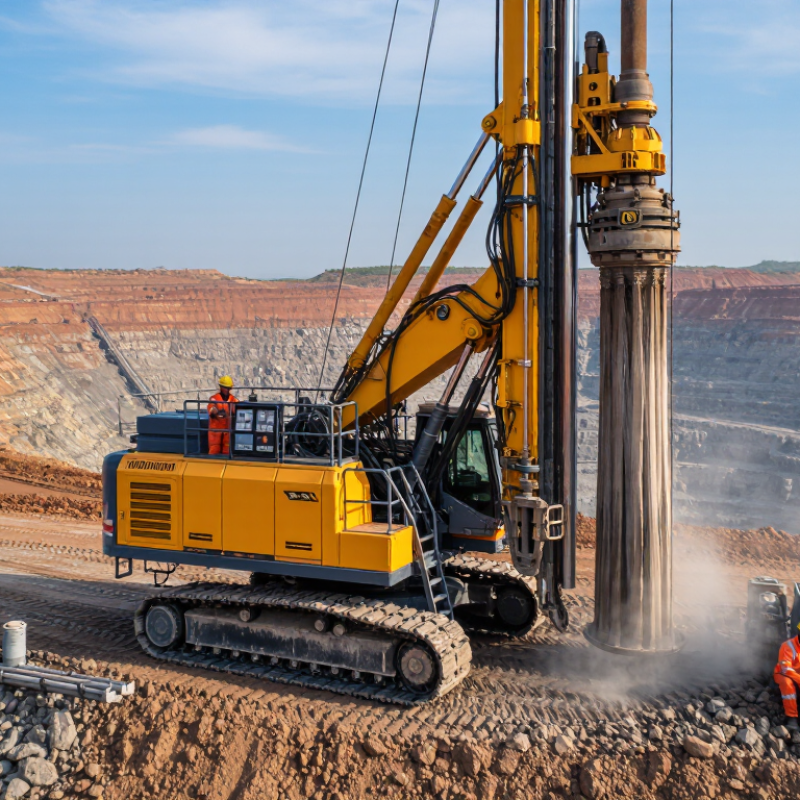
China Best Surface Drilling Rig Manufacturer Supplier

Definition and Role of Surface Drilling Rigs

Definition and Role of Surface Drilling Rigs

A surface drilling rig is a machine that creates holes from ground level. It uses rotary, down-the-hole, or top-hammer drilling methods. Operators use these rigs for construction, quarrying, mining, geotechnical surveys, and foundation preparation. The rig transfers controlled force through a drill string, while air or water removes cuttings from the borehole.

Its role is more than simply making holes. A reliable rig helps teams investigate rock layers, install anchors, collect samples, and prepare stable foundations. Experienced operators adjust feed pressure, rotation speed, and flushing flow according to ground conditions. Hard rock demands different settings from loose soil. Poor adjustment can damage tools, waste fuel, and create inaccurate boreholes. No setup is perfect. Site data can still be incomplete.

Tips: Check the ground report before selecting equipment. Match drilling depth, hole diameter, and rock strength with the rig’s specifications. Inspect hoses, rods, filters, and safety controls every shift. Keep the mast aligned. Small alignment errors may grow into costly drilling problems. Record pressure, penetration rate, and unusual vibration during operation. These notes support better maintenance and more reliable production decisions. A qualified surface drilling rig manufacturer or supplier should provide clear technical data, operator guidance, and responsive service. Ask for evidence, not promises.

Key Types of Surface Drilling Rigs in China

China Best Surface Drilling Rig Manufacturer Supplier

Key Types of Surface Drilling Rigs in China

China’s surface drilling rig market covers several practical machine types. Crawler-mounted rigs suit rough benches, open pits, and remote construction areas. Their tracks spread weight across loose ground. Truck-mounted rigs move faster between sites, especially along prepared roads. Rotary drilling rigs use torque and large drill rods for soil, limestone, and softer rock. Down-the-hole rigs deliver compressed air directly to the hammer, producing straight holes in hard formations. Hydraulic top-hammer rigs work well for quarrying, anchoring, and controlled blasting preparation.

Tips: Match the rig to rock hardness, hole diameter, depth, and working space. Check air consumption before choosing a down-the-hole model. A powerful compressor cannot fix an unsuitable hammer. Ask for test records, maintenance guidance, and spare-parts availability. These details often matter more than a low purchase price.

Experienced buyers also inspect the feed beam, hydraulic valves, dust-control system, and operator controls. A stable feed reduces rod wear and improves drilling accuracy. Dust suppression protects workers and keeps nearby equipment cleaner. Fuel use should be measured under real working conditions, not only from a brochure. A perfect machine rarely exists. I would also question impressive depth claims because ground conditions can change performance sharply. Reliable suppliers should explain these limits clearly and provide documented factory testing, safety instructions, and responsive technical support.

China Best Surface Drilling Rig Manufacturer Supplier - Key Types of Surface Drilling Rigs in China

Surface Rig Type Primary Drilling Method Typical Hole Diameter Typical Drilling Depth Common Applications Main Advantages Typical Mobility
Down-the-Hole (DTH) Crawler Rig Percussion hammer operates at the bottom of the hole using compressed air 90–305 mm 30–300 m Open-pit mining, quarrying, construction, water wells and ground anchoring Good straight-hole accuracy and effective performance in hard rock Crawler-mounted
Top-Hammer Crawler Rig Percussion energy is transmitted through drill rods to the bit 38–127 mm 10–40 m per hole Bench drilling, road construction, foundation work and small quarry operations High penetration rate in shallow-to-medium holes and compact dimensions Crawler-mounted
Rotary Blasthole Rig Rotary drilling with tricone or drag-type bits; air may be used for cuttings removal 152–406 mm 15–60 m Large open-pit mines, aggregate quarries and production blasting Suitable for large-diameter production holes and high-volume drilling Crawler or truck-mounted
Rotary-DTH Combination Rig Selectable rotary, down-the-hole percussion or combined drilling modes 115–305 mm 30–250 m Mixed geology, mining, quarrying, geothermal and infrastructure projects Flexible configuration for changing rock conditions and hole requirements Crawler-mounted
Water-Well Drilling Rig DTH, rotary mud drilling or air rotary drilling, depending on geology 100–400 mm 80–600 m Agricultural wells, municipal water supply, industrial wells and geothermal exploration Long mast options, adaptable drilling systems and deep-hole capability Crawler, truck or trailer-mounted
Reverse Circulation (RC) Exploration Rig Dual-wall rods circulate air to return rock samples through the inner tube 100–165 mm 150–500 m Mineral exploration, grade-control drilling and near-surface resource evaluation Fast sample return with generally lower contamination than conventional air drilling Crawler or truck-mounted
Anchor and Bolting Rig Top-hammer or rotary-percussive drilling with single or double drill rods 30–180 mm 5–40 m Slope stabilization, foundation anchoring, tunneling and retaining structures Compact design, precise positioning and suitability for confined work areas Crawler-mounted
Geothermal Drilling Rig Rotary, DTH or rotary-percussive drilling with air, water or drilling mud circulation 150–350 mm 100–500 m Ground-source heat pump systems, geothermal wells and thermal-energy projects Designed for sustained deep drilling and varied circulation requirements Crawler or truck-mounted

Note: Performance ranges are typical industry reference values. Actual hole diameter, drilling depth, penetration rate and configuration depend on rock conditions, rig specifications, tooling, compressor capacity and project requirements.

Core Technologies and Performance Features

China Best Surface Drilling Rig Manufacturer Supplier

Core Technologies and Performance Features

Surface drilling rigs now demand more than high torque. They must control dust, fuel use, vibration, and downtime across changing rock conditions. MarketsandMarkets estimated the global drilling equipment market would grow at about 5% annually through 2028, driven by mining and infrastructure investment. This trend favors machines with flexible power systems and accurate drilling controls.

A reliable rig combines a high-pressure hydraulic circuit, a durable rotary head, and a matched air compressor. These systems support stable penetration in hard rock and reduce tool wear. Down-the-hole drilling can improve hole accuracy, especially when operators manage feed pressure carefully. Small details matter. A sealed boom joint, for example, can protect alignment during long shifts.

Data systems are becoming practical, not decorative. Remote monitoring can record engine load, compressor pressure, fuel consumption, and drilling depth. The Global Mining Guidelines Group promotes interoperable digital standards, while Deloitte’s 2024 mining technology review links connected equipment with better maintenance decisions. Dust suppression also deserves attention, because airborne silica remains a serious occupational hazard. Water mist systems help, but they can waste water in dry regions. That weakness needs honest engineering review. Field experience still shows that operator training, maintenance discipline, and local spare-part access often decide real productivity more than brochure specifications.

How to Evaluate a Chinese Drilling Rig Manufacturer

Choosing the China best surface drilling rig manufacturer requires evidence beyond a polished factory tour. I would inspect at least three operating machines, not only showroom units. Ask for drilling depth, torque, fuel use, compressor output, and failure records under similar rock conditions. A useful benchmark comes from the Global Off-Highway Vehicle Market report, which highlights rising demand for efficient, lower-emission construction equipment. Efficiency must be measured in real production hours, not brochure claims.

Check the manufacturer’s quality system and traceability. ISO 9001 certification is useful, but it does not prove every hydraulic valve will survive harsh sites. Request serial-number records, weld inspection reports, pressure-test results, and component warranty terms. The International Trade Centre’s trade data shows China is a major exporter of machinery, yet export volume alone says little about after-sales performance. Ask how many technicians support your region and how quickly critical parts can arrive. Silence is a warning.

Review independent test documentation for noise, emissions, safety guards, and electrical protection. European and international machinery standards can provide a stronger comparison than vague “CE-ready” language. Also examine the total cost over five years, including drill pipes, filters, downtime, training, and transport. I have seen buyers focus on purchase price and later regret weak service planning. The evaluation is not perfect. Site geology, operator skill, and maintenance habits can change results dramatically. Get references from comparable mines or construction projects, then contact them directly.

Applications, Safety Standards, and After-Sales Support

Surface drilling rigs serve quarries, open-pit mines, construction sites, and foundation projects. They drill through rock, soil, and mixed ground conditions. Choosing the correct rig depends on hole diameter, drilling depth, terrain, and production targets. An experienced operator also checks transport access, water availability, and dust control before work begins. Small details matter.

Safety must guide every operating decision. A reliable rig should support risk assessment practices aligned with ISO 12100 and applicable local regulations. Guards should cover moving parts, while emergency stops remain easy to reach. Operators need training in machine controls, ground stability, compressed air, and personal protective equipment. Dust suppression protects workers near the drill point. Noise protection matters too. Regular inspections should cover hoses, drill rods, brakes, alarms, and hydraulic leaks.

After-sales support becomes critical when production cannot wait. Suppliers should provide clear manuals, training, maintenance schedules, and accessible technical assistance. Spare parts planning reduces downtime, especially for wear items such as drill bits, seals, filters, and hoses. Remote fault diagnosis can identify simple issues quickly, while field technicians handle complex repairs. Response times should be written into service agreements. No system is flawless. A checklist may still be missed during a busy shift, so honest reporting and repeated training remain necessary. Customer feedback should influence future maintenance guidance and equipment improvements.

Copyright 2025 Fluidra S.A. | Created by BCM Marketing Agencia Privacy Policy Legal note | Cookie policy |

Technical cookies are strictly necessary for our website to work and you can navigate through it. These types of cookies are those that, for example, allow us to identify you, give you access to certain restricted parts of the page if necessary, or remember different options or services already selected by you, such as your privacy preferences. Therefore, they are activated by default, your authorization not being necessary in this regard. Through the configuration of your browser, you can block or alert the presence of this type of cookies, although such blocking will affect the proper functioning of the different functionalities of our website.


The analysis cookies allow us to study the navigation of the users of our website in general (for example, which sections of the page are the most visited, which services are used most and if they work correctly, etc.). From the statistical information on navigation on our website, we can improve both the operation of the page itself and the different services it offers. Therefore, these cookies do not have an advertising purpose, but only serve to make our website work better, adapting to our users in general. By activating them you will contribute to this continuous improvement. You can enable or disable these cookies by checking the corresponding box, being disabled by default.


Functionality cookies allow us to remember your preferences, to personalize certain characteristics and general options of our website, every time you access it (for example, the language in which the information is presented to you, the sections marked as favorites, your browser type, etc.) Therefore, this type of cookies does not have an advertising purpose, but by activating them you will improve the functionality of the website (for example, adapting to your type of browser) and the customization of it based on your preferences (for example, by presenting the information in the language that you have chosen in previous occasions), which will contribute to the ease, usability and comfort of our page during your navigation. You can enable or disable these cookies by checking the corresponding box, being disabled by default.


Advertising cookies allow us to manage the advertising spaces included in our website based on criteria such as the content shown or the frequency in which the ads are displayed. For example, if you have been shown the same ad several times on our website, and you have not shown a personal interest by clicking on it, it will not appear again. In summary, by activating this type of cookies, the advertising shown on our website will be more useful and diverse, and less repetitive. You can enable or disable these cookies by checking the corresponding box, being disabled by default.


Behavioral advertising cookies allow us to obtain information based on the observation of your browsing habits and behaviors on the web, in order to show you advertising content that best suits your personal tastes and interests. To understand it in a very simple way, we will give you a fictitious example: if your last searches on the web were related to suspense literature, we would show you advertising about suspense books. Therefore, activating this type of cookies, the advertising that we show you on our website will not be generic, but will be oriented to your searches, tastes and interests, therefore adjusting exclusively to you. You can enable or disable these cookies by checking the corresponding box, being disabled by default.
To understand it in a very simple way, we will give you a fictitious example: if your last searches on the web were related to suspense literature, we would show you advertising about suspense books. Therefore, activating this type of cookies, the advertising that we show you on our website will not be generic, but will be oriented to your searches, tastes and interests, therefore adjusting exclusively to you. You can enable or disable these cookies by checking the corresponding box, being disabled by default.

SAVE

We use our own and third-party cookies to ensure the proper functioning of the website and to analyse our services, improve your experience on our website and show you advertisements related to your interests according to profiling based on your browsing habits (e.g. websites visited). You can accept all cookies by clicking "ACCEPT" or set or reject them by clicking here. If you would like to know more about the use of cookies, please see our COOKIE POLICY.


ACCEPT ALL
Reject no essentials


