
China Best PCB Conveyor Manufacturer for Global Buyers?
FLUID HANDLING EXPERTS

Blog, all our news

China Best PCB Conveyor Manufacturer for Global Buyers?

Choosing China’s best PCB Conveyor manufacturer requires more than comparing prices or catalog photos. Buyers should examine board-width range, transfer accuracy, line-speed control, ESD handling, and compatibility with existing SMT equipment. A useful machine should move a panel steadily, without jolts, while operators can reach adjustment points and emergency stops easily. Small details matter.

A fictional composite process engineer, Lin Wei, puts the principle this way: “A conveyor earns trust when every board arrives aligned, at the right speed, shift after shift.” This is an illustrative quotation, not a verified statement from a named industry expert. It reflects a practical evaluation standard: ask manufacturers for test records, factory acceptance procedures, spare-parts lead times, and clear answers about installation support. Request a demonstration using representative boards when possible. A smooth empty-belt test proves little.

For global buyers, the strongest supplier is not automatically the largest or cheapest. Look for documented quality controls, responsive technical communication, and options that fit the actual production line. Confirm dimensions, interface requirements, and expected throughput before approving specifications. Then check how the supplier handles faults, training, and replacement parts. These steps reduce avoidable surprises, though they cannot remove every risk. Sometimes the overlooked cable route or awkward access panel becomes the daily frustration. This guide explores how to compare Chinese PCB Conveyor manufacturers with evidence, practical questions, and realistic expectations.
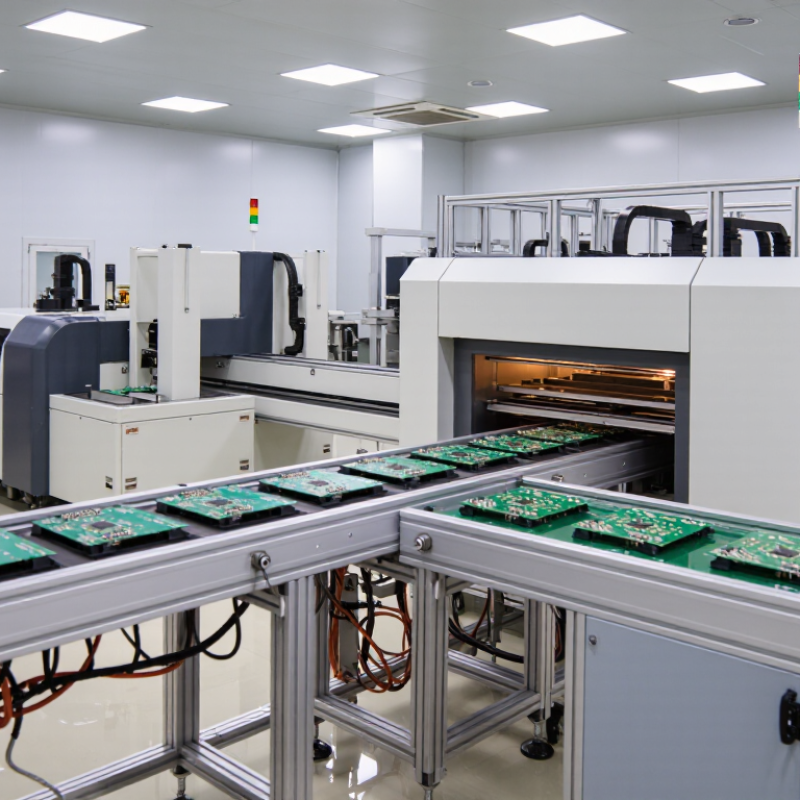
China Best PCB Conveyor Manufacturer for Global Buyers?

What Is a PCB Conveyor and How Is It Used in Electronics Manufacturing?

A PCB conveyor moves printed circuit boards between machines on a surface-mount technology line. It may connect solder-paste printing, component placement, reflow, and inspection stations. Adjustable side rails guide each board, while sensors control entry and exit. Some models also provide a short buffer when one machine runs slower than the next. Small details matter: board width, transfer height, edge clearance, and electrostatic-discharge protection must suit the line. A tilted or poorly aligned board can interrupt production.

Automation is growing, but a conveyor is only one part of the system. The International Federation of Robotics’ World Robotics 2024 report counted 4.28 million industrial robots operating worldwide in 2023. WSTS’s Fall 2024 forecast projected global semiconductor sales of $697.2 billion in 2025, an 11.2% rise. These figures describe broader manufacturing demand, not conveyor sales. For buyers, useful checks include transfer accuracy, speed adjustment, compatible control signals, and access for cleaning and maintenance. Ask how the unit handles narrow boards and frequent product changeovers. A faster line is not automatically a better line; poor buffering can simply move the bottleneck downstream.

Which Types of PCB Conveyors Do Chinese Manufacturers Offer?

Chinese PCB conveyor manufacturers offer several formats for different points in an SMT production line. A magazine loader transfers bare boards onto the line, while an unloader collects processed boards into magazines. Both use adjustable rails and controlled pushers to handle different board widths. Small details matter.

Link conveyors move PCBs between machines, such as a printer and a placement machine. Inspection conveyors provide a stable area for visual checks, often with lighting and a work surface. Buffer conveyors hold boards temporarily when neighboring machines run at different speeds. Turn conveyors rotate boards to change their travel direction, while reject units divert boards that need review. Not every factory needs every type.

For compact lines, manufacturers may offer lift or pass-through conveyors that move boards between levels or across work areas. Cooling conveyors give freshly processed boards time to settle before the next operation. Ask about rail adjustment, conveyor speed, board thickness, and signal compatibility before choosing a model. A catalog photo rarely shows how easy cleaning or changeovers are. I would verify those points with a sample run; specifications alone can miss awkward setup steps.

Which Types of PCB Conveyors Do Chinese Manufacturers Offer?

Common options for SMT production lines include magazine loaders and unloaders, link conveyors, inspection conveyors, buffer conveyors, turn conveyors, and cooling conveyors.

The numbered positions show an illustrative SMT-line sequence, not market-share data or a fixed production layout. Conveyor selection and placement depend on the line configuration and process requirements.

How to Evaluate a Chinese PCB Conveyor Manufacturer

Choosing a Chinese PCB conveyor manufacturer starts with the production line, not the catalogue. Share board dimensions, weight, required throughput, and neighboring machine heights before comparing quotes. Ask how belt speed is adjusted, how guide rails are aligned, and what happens when a board jams. Small details matter. Request a sample layout and a recorded acceptance test using boards close to your own. Check whether operators can reach controls without leaning over moving parts. A polished demonstration can hide awkward changeovers. A recorded test helps, but it cannot fully reproduce your actual board mix.

Evaluate engineering evidence, not confident wording. Look for drawings with tolerances, wiring information, spare-parts lists, and clear installation requirements. Ask who handles commissioning, what response time is realistic, and which components may have long lead times. If possible, inspect a working unit or arrange a live video call from the assembly floor. Watch a board transfer across each gap. Does it pause, tilt, or scrape? Talk with a recent buyer, while remembering that one reference may not reflect every order. Compare the written warranty and acceptance criteria carefully; vague promises are difficult to verify later. Price matters, though a low-cost conveyor that disrupts production can prove expensive.

What Should Global Buyers Check Before Placing an Order?

Before ordering a PCB conveyor, confirm its working width, board thickness range, transfer height, and edge clearance against your actual production line. Check whether it connects cleanly with upstream and downstream machines, including compatible control signals and conveyor direction. Small details matter. Ask for drawings, electrical specifications, spare-parts lists, and a written acceptance test. A polished demonstration can still hide sensor delays or unstable board transfers.

The International Federation of Robotics reported 162 industrial robots per 10,000 manufacturing employees worldwide in 2023 in its World Robotics 2024 report. That figure reflects broader factory automation, not PCB conveyor performance, but it highlights why line integration deserves careful review. Request a factory acceptance test using boards close to your real minimum and maximum sizes. Run the actual board. Watch for skew, jams, surface contact, and inconsistent stopping at the handoff point.

Also verify frame rigidity, belt or chain material, sensor positioning, noise levels, and access for cleaning and maintenance. Ask how faults are displayed and whether operators can adjust speed safely. Clarify installation support, delivery terms, warranty coverage, and the response time for technical help in your region. If the supplier cannot provide a clear test record, pause before paying. Paperwork is not a perfect predictor; it is still better than guessing.

How Do Installation, Compliance, and After-Sales Support Affect Supplier Choice?

For global buyers, a PCB conveyor supplier should be judged by more than its quoted price. Installation planning affects how smoothly equipment joins an existing production line. Share the line height, available floor space, board dimensions, and target speed before confirming a design. A practical supplier will check clearances and cable routes, not just send a machine drawing. Small details matter. Ask who supervises installation, what tools are needed, and whether operators receive hands-on training. A missed height adjustment can cause board transfers to snag.

Compliance also needs specific questions. Request electrical documentation, material information, and safety features relevant to the destination market. Check that documents match the delivered configuration; a generic file may not answer an auditor’s questions. After-sales support is equally concrete. Confirm response hours, spare-part availability, troubleshooting channels, and warranty terms in writing. Ask how quickly common parts, such as sensors or belts, can be supplied. Still, even a careful checklist cannot predict every awkward corner in a real factory. Buyers should leave time for commissioning adjustments and keep notes on recurring faults. A supplier’s honest account of limitations may be more useful than a promise of effortless operation.

China Best PCB Conveyor Manufacturer for Global Buyers? - How Do Installation, Compliance, and After-Sales Support Affect Supplier Choice?

Supplier evaluation matrix. Suggested scoring weights are a starting point for buyers, not industry benchmarks; adjust them to the project and destination market.

Evaluation dimension Suggested weight Evidence to request How the buyer can verify it Why it affects supplier choice
Line and PCB compatibility 20% Equipment drawings and specifications covering conveyor width, transfer height, board dimensions and weight, direction of travel, line speed, and control interfaces. Compare the supplier’s drawings and limits with the existing SMT line layout and the PCB range in the production plan. Confirm interface details with adjacent equipment suppliers. A conveyor must fit the line physically and handle the intended boards and production conditions; compatibility should be confirmed before ordering.
Installation planning and commissioning 20% Installation requirements, site-preparation checklist, utility requirements, leveling and alignment instructions, commissioning procedure, and the division of work between supplier and buyer. Request a written installation plan that identifies prerequisites, responsible parties, expected activities, and the acceptance checks to be completed after installation. Clear preparation and commissioning responsibilities help avoid delays, interface issues, and disagreements about whether the equipment is ready for production.
Destination-market compliance 20% A list of applicable requirements for the destination and product configuration, relevant declarations or certificates, equipment labels, and safety documentation. Confirm the applicable rules with the importer or qualified compliance professional. Check that documents identify the supplied model and match its configuration. For EU machinery, verify which legal requirements apply at the time the product is placed on the market. Requirements depend on the destination, product design, and market-placement date. A document should not be assumed to cover every country or configuration.
Electrical safety, EMC, and ESD needs Included in compliance review Electrical schematics, safety-device details, grounding instructions, and any relevant electromagnetic-compatibility or electrostatic-discharge documentation for the offered configuration. Review documentation against the project’s electrical installation and ESD-control requirements; obtain confirmation from the supplier for the exact options included. Electrical and ESD requirements vary by site and application. Verification helps identify missing protections or documentation before shipment and installation.
After-sales service and spare parts 20% Warranty terms, support channels and hours, escalation process, spare-parts list, parts availability terms, and written targets for response and resolution. Put service coverage, response targets, warranty exclusions, and parts arrangements in the contract. Ask who provides support in the buyer’s time zone and language. Response times and service coverage are supplier-specific; written commitments make support expectations clearer for overseas buyers.
Documentation and operator training 10% Operation and maintenance manuals, troubleshooting guidance, parts diagrams, training format, and available document languages. Review a sample manual and training outline before purchase; confirm delivery format and language for the intended operators and maintenance staff. Usable documentation and training support safe operation, routine maintenance, and faster diagnosis of common issues.
Quality-system evidence and acceptance criteria 10% Applicable quality-management-system certificate, inspection records, test procedure, and agreed factory or site acceptance criteria. Check the certificate’s scope, validity, and issuing body. Define measurable equipment acceptance checks in the purchase documents; do not treat a quality-system certificate as product approval. Quality-system evidence concerns the manufacturer’s management processes; separate product and destination-market requirements still need to be checked.
Copyright 2025 Fluidra S.A. | Created by BCM Marketing Agencia Privacy Policy Legal note | Cookie policy |

Technical cookies are strictly necessary for our website to work and you can navigate through it. These types of cookies are those that, for example, allow us to identify you, give you access to certain restricted parts of the page if necessary, or remember different options or services already selected by you, such as your privacy preferences. Therefore, they are activated by default, your authorization not being necessary in this regard. Through the configuration of your browser, you can block or alert the presence of this type of cookies, although such blocking will affect the proper functioning of the different functionalities of our website.


The analysis cookies allow us to study the navigation of the users of our website in general (for example, which sections of the page are the most visited, which services are used most and if they work correctly, etc.). From the statistical information on navigation on our website, we can improve both the operation of the page itself and the different services it offers. Therefore, these cookies do not have an advertising purpose, but only serve to make our website work better, adapting to our users in general. By activating them you will contribute to this continuous improvement. You can enable or disable these cookies by checking the corresponding box, being disabled by default.


Functionality cookies allow us to remember your preferences, to personalize certain characteristics and general options of our website, every time you access it (for example, the language in which the information is presented to you, the sections marked as favorites, your browser type, etc.) Therefore, this type of cookies does not have an advertising purpose, but by activating them you will improve the functionality of the website (for example, adapting to your type of browser) and the customization of it based on your preferences (for example, by presenting the information in the language that you have chosen in previous occasions), which will contribute to the ease, usability and comfort of our page during your navigation. You can enable or disable these cookies by checking the corresponding box, being disabled by default.


Advertising cookies allow us to manage the advertising spaces included in our website based on criteria such as the content shown or the frequency in which the ads are displayed. For example, if you have been shown the same ad several times on our website, and you have not shown a personal interest by clicking on it, it will not appear again. In summary, by activating this type of cookies, the advertising shown on our website will be more useful and diverse, and less repetitive. You can enable or disable these cookies by checking the corresponding box, being disabled by default.


Behavioral advertising cookies allow us to obtain information based on the observation of your browsing habits and behaviors on the web, in order to show you advertising content that best suits your personal tastes and interests. To understand it in a very simple way, we will give you a fictitious example: if your last searches on the web were related to suspense literature, we would show you advertising about suspense books. Therefore, activating this type of cookies, the advertising that we show you on our website will not be generic, but will be oriented to your searches, tastes and interests, therefore adjusting exclusively to you. You can enable or disable these cookies by checking the corresponding box, being disabled by default.
To understand it in a very simple way, we will give you a fictitious example: if your last searches on the web were related to suspense literature, we would show you advertising about suspense books. Therefore, activating this type of cookies, the advertising that we show you on our website will not be generic, but will be oriented to your searches, tastes and interests, therefore adjusting exclusively to you. You can enable or disable these cookies by checking the corresponding box, being disabled by default.

SAVE

We use our own and third-party cookies to ensure the proper functioning of the website and to analyse our services, improve your experience on our website and show you advertisements related to your interests according to profiling based on your browsing habits (e.g. websites visited). You can accept all cookies by clicking "ACCEPT" or set or reject them by clicking here. If you would like to know more about the use of cookies, please see our COOKIE POLICY.


ACCEPT ALL
Reject no essentials


