
China Best MCB Inspection Conveyor Price and Supplier
FLUID HANDLING EXPERTS

Blog, all our news

China Best MCB Inspection Conveyor Price and Supplier

China’s Mcb Inspection Conveyor market is evolving with factory automation, traceable quality control, and tighter production targets. The International Federation of Robotics reported 541,302 industrial robots installed worldwide in 2023. That figure signals stronger demand for connected inspection equipment.

An Mcb Inspection Conveyor can guide miniature circuit breakers through vision checks, terminal verification, label reading, and reject handling. A typical line may include stainless-steel rails, servo indexing, photoelectric sensors, and adjustable nests. Small alignment errors matter. They can distort camera results or damage breaker housings.

Quality expert W. Edwards Deming stated, “Quality comes not from inspection, but from the improvement of the production process.” His principle remains highly relevant here. Inspection should support stable assembly, not hide weak process control.

Price alone is an incomplete buying measure. Conveyor speed, camera resolution, PLC brand, fixture precision, software traceability, and after-sales support can change the final cost significantly. Chinese suppliers may offer competitive pricing, but their technical depth varies. Ask for sample testing, cycle-time evidence, spare-parts lists, and acceptance criteria.

A lower quotation can still become expensive. Downtime exposes that weakness quickly. Conversely, premium equipment is not automatically better.

This article compares China’s Mcb Inspection Conveyor suppliers through practical criteria, including inspection accuracy, customization, delivery capability, documentation, and total ownership cost. The comparison is not perfect; supplier specifications are sometimes difficult to verify independently. Buyers should request factory videos, test reports, and reference installations before choosing a long-term partner.
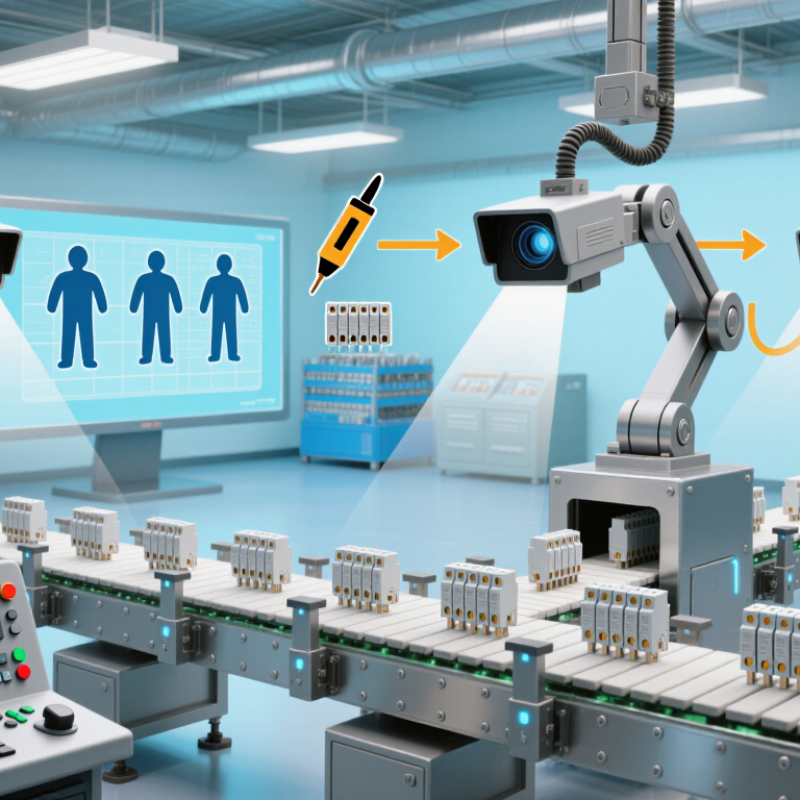
China Best MCB Inspection Conveyor Price and Supplier

MCB Inspection Conveyor: Definition, Purpose, and Main Functions

An MCB inspection conveyor is an integrated line that moves miniature circuit breakers through controlled inspection points. MCB means miniature circuit breaker. The conveyor usually combines indexing belts, nests, sensors, cameras, electrical testers, and reject units. Its purpose is simple: keep each breaker stable while checking assembly quality, markings, terminals, and switching movement.

Modern lines can inspect more consistently than manual handling. According to the International Federation of Robotics, World Robotics 2024 recorded 541,302 industrial robot installations worldwide in 2023. This growth supports greater demand for connected inspection equipment. However, automation does not remove every risk. A loose terminal, poor camera angle, or dusty sensor can still create false results. Operators should verify sample parts during every shift.

Main functions include precise positioning, barcode or model identification, visual inspection, electrical testing, data recording, and automatic separation of defective units. A practical conveyor may use adjustable guides for different MCB sizes, stopping each product beneath a camera for a clear image. The supplier should explain cycle time, inspection accuracy, changeover time, spare parts, and service response. Price should include tooling, software, installation, training, and future maintenance. A low quotation may hide expensive integration work. ISO 12100 risk assessment and IEC 60204-1 electrical safety requirements should guide the technical review. The imperfect part is unavoidable: inspection limits must be tested with real production variation, not only clean samples.

How MCB Inspection Conveyors Work in Circuit Breaker Production

How MCB Inspection Conveyors Work in Circuit Breaker Production

An MCB inspection conveyor moves miniature circuit breakers through controlled production stations. Each unit enters on a guided belt or indexing chain. Side rails keep the housings aligned. A sensor detects the product position before inspection begins. The conveyor then stops briefly, allowing cameras and testing probes to work accurately. This repeated motion reduces manual handling and helps maintain consistent spacing.

A typical system checks housing appearance, terminal position, label placement, and assembly quality. Electrical stations may verify continuity, insulation, or trip-related performance, depending on the production plan. A PLC coordinates sensors, actuators, test signals, and product tracking. If one breaker fails, a pneumatic device removes it into a separate tray. Data can record the inspection result, time, and station number. Small details matter.

In practical installations, conveyor price depends on speed, inspection modules, frame material, controls, and customization. A reliable supplier should provide layout drawings, sample testing, safety documentation, and clear maintenance guidance. Ask how rejected products are identified and how calibration is managed. These questions reveal more than a low quotation. No production line is perfect. Dust, vibration, or loose guides can create false failures. I have seen alignment problems imitate electrical defects. Regular cleaning and careful sensor adjustment often prevent expensive troubleshooting, although every line still needs periodic review.

Key Features to Compare When Choosing an MCB Inspection Conveyor

China Best MCB Inspection Conveyor Price and Supplier

When comparing an MCB inspection conveyor, start with inspection accuracy, not the quoted price. The system should detect missing labels, damaged housings, loose terminals, and incorrect assembly positions. IEC 60898-1 provides relevant performance requirements for circuit-breakers, but conveyor acceptance still needs practical factory testing. Ask suppliers for sample results, false-rejection rates, and inspection repeatability. Small errors matter.

Speed must match the real production rhythm. A line rated at 120 units per minute may perform differently after adding cameras, lighting, and reject devices. The International Federation of Robotics reported 541,302 industrial robot installations in 2023, showing stronger demand for automated production. That trend also increases the need for stable communication between conveyors, sensors, and inspection software. Check indexing accuracy, belt vibration, changeover time, and emergency-stop access. Good lighting is often overlooked.

Traceability is another key comparison. Deloitte’s 2024 Smart Manufacturing and Operations Survey found that 86% of manufacturers view smart manufacturing as important to competitiveness. Therefore, the conveyor should record inspection images, product codes, fault types, and operator actions. Stainless steel contact areas, guarded moving parts, and easy-clean surfaces support safer maintenance. I would not trust a supplier using only factory videos. Request a site acceptance test, maintenance records, spare-part availability, and a clear warranty. The lowest purchase price can hide costly calibration work. Supplier reliability needs evidence, not confident promises.

China Best MCB Inspection Conveyor Price and Supplier - Key Features to Compare When Choosing an MCB Inspection Conveyor

Indicative industry specifications and price ranges for automatic MCB inspection conveyors. Actual values depend on inspection stations, product configuration, automation level, and required compliance.
Comparison Dimension Typical Market Range or Requirement Recommended Selection Benchmark Why It Matters
Indicative Equipment Price Approximately USD 8,000–30,000 for a conveyor-based inspection system, excluding customized tooling, shipping, installation, and taxes. Request a complete quotation that separately lists conveyor, vision system, tooling, software, commissioning, spare parts, and after-sales service. A low initial price may exclude important inspection functions or integration costs.
Conveyor Speed Commonly 10–40 m/min for controlled part handling and inline inspection. Choose a speed that meets the required cycle time while maintaining stable product positioning and image quality. Excessive speed can cause vibration, blurred images, missed defects, and unstable rejection timing.
Throughput Typically 30–120 pieces/min, depending on the number of inspection points and MCB model. Confirm the tested throughput using the actual MCB size, orientation, and inspection sequence. Nominal conveyor speed does not equal finished-product inspection capacity.
Product Compatibility Commonly supports single-pole, double-pole, three-pole, and four-pole MCB configurations with dedicated fixtures. Select quick-change tooling or adjustable guides when multiple pole counts or product sizes are required. Flexible tooling reduces changeover time and prevents incorrect product positioning.
Inspection Items Typical checks include housing appearance, terminal presence, screw position, toggle position, label or marking, clips, cracks, burrs, and assembly completeness. Verify that the system can inspect every required defect category with documented sample images. A system designed only for appearance inspection may not verify assembly or functional conditions.
Vision Resolution Industrial cameras commonly use 2–12 megapixels, depending on field of view and defect size. Match camera resolution and lens selection to the smallest defect that must be detected, rather than selecting by megapixels alone. Lighting, lens quality, contrast, and product stability affect detection performance as much as camera resolution.
Inspection Accuracy A well-configured vision station may achieve 98%–99.9% classification accuracy, but results depend on defect definition and sample quality. Require a factory acceptance test using qualified samples, known defects, good products, and agreed false-reject limits. Accuracy claims are meaningful only when the test conditions and defect standards are clearly defined.
Lighting System LED bar, ring, coaxial, dome, or backlight illumination may be used according to the surface and defect type. Choose adjustable, diffuse, and replaceable LED lighting with controlled intensity. Stable lighting improves image consistency and reduces false rejects caused by reflections or shadows.
Reject Mechanism Common options include pneumatic cylinders, air jets, servo pushers, and diverter gates. Use a reject device with position feedback, reject confirmation, and a segregated nonconforming-product container. Reject confirmation helps prevent defective MCBs from continuing into packing or shipment.
Positioning Repeatability Typical mechanical positioning repeatability is approximately ±0.1–0.5 mm, depending on tooling and conveyor design. Specify the repeatability required by the smallest inspection feature and validate it with repeated production samples. Consistent positioning is essential for reliable image comparison and precise rejection.
Frame and Conveyor Materials Powder-coated steel or anodized aluminum frames; stainless steel contact parts are commonly used where cleanliness or corrosion resistance is important. Select rigid construction, low-vibration supports, and wear-resistant belts or fixtures. Mechanical rigidity supports stable inspection and reduces maintenance caused by belt or frame deformation.
Control System PLC-based control with an industrial computer or vision controller is widely used. Require recipe management, alarm history, user permissions, production statistics, and image storage for rejected parts. Traceable data makes troubleshooting, quality audits, and model changeovers easier.
Data and Communication Common interfaces include Ethernet, digital I/O, Modbus TCP, OPC UA, and barcode or QR-code readers. Confirm compatibility with the existing line PLC, MES, traceability system, and production database. Compatible communication prevents manual data entry and supports production traceability.
Electrical Supply Industrial equipment commonly uses 220–240 V AC or 380–415 V AC, 50/60 Hz, depending on the machine design and destination. Specify the installation site's voltage, frequency, phase configuration, and applicable electrical standards before ordering. Correct electrical configuration reduces commissioning delays and modification costs.
Compressed Air Requirement Pneumatic rejection systems commonly require approximately 0.5–0.7 MPa clean, dry compressed air. Confirm air consumption, filtration requirements, noise level, and whether the machine includes pressure monitoring. Insufficient or contaminated air can cause inconsistent rejection and premature valve failure.
Machine Footprint A basic inspection conveyor may occupy approximately 1.5–3.5 m in length and 0.6–1.2 m in width, excluding upstream and downstream equipment. Request a general arrangement drawing showing maintenance clearance, operator access, loading height, and discharge height. Available floor space and line height often determine whether integration is practical.
Safety Features Typical safeguards include emergency stops, protective covers, interlocked access doors, warning indicators, and overload protection. Require a documented risk assessment and safety circuit suitable for the installation country. Safety design protects operators and supports compliance with applicable machinery requirements.
Changeover Time Manual fixture changeovers commonly take 10–30 minutes; quick-change tooling can reduce this time. Prefer guided fixtures, parameterized recipes, tool identification, and clear changeover instructions. Shorter changeovers improve utilization when several MCB models are produced on the same line.
Acceptance Testing A formal FAT and on-site SAT should cover throughput, detection capability, false rejects, reject confirmation, safety, and data records. Agree on measurable acceptance criteria before purchase and use customer-approved samples. Clear acceptance criteria reduce disputes and establish an objective basis for final payment.
Warranty and Technical Support Industrial automation warranties commonly cover approximately 12 months from shipment or commissioning, subject to contract terms. Compare response time, remote diagnosis, spare-parts availability, software support, manuals, training, and local service capability. Responsive support reduces downtime and protects the long-term value of the inspection conveyor.

MCB Inspection Conveyor Price Factors in China

China Best MCB Inspection Conveyor Price and Supplier

MCB inspection conveyor prices in China depend on more than frame size. Conveyor length, indexing accuracy, inspection stations, and electrical integration often create the largest cost differences. A basic line may use visual checks and manual loading. An advanced system can include cameras, barcode readers, servo positioning, insulation testing, and automatic rejection. Every added station increases programming, calibration, and commissioning time.

Automation demand also affects supplier capacity. The International Federation of Robotics reported 276,288 industrial robot installations in China during 2023, representing about 51% of global installations. This indicates strong local automation capability, but it does not guarantee a low quotation. Skilled engineering hours remain expensive. The supplier’s inspection software, spare-part stock, and response distance also influence the total price. Small details matter.

A reliable quotation should identify cycle time, product range, accuracy, and acceptance testing. For example, a conveyor handling 30 MCBs per minute needs different feeding and buffering than one handling 12 units. IEC 60947-2 requirements can influence test equipment and safety design. ISO 9001 certification supports process control, but certification alone cannot prove machine performance. Request sample test records, camera images, rejection data, and a written warranty. A cheap quote may omit fixtures or future format changes. That is a common weakness. The better approach is comparing total ownership cost, not only the initial price.

China MCB Inspection Conveyor Price Factors

Indicative share of total equipment cost for a standard automated MCB inspection conveyor

The estimated cost structure shows that automation and control systems, machine-vision inspection, and conveyor mechanics are the main price drivers. Final pricing varies with inspection points, production speed, rejection requirements, customization, installation, and testing scope. These percentages are practical planning estimates rather than quotations from a specific supplier.

How to Select a Reliable Chinese MCB Inspection Conveyor Supplier

Selecting a reliable Chinese MCB inspection conveyor supplier requires more than comparing the lowest price. Check whether the supplier understands your MCB dimensions, testing points, cycle time, and rejection requirements. Ask for layout drawings, electrical schematics, inspection records, and a clear quotation. A dependable supplier should explain sensor accuracy, PLC controls, conveyor materials, and safety protection in practical terms.

Request a sample test before signing the contract. Send several MCB samples with different terminal positions and surface conditions. Review inspection results, rejection timing, and production speed. During a factory audit, examine wiring quality, calibration tools, spare-part storage, and operator training. Factory acceptance testing is essential. However, video demonstrations are not enough. A polished video can hide unstable performance. This is an easy mistake to make. Confirm installation support, response time, warranty coverage, and software access in writing. Also check whether replacement sensors are available without long delays.

Tips: Compare complete operating costs, not only the machine price. Ask for three-year estimates covering energy, maintenance, spare parts, and downtime. A slightly higher quotation may provide better stability and documentation. Still, expensive equipment is not automatically reliable. Insist on measurable standards, such as inspection accuracy, throughput, and repeatability. Keep communication records and clarify who pays for modifications. One overlooked detail can affect the whole line. Supplier references are useful, but recent production evidence matters more. Allow room for improvement, because the first specification may not fit real factory conditions perfectly.

Copyright 2025 Fluidra S.A. | Created by BCM Marketing Agencia Privacy Policy Legal note | Cookie policy |

Technical cookies are strictly necessary for our website to work and you can navigate through it. These types of cookies are those that, for example, allow us to identify you, give you access to certain restricted parts of the page if necessary, or remember different options or services already selected by you, such as your privacy preferences. Therefore, they are activated by default, your authorization not being necessary in this regard. Through the configuration of your browser, you can block or alert the presence of this type of cookies, although such blocking will affect the proper functioning of the different functionalities of our website.


The analysis cookies allow us to study the navigation of the users of our website in general (for example, which sections of the page are the most visited, which services are used most and if they work correctly, etc.). From the statistical information on navigation on our website, we can improve both the operation of the page itself and the different services it offers. Therefore, these cookies do not have an advertising purpose, but only serve to make our website work better, adapting to our users in general. By activating them you will contribute to this continuous improvement. You can enable or disable these cookies by checking the corresponding box, being disabled by default.


Functionality cookies allow us to remember your preferences, to personalize certain characteristics and general options of our website, every time you access it (for example, the language in which the information is presented to you, the sections marked as favorites, your browser type, etc.) Therefore, this type of cookies does not have an advertising purpose, but by activating them you will improve the functionality of the website (for example, adapting to your type of browser) and the customization of it based on your preferences (for example, by presenting the information in the language that you have chosen in previous occasions), which will contribute to the ease, usability and comfort of our page during your navigation. You can enable or disable these cookies by checking the corresponding box, being disabled by default.


Advertising cookies allow us to manage the advertising spaces included in our website based on criteria such as the content shown or the frequency in which the ads are displayed. For example, if you have been shown the same ad several times on our website, and you have not shown a personal interest by clicking on it, it will not appear again. In summary, by activating this type of cookies, the advertising shown on our website will be more useful and diverse, and less repetitive. You can enable or disable these cookies by checking the corresponding box, being disabled by default.


Behavioral advertising cookies allow us to obtain information based on the observation of your browsing habits and behaviors on the web, in order to show you advertising content that best suits your personal tastes and interests. To understand it in a very simple way, we will give you a fictitious example: if your last searches on the web were related to suspense literature, we would show you advertising about suspense books. Therefore, activating this type of cookies, the advertising that we show you on our website will not be generic, but will be oriented to your searches, tastes and interests, therefore adjusting exclusively to you. You can enable or disable these cookies by checking the corresponding box, being disabled by default.
To understand it in a very simple way, we will give you a fictitious example: if your last searches on the web were related to suspense literature, we would show you advertising about suspense books. Therefore, activating this type of cookies, the advertising that we show you on our website will not be generic, but will be oriented to your searches, tastes and interests, therefore adjusting exclusively to you. You can enable or disable these cookies by checking the corresponding box, being disabled by default.

SAVE

We use our own and third-party cookies to ensure the proper functioning of the website and to analyse our services, improve your experience on our website and show you advertisements related to your interests according to profiling based on your browsing habits (e.g. websites visited). You can accept all cookies by clicking "ACCEPT" or set or reject them by clicking here. If you would like to know more about the use of cookies, please see our COOKIE POLICY.


ACCEPT ALL
Reject no essentials


