
China Best CNC Furniture Side Drilling Machine?
FLUID HANDLING EXPERTS

Blog, all our news

China Best CNC Furniture Side Drilling Machine?

Choosing the China best CNC furniture side drilling machine is not just a price comparison. The right machine must match the shop’s panel sizes, hole patterns, daily workload, and operator experience. A Furniture Side Drilling Cnc Machine can help produce repeatable side holes for cabinet panels, shelf supports, and connector fittings. But accuracy depends on more than the machine itself. Tool condition, panel positioning, and setup discipline matter every day.

Look closely at the details. Can the machine handle your common panel thicknesses? Are the clamps easy to adjust? Does the control system make drilling positions clear, or does it slow operators during frequent job changes? Ask suppliers for a live demonstration using your own panel drawings. Check the finished holes for alignment, edge distance, and clean exits. Small defects matter. A slightly misplaced hole can complicate assembly across an entire cabinet run.

A careful comparison also includes service access, spare-part availability, training, and realistic delivery times. These details can be less exciting than spindle speed, yet they often shape the machine’s long-term value. One limitation should be stated clearly: no verified expert name or quotation was included in the supplied material, so attributing a remark here would risk inventing authority. Use a documented statement from a named furniture-machinery specialist before publication. This guide can then assess what “best” means for a particular workshop—not just which model looks strongest on a specification sheet.
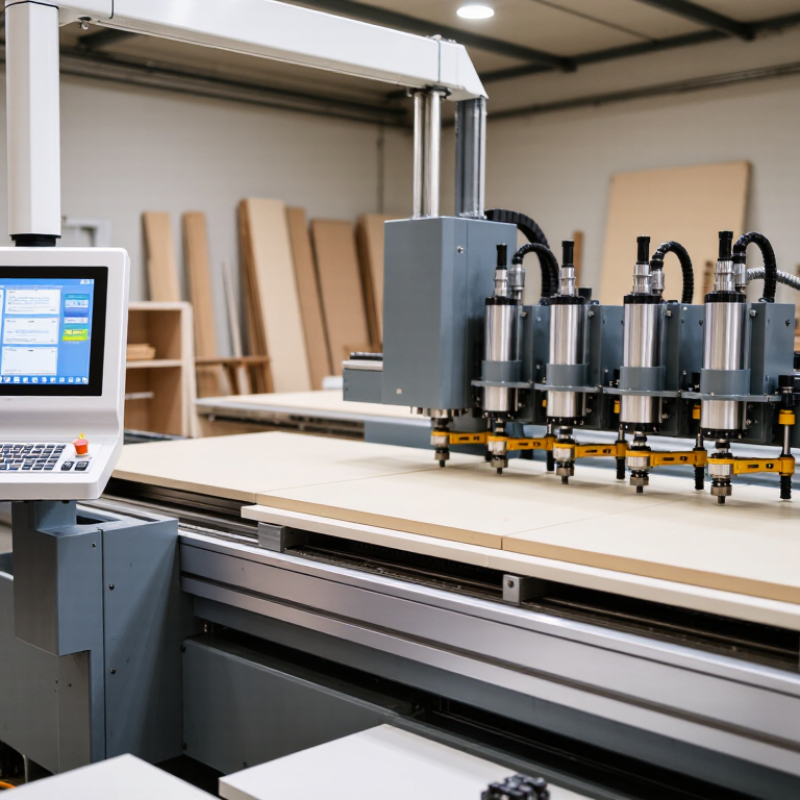
China Best CNC Furniture Side Drilling Machine?

Definition and Core Functions of CNC Furniture Side Drilling Machines

China Best CNC Furniture Side Drilling Machine?

Definition and Core Functions of CNC Furniture Side Drilling Machines

A CNC furniture side drilling machine is designed to bore accurate holes into the edges or faces of cabinet panels. A programmed controller positions the panel and drilling head, then guides the tool to specified coordinates. Depending on its configuration, the machine can create connector, dowel, shelf-support, or hinge-related holes. This makes it useful for repeatable cabinet production, especially when many panels share the same layout. The process is precise, but only when panel dimensions, tool condition, and machine calibration are checked.

Market context helps explain the demand for dependable panel processing. Grand View Research’s Furniture Market report estimated the global furniture market at USD 556.67 billion in 2020, with a projected 5.4% compound annual growth rate from 2021 to 2028. That is market growth, not proof that every workshop needs automation. In practice, a side drilling machine can reduce manual marking and keep hole spacing consistent across a batch. Operators still need to verify the first panel, secure the workpiece, and clear dust from the drilling area. Small errors matter. A worn bit or an incorrect program can send holes off position, so automation still needs experienced hands.

Main Components and How the Drilling Process Works

A CNC furniture side drilling machine typically includes a rigid frame, worktable, locating fence, clamps, drilling spindle, and numerical controller. The fence registers the panel edge, while clamps hold the board steady. A servo-driven spindle positions the bit and controls its rotation. Some machines use several drill heads for different hole directions. Small errors matter.

The operator imports a drilling pattern or enters hole coordinates, then places the panel against the fence. Sensors or manual checks confirm its position before clamping. The spindle moves to each programmed point and drills to a set depth. Feed speed, bit condition, and panel material all affect the result. A worn bit can leave rough edges, even when the coordinates are correct.

Automation is expanding across manufacturing. The International Federation of Robotics reported 4,281,585 industrial robots operating worldwide in 2023, up 10% from 2022 in its World Robotics 2024 report. This figure covers industries broadly, not furniture drilling alone. It signals a wider move toward automated production, but it does not guarantee better holes. Operators still need to test the first panel, check hole depth and spacing, and adjust settings when board thickness varies. In practice, that first setup can be imperfect. A careful recheck often prevents repeated errors.

Common Machine Types and Key Technical Specifications

Furniture side-drilling machines generally fall into three groups: single-spindle units, multi-spindle machines, and CNC drilling systems. A single spindle suits small workshops and varied orders, but each hole may require another setup. Multi-spindle heads drill repeated patterns faster. CNC models add programmable positioning for cabinet sides, shelves, and connector holes. More automation helps, but only when the operator can maintain tools and verify programs.

Compare spindle count, drilling diameter, maximum depth, and usable workpiece dimensions. Check the X, Y, and Z travel, positioning accuracy, spindle speed, and feed rate against your panel sizes and materials. For example, a machine intended for 18-millimeter board should still accommodate thicker panels if your production requires them. Ask how accuracy is measured; a stated tolerance means little without a defined test method. Small details matter.

Clamping should hold narrow panels firmly without marking the surface. Look for clear controls, accessible bit changes, and effective dust extraction around the drilling zone. Confirm whether the machine supports your required hole patterns and file formats. A neat specification sheet can still mislead. Real production brings worn bits, inconsistent panels, and rushed changeovers, so a sample test on your own material is useful. Perfect repeatability is not guaranteed. Tool condition and setup still matter.

Applications in Modern Furniture Manufacturing

In modern furniture manufacturing, a CNC side drilling machine creates horizontal holes in cabinet panels, drawer parts, and bed-frame components. These holes can hold dowels, confirmat screws, or shelf supports, depending on the design. A cabinet side panel, for example, may need several accurately spaced holes along its edge. The machine can follow a programmed pattern across repeated parts, reducing the need to mark every position by hand. Small details matter.

This is useful in kitchens, office furniture, wardrobes, and modular storage, where panels often meet at fixed angles. A side drilling operation can also complement nesting or panel-saw workflows, helping workshops prepare parts for assembly. Operators should match the program to panel thickness, drilling depth, and connector size. Test cuts on offcuts are practical, especially when changing materials or hardware. Setup still matters.

The machine does not remove every production challenge. Veneer can chip, panels may vary slightly, and a perfect drilling plan on screen can meet a warped board in the shop. Check tool condition, clamping, and dust extraction before a production run. For mixed custom orders, thoughtful setup may take longer than expected; that trade-off deserves attention when estimating output.

How to Evaluate Leading CNC Side Drilling Machines in China

China Best CNC Furniture Side Drilling Machine?

How to Evaluate Leading CNC Side Drilling Machines in China

Evaluating a leading Chinese CNC side drilling machine starts with your actual panels, not a showroom demonstration. Grand View Research’s Furniture Market Size, Share & Trends Analysis Report, 2024–2030, estimated the global furniture market at USD 677.09 billion in 2023. That figure signals a large, evolving market, but it cannot prove any machine’s performance. Test real panels.

Run repeated jobs on your own materials, including narrow pieces and panels with different thicknesses. Check hole position, edge distance, drilling depth, and repeatability across a full shift. A neat sample is not enough. Record cycle time, tool changes, setup time, and rejected pieces; these numbers reveal more than a fast demonstration. Watch how the operator loads panels and clears dust, too.

For positioning tests, ISO 230-2 offers a structured method for assessing axis accuracy and repeatability. Ask the supplier to explain how its test conditions relate to your production setup. Also inspect clamping stability, program transfer, maintenance access, and local service response. One concern: a short acceptance test can make a machine look better than it performs during busy weeks. Request a longer trial when possible, and keep the results—even if they complicate the purchase decision.

Copyright 2025 Fluidra S.A. | Created by BCM Marketing Agencia Privacy Policy Legal note | Cookie policy |

Technical cookies are strictly necessary for our website to work and you can navigate through it. These types of cookies are those that, for example, allow us to identify you, give you access to certain restricted parts of the page if necessary, or remember different options or services already selected by you, such as your privacy preferences. Therefore, they are activated by default, your authorization not being necessary in this regard. Through the configuration of your browser, you can block or alert the presence of this type of cookies, although such blocking will affect the proper functioning of the different functionalities of our website.


The analysis cookies allow us to study the navigation of the users of our website in general (for example, which sections of the page are the most visited, which services are used most and if they work correctly, etc.). From the statistical information on navigation on our website, we can improve both the operation of the page itself and the different services it offers. Therefore, these cookies do not have an advertising purpose, but only serve to make our website work better, adapting to our users in general. By activating them you will contribute to this continuous improvement. You can enable or disable these cookies by checking the corresponding box, being disabled by default.


Functionality cookies allow us to remember your preferences, to personalize certain characteristics and general options of our website, every time you access it (for example, the language in which the information is presented to you, the sections marked as favorites, your browser type, etc.) Therefore, this type of cookies does not have an advertising purpose, but by activating them you will improve the functionality of the website (for example, adapting to your type of browser) and the customization of it based on your preferences (for example, by presenting the information in the language that you have chosen in previous occasions), which will contribute to the ease, usability and comfort of our page during your navigation. You can enable or disable these cookies by checking the corresponding box, being disabled by default.


Advertising cookies allow us to manage the advertising spaces included in our website based on criteria such as the content shown or the frequency in which the ads are displayed. For example, if you have been shown the same ad several times on our website, and you have not shown a personal interest by clicking on it, it will not appear again. In summary, by activating this type of cookies, the advertising shown on our website will be more useful and diverse, and less repetitive. You can enable or disable these cookies by checking the corresponding box, being disabled by default.


Behavioral advertising cookies allow us to obtain information based on the observation of your browsing habits and behaviors on the web, in order to show you advertising content that best suits your personal tastes and interests. To understand it in a very simple way, we will give you a fictitious example: if your last searches on the web were related to suspense literature, we would show you advertising about suspense books. Therefore, activating this type of cookies, the advertising that we show you on our website will not be generic, but will be oriented to your searches, tastes and interests, therefore adjusting exclusively to you. You can enable or disable these cookies by checking the corresponding box, being disabled by default.
To understand it in a very simple way, we will give you a fictitious example: if your last searches on the web were related to suspense literature, we would show you advertising about suspense books. Therefore, activating this type of cookies, the advertising that we show you on our website will not be generic, but will be oriented to your searches, tastes and interests, therefore adjusting exclusively to you. You can enable or disable these cookies by checking the corresponding box, being disabled by default.

SAVE

We use our own and third-party cookies to ensure the proper functioning of the website and to analyse our services, improve your experience on our website and show you advertisements related to your interests according to profiling based on your browsing habits (e.g. websites visited). You can accept all cookies by clicking "ACCEPT" or set or reject them by clicking here. If you would like to know more about the use of cookies, please see our COOKIE POLICY.


ACCEPT ALL
Reject no essentials


