
What Is a Centrifugal Flow Fan and How Does It Work?
FLUID HANDLING EXPERTS

Blog, all our news

What Is a Centrifugal Flow Fan and How Does It Work?

A Centrifugal Flow Fan moves air by changing its direction and energy. Air enters through the fan’s central inlet, where a rotating impeller catches it. The blades push the air outward, away from the shaft. Inside the curved housing, often called a volute, the air is guided toward an outlet. That turn matters. In many installations, the outlet carries air away at roughly a right angle to the inlet.

The idea sounds simple. The details matter. Blade shape, rotational speed, air density, and duct resistance all affect performance. A backward-curved impeller, for example, behaves differently from a forward-curved or radial-blade design. The fan’s pressure-flow curve can help match a model to a real system, such as an HVAC duct or an industrial ventilation line. A fan that looks powerful on paper may deliver less air when connected to narrow ducts, filters, or sharp bends. Blocked passages are not something the fan can simply overcome.

This guide explains the main components, airflow path, and factors that influence fan selection. It also looks at noise, vibration, and routine inspection, because these practical details are easy to overlook. A diagram can clarify the airflow, but it cannot capture every installation condition. That limitation is worth remembering. For a specific application, compare manufacturer data with measured system requirements, and follow the equipment instructions.
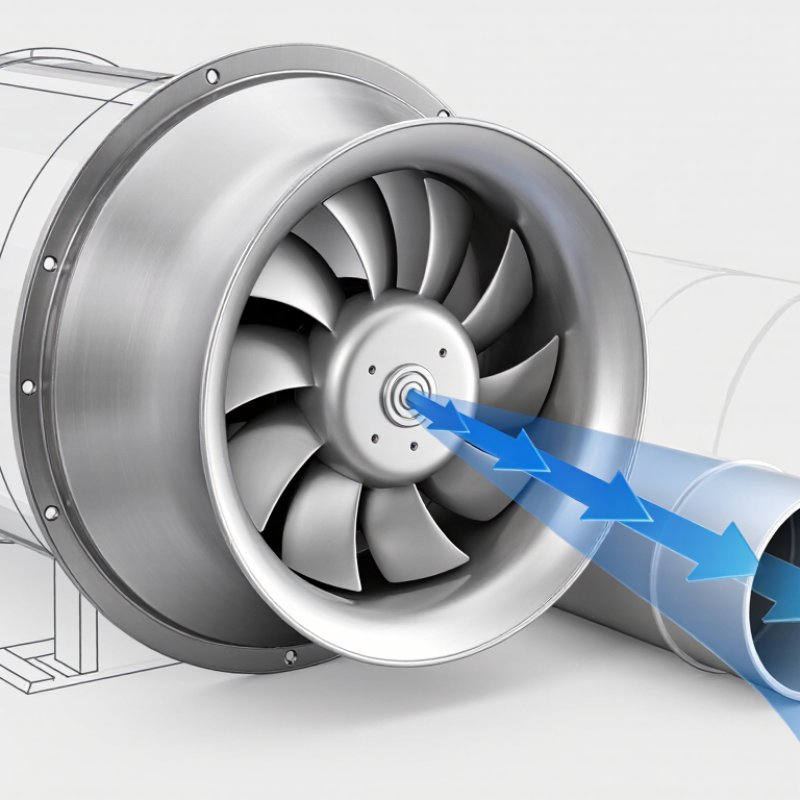
What Is a Centrifugal Flow Fan and How Does It Work?

Definition and Purpose of a Centrifugal Flow Fan

A centrifugal flow fan moves air by converting rotational energy into airflow and pressure. Air enters near the center of a spinning impeller, then travels outward through curved blades. The fan casing guides this faster-moving air toward the outlet. Air moves inward, then outward. This design is useful when a system needs steady airflow against resistance from filters, ducts, or equipment.

Its purpose is not simply to move air, but to deliver the flow and pressure a ventilation or process system requires. The U.S. Department of Energy’s Improving Fan System Performance sourcebook estimates that fan systems use roughly 7% of electricity in U.S. manufacturing. That figure makes proper selection and control worth attention. A fan that is too large may waste energy or create excess noise; one that is too small may fail to meet airflow needs. Real systems also change as filters collect dust. That detail is easy to overlook.

Tips: Check the required airflow and static pressure before choosing a fan. Keep filters clean, and verify airflow after installation. A quiet fan is not always an efficient one.

What Is a Centrifugal Flow Fan and How Does It Work? — Definition and Purpose

Dimension Description Purpose or Practical Significance
Definition A centrifugal flow fan is a mechanical device that uses a rotating impeller to move air or gas. In a typical design, fluid enters near the center of the impeller and leaves its outer edge in a direction broadly perpendicular to the inlet flow. It moves air through ducts, equipment, and other systems, including applications where the airflow must overcome resistance.
Airflow path Air commonly enters through an inlet aligned with the impeller shaft, travels through the rotating impeller, and exits around the impeller’s circumference into an outlet passage. The change in flow direction distinguishes a centrifugal fan from an axial fan, in which air generally travels along the fan shaft.
Impeller The impeller consists of a hub and blades that rotate to transfer energy to the air. Blade shape and orientation vary by fan design. Impeller geometry influences airflow, pressure capability, efficiency, and suitability for different operating conditions.
How pressure is produced Rotation accelerates air outward through the impeller. The resulting airflow and pressure rise are influenced by the impeller and the surrounding casing or outlet arrangement. The fan provides the pressure needed to move air through system components such as filters, coils, ducts, and grilles.
Volute or casing Many centrifugal fans use a casing, often shaped like a volute, to collect air discharged from the impeller and guide it toward the outlet. Some designs use different casing arrangements. The casing helps direct the discharge flow and can help convert part of its velocity into static pressure.
Drive and rotation An electric motor or another power source turns the impeller, either directly or through a transmission such as a belt drive. Drive type and operating speed affect the fan’s delivered airflow and pressure. The motor must be selected for the required operating conditions.
Typical purpose Centrifugal fans are used for ventilation, heating and air-conditioning systems, process air movement, and equipment cooling. They are useful when air needs to be routed through a system that creates resistance, rather than simply moved across an open area.
Common design variations Common impeller categories include forward-curved, backward-curved, and radial-blade designs. Their performance and suitable applications differ. Selection should be based on the required airflow, system pressure, air characteristics, efficiency needs, and operating environment.
Key selection factors Important factors include required airflow, total system pressure, air temperature and density, available space, noise limits, and the resistance of connected equipment and ductwork. Matching the fan to the system helps it operate closer to its intended duty point and avoids relying on airflow ratings alone.
Operating note Actual airflow depends on the interaction between the fan’s performance characteristics and the resistance of the connected system. A fan’s stated maximum airflow does not necessarily equal the airflow it will deliver once installed in a system.

Main Components and Their Functions

A centrifugal flow fan draws air into the center of its impeller and sends it outward. The impeller is a rotating wheel fitted with curved or straight blades. As it spins, the blades add energy to the air. That motion matters. The inlet guides air toward the wheel; a poorly matched inlet can create turbulence and reduce useful airflow. Around the impeller, the scroll-shaped casing collects the moving air and helps convert some of its velocity into pressure. The outlet then directs this pressurized stream into a duct or open space.

The motor provides rotation, while the shaft transfers that motion to the impeller. Bearings support the shaft and help it turn steadily. If they wear or lose alignment, vibration and noise may appear. Not always the cause. A loose mount or an unbalanced impeller can produce similar symptoms, so identifying the fault takes more than listening. Some fans include inlet guide vanes to adjust airflow before it reaches the impeller. Their position can affect both volume and efficiency. During inspection, check for dust buildup on the blades; even a thin layer can disturb airflow and add imbalance. A fan’s actual output also depends on duct resistance, not just motor speed.

How the Impeller Creates Air Movement

What Is a Centrifugal Flow Fan and How Does It Work?

How the Impeller Creates Air Movement

A centrifugal flow fan moves air by spinning an impeller inside a housing. Air enters near the center, called the impeller eye. Curved or straight blades catch it and carry it outward as they rotate. Think of water flung from a turning wheel, though air behaves differently. The impeller gives the air energy and speed.

As the air moves outward, the fan casing gathers it and guides it toward the outlet. This change in direction—from entering along the shaft to leaving across it—creates the fan’s characteristic airflow. The shape of the blades, their speed, and the available outlet all affect performance. A dusty grille or narrow duct can restrict flow. Real systems are rarely as tidy as diagrams suggest, so measured airflow may differ from expectations.

Tips: Keep the inlet and outlet clear, and check for dust on the blades. Listen for new vibration or rubbing sounds. Small changes can reveal a problem, but noise alone does not identify its cause.

The Airflow Path from Inlet to Outlet

Air enters a centrifugal flow fan through the inlet, moving straight toward the center of the rotating wheel. This central opening is called the eye. Curved blades catch the incoming air and carry it outward. The wheel adds velocity and sends the air toward the casing. A noticeable change in direction occurs.

Inside the casing, the air travels around the wheel and gathers in the expanding passage. The widening shape helps convert some air velocity into static pressure. The flow then leaves through the outlet, usually at an angle to its original path. Nearby elbows or a narrow inlet can disrupt this route, creating uneven flow and extra noise. Small details matter.

The U.S. Department of Energy’s Improving Fan System Performance sourcebook estimates that fans account for about 15% of electricity used by industrial motor systems. That figure is not a performance rating for an individual fan; actual energy use depends on the system and operating conditions. A practical check is to measure airflow and pressure at the installed fan, rather than rely only on a catalog value. Even careful measurements have limits: readings can shift with damper position, duct leaks, or changing filters.

What Is a Centrifugal Flow Fan and How Does It Work?

The airflow path from inlet to outlet

Air enters near the center of the rotating impeller and is accelerated outward. The fan raises the air’s pressure; the casing then guides the flow toward the outlet. This illustrative example shows static pressure relative to ambient air. Actual readings vary with fan design, speed, and operating conditions.

Common Fan Designs and Their Applications

A centrifugal flow fan draws air into the center of a rotating impeller and pushes it outward. Its curved housing guides the air toward an outlet, often at a right angle to the intake. This layout can provide steady airflow against resistance from ducts, filters, or equipment. The exact result depends on fan size, speed, and system design.

Common designs suit different jobs. Forward-curved blades move substantial air at relatively low pressure, making them useful in compact ventilation and heating systems. Backward-curved blades are often more energy-efficient in clean-air applications, such as commercial HVAC units. Radial blades are sturdy and handle dustier air in some industrial processes, though they may be louder. No design is ideal everywhere. A fan selected by airflow alone may struggle once connected to a restrictive duct.

Tips: Check the required airflow and static pressure together. Inspect the air for dust, moisture, or heat before choosing a blade style. Allow space for service access. Real installations can differ from calculations, so verify performance after setup. That detail is easy to miss.

Copyright 2025 Fluidra S.A. | Created by BCM Marketing Agencia Privacy Policy Legal note | Cookie policy |

Technical cookies are strictly necessary for our website to work and you can navigate through it. These types of cookies are those that, for example, allow us to identify you, give you access to certain restricted parts of the page if necessary, or remember different options or services already selected by you, such as your privacy preferences. Therefore, they are activated by default, your authorization not being necessary in this regard. Through the configuration of your browser, you can block or alert the presence of this type of cookies, although such blocking will affect the proper functioning of the different functionalities of our website.


The analysis cookies allow us to study the navigation of the users of our website in general (for example, which sections of the page are the most visited, which services are used most and if they work correctly, etc.). From the statistical information on navigation on our website, we can improve both the operation of the page itself and the different services it offers. Therefore, these cookies do not have an advertising purpose, but only serve to make our website work better, adapting to our users in general. By activating them you will contribute to this continuous improvement. You can enable or disable these cookies by checking the corresponding box, being disabled by default.


Functionality cookies allow us to remember your preferences, to personalize certain characteristics and general options of our website, every time you access it (for example, the language in which the information is presented to you, the sections marked as favorites, your browser type, etc.) Therefore, this type of cookies does not have an advertising purpose, but by activating them you will improve the functionality of the website (for example, adapting to your type of browser) and the customization of it based on your preferences (for example, by presenting the information in the language that you have chosen in previous occasions), which will contribute to the ease, usability and comfort of our page during your navigation. You can enable or disable these cookies by checking the corresponding box, being disabled by default.


Advertising cookies allow us to manage the advertising spaces included in our website based on criteria such as the content shown or the frequency in which the ads are displayed. For example, if you have been shown the same ad several times on our website, and you have not shown a personal interest by clicking on it, it will not appear again. In summary, by activating this type of cookies, the advertising shown on our website will be more useful and diverse, and less repetitive. You can enable or disable these cookies by checking the corresponding box, being disabled by default.


Behavioral advertising cookies allow us to obtain information based on the observation of your browsing habits and behaviors on the web, in order to show you advertising content that best suits your personal tastes and interests. To understand it in a very simple way, we will give you a fictitious example: if your last searches on the web were related to suspense literature, we would show you advertising about suspense books. Therefore, activating this type of cookies, the advertising that we show you on our website will not be generic, but will be oriented to your searches, tastes and interests, therefore adjusting exclusively to you. You can enable or disable these cookies by checking the corresponding box, being disabled by default.
To understand it in a very simple way, we will give you a fictitious example: if your last searches on the web were related to suspense literature, we would show you advertising about suspense books. Therefore, activating this type of cookies, the advertising that we show you on our website will not be generic, but will be oriented to your searches, tastes and interests, therefore adjusting exclusively to you. You can enable or disable these cookies by checking the corresponding box, being disabled by default.

SAVE

We use our own and third-party cookies to ensure the proper functioning of the website and to analyse our services, improve your experience on our website and show you advertisements related to your interests according to profiling based on your browsing habits (e.g. websites visited). You can accept all cookies by clicking "ACCEPT" or set or reject them by clicking here. If you would like to know more about the use of cookies, please see our COOKIE POLICY.


ACCEPT ALL
Reject no essentials



