
What Are the Best Venous Ulcer Dressings from China?
FLUID HANDLING EXPERTS

Blog, all our news

What Are the Best Venous Ulcer Dressings from China?

Choosing the best Venous Ulcers dressings from China starts with the wound, not the product label. A venous leg ulcer may produce heavy fluid, have fragile skin around its edges, or change as swelling improves. These details matter. A dressing that suits one wound may be uncomfortable or ineffective for another.

Professor Keith Harding, a respected wound-healing researcher, has emphasized evidence-based assessment and care. In paraphrase, his practical message is: assess the wound and its cause before selecting treatment. That distinction is important. Dressings can help manage moisture, protect the wound surface, and support comfort, but they do not correct venous hypertension. Compression may be central to care when clinically appropriate and safely prescribed. Not for every patient.

This guide compares dressing types available from Chinese manufacturers, including absorbent, foam, alginate, and hydrofiber options. It considers fluid handling, contact with delicate skin, ease of removal, product documentation, and consistency between batches. A clean package and an attractive claim are not enough. Buyers and clinicians should check the intended use, material details, quality controls, and evidence supporting performance. Availability and product standards can vary between suppliers, so comparisons should be verified rather than assumed. The best choice is not always the newest or most expensive. It is the option that fits the wound, the care plan, and the patient’s needs. And sometimes, the evidence leaves room for doubt. This overview is a starting point, not a substitute for professional assessment.
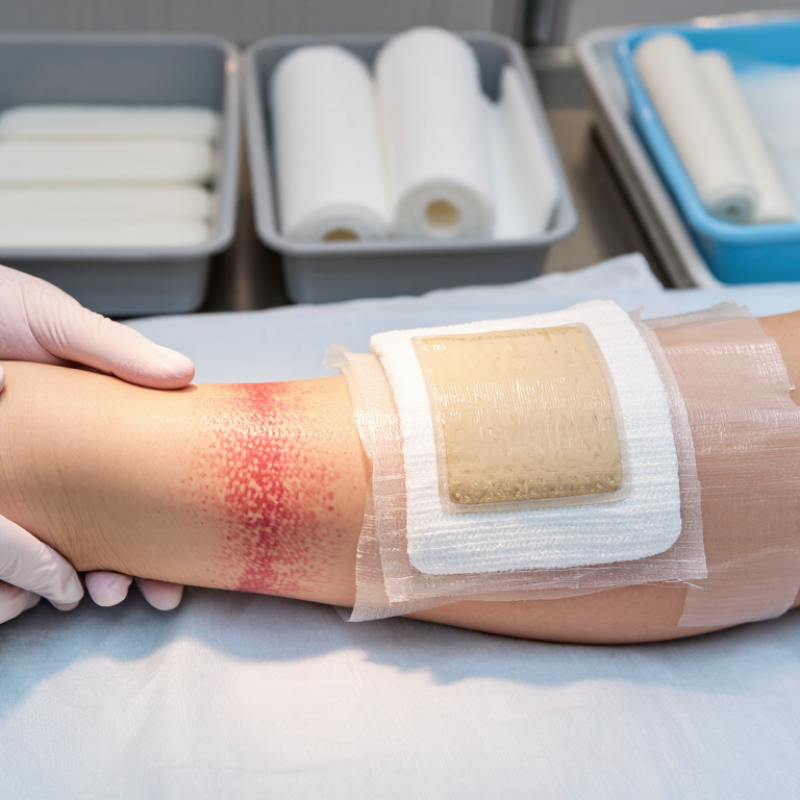
What Are the Best Venous Ulcer Dressings from China?

Understanding Venous Ulcers and the Role of Dressings

Venous ulcers usually develop when damaged leg veins allow blood to pool, raising pressure in the lower leg. They often appear near the ankle, where skin may look swollen, discolored, or fragile. The wound can produce steady drainage. That detail matters. A dressing must manage moisture without leaving the surrounding skin soggy. Compression can support healing, but a clinician should assess circulation first, often using an ankle-brachial index. The wrong level of compression may cause harm.

Dressings help control fluid, protect delicate tissue, and reduce friction; they do not correct the underlying vein problem. Foam dressings may suit moderate drainage, while alginate or absorbent fiber dressings can help with heavier fluid. A clinician should select the product based on wound depth, drainage, skin condition, and signs of infection. No dressing fits every wound. For products sourced from China, buyers can review material details, sterilization information, and quality documentation, rather than relying on appearance alone. It is easy to oversimplify this choice: a wound that looks cleaner may still need reassessment if pain, redness, odor, or drainage increases.

Main Types of Venous Ulcer Dressings Made in China

Chinese-made venous ulcer dressings commonly include foam, alginate, hydrofiber, hydrocolloid, and silver-containing products. Foam dressings cushion the wound and absorb moderate to heavy drainage. Alginate and hydrofiber suit wetter ulcers; they form a gel as they absorb fluid. Hydrocolloids are generally used for shallow wounds with lighter drainage. Silver dressings may be considered when local infection is suspected, under clinical guidance—not as a substitute for assessment.

A dressing cannot correct poor venous circulation on its own. Compression is central when clinically appropriate.

A 2012 Cochrane review reported faster healing with compression than without it (hazard ratio 2.17; 95% CI 1.52–3.10, five studies). Clinicians should assess arterial circulation before compression, then match the dressing to wound depth, drainage, and surrounding skin. In practice, the best fit can change as the ulcer improves; dressing selection is not always neat.

Tips: Check the wound at each change. Protect the fragile skin around it, and seek clinical review for spreading redness, fever, or increasing pain.

How Dressing Materials Support Wound Healing

What Are the Best Venous Ulcer Dressings from China?

How Dressing Materials Support Wound Healing

A venous ulcer often produces steady drainage, especially around the lower leg and ankle. The right dressing helps manage that fluid while protecting fragile skin. It does not correct the underlying venous pressure; compression and clinical assessment remain central to care.

Material matters. Foam dressings can absorb moderate to heavy exudate and cushion the wound beneath a compression wrap. Alginate dressings may suit deeper, wetter areas, but they need enough fluid to work well. A non-adherent contact layer can reduce trauma when dressings are changed. Too much moisture can soften the skin edges. Too little can leave the wound bed dry.

Fit matters. When comparing dressings made in China, clinicians and purchasers can review sterile packaging, absorbency information, material consistency, and clear instructions for use. These details support safer selection, but they cannot replace patient-specific judgment. Wound size, drainage, skin sensitivity, and comfort all affect performance. There is no universal best option, and product descriptions do not always show how a dressing behaves beneath compression. Checking the wound and surrounding skin at each change can reveal whether the material is helping or irritating.

Comparing Dressings by Exudate, Wound Condition, and Comfort

What Are the Best Venous Ulcer Dressings from China?

For a heavily exuding venous ulcer, an alginate or gelling-fibre dressing can help contain fluid beneath compression. For moderate exudate, foam may offer a practical balance of absorption and cushioning. With light exudate, a soft, low-adherent contact layer may reduce trauma during changes. These are starting points, not rules. Wounds International’s 2013 consensus on exudate management stresses matching dressing performance to fluid level and wound needs. Check the surrounding skin, too; white, soggy edges can signal excess moisture.

Wound condition and comfort matter as much as absorbency. A tender wound may need a gentle contact layer, while fragile surrounding skin calls for careful adhesive selection and removal. The 2013 Cochrane review included 42 trials and 4,321 participants, but found no reliable basis for choosing a dressing by healing rate alone; compression remains central to venous-ulcer care. That distinction is easy to miss. When comparing products made in China, request evidence for absorption and fluid retention under compression, skin compatibility, and sterilisation validation. A dressing that looks suitable in a catalogue may feel stiff, leak at the edges, or hurt at removal. I would not treat any product category as a perfect fit; reassess comfort, exudate, and skin condition at each change.

Assessing Product Quality, Clinical Evidence, and Supplier Standards

What Are the Best Venous Ulcer Dressings from China?

Product quality starts with the wound, not the catalogue. A dressing should handle the ulcer’s exudate, protect fragile surrounding skin, and stay comfortable beneath compression. In a clinic, a saturated pad that leaks before the next change is a practical failure, even if its material specification looks impressive. The Cochrane review of dressings and topical agents assessed 78 studies involving 7,014 people with venous leg ulcers. It found the evidence too uncertain to establish that one dressing type consistently heals ulcers better than another when compression is used. That gap matters. Buyers should ask for clinical data on the specific product, not broad claims based on a material category.

Supplier checks need equal attention. Request the ISO 13485 certificate and confirm that its scope covers the product and manufacturing site. For products contacting wounds, review relevant biocompatibility testing, and ask how sterilization is validated when the product is supplied sterile. Batch traceability, change-control records, and complaint-handling procedures help connect a shipped dressing to its production history. A certificate alone is not enough. Check whether test reports identify the exact product configuration, and whether performance data reflect realistic wear and fluid handling. I would still question a polished brochure if the supplier cannot explain how it investigates a leaking dressing or a failed batch.

Copyright 2025 Fluidra S.A. | Created by BCM Marketing Agencia Privacy Policy Legal note | Cookie policy |

Technical cookies are strictly necessary for our website to work and you can navigate through it. These types of cookies are those that, for example, allow us to identify you, give you access to certain restricted parts of the page if necessary, or remember different options or services already selected by you, such as your privacy preferences. Therefore, they are activated by default, your authorization not being necessary in this regard. Through the configuration of your browser, you can block or alert the presence of this type of cookies, although such blocking will affect the proper functioning of the different functionalities of our website.


The analysis cookies allow us to study the navigation of the users of our website in general (for example, which sections of the page are the most visited, which services are used most and if they work correctly, etc.). From the statistical information on navigation on our website, we can improve both the operation of the page itself and the different services it offers. Therefore, these cookies do not have an advertising purpose, but only serve to make our website work better, adapting to our users in general. By activating them you will contribute to this continuous improvement. You can enable or disable these cookies by checking the corresponding box, being disabled by default.


Functionality cookies allow us to remember your preferences, to personalize certain characteristics and general options of our website, every time you access it (for example, the language in which the information is presented to you, the sections marked as favorites, your browser type, etc.) Therefore, this type of cookies does not have an advertising purpose, but by activating them you will improve the functionality of the website (for example, adapting to your type of browser) and the customization of it based on your preferences (for example, by presenting the information in the language that you have chosen in previous occasions), which will contribute to the ease, usability and comfort of our page during your navigation. You can enable or disable these cookies by checking the corresponding box, being disabled by default.


Advertising cookies allow us to manage the advertising spaces included in our website based on criteria such as the content shown or the frequency in which the ads are displayed. For example, if you have been shown the same ad several times on our website, and you have not shown a personal interest by clicking on it, it will not appear again. In summary, by activating this type of cookies, the advertising shown on our website will be more useful and diverse, and less repetitive. You can enable or disable these cookies by checking the corresponding box, being disabled by default.


Behavioral advertising cookies allow us to obtain information based on the observation of your browsing habits and behaviors on the web, in order to show you advertising content that best suits your personal tastes and interests. To understand it in a very simple way, we will give you a fictitious example: if your last searches on the web were related to suspense literature, we would show you advertising about suspense books. Therefore, activating this type of cookies, the advertising that we show you on our website will not be generic, but will be oriented to your searches, tastes and interests, therefore adjusting exclusively to you. You can enable or disable these cookies by checking the corresponding box, being disabled by default.
To understand it in a very simple way, we will give you a fictitious example: if your last searches on the web were related to suspense literature, we would show you advertising about suspense books. Therefore, activating this type of cookies, the advertising that we show you on our website will not be generic, but will be oriented to your searches, tastes and interests, therefore adjusting exclusively to you. You can enable or disable these cookies by checking the corresponding box, being disabled by default.

SAVE

We use our own and third-party cookies to ensure the proper functioning of the website and to analyse our services, improve your experience on our website and show you advertisements related to your interests according to profiling based on your browsing habits (e.g. websites visited). You can accept all cookies by clicking "ACCEPT" or set or reject them by clicking here. If you would like to know more about the use of cookies, please see our COOKIE POLICY.


ACCEPT ALL
Reject no essentials


