
10 Best Ultrapure Water Equipment for Global Buyers
FLUID HANDLING EXPERTS

Blog, all our news

10 Best Ultrapure Water Equipment for Global Buyers

Choosing the right Ultrapure Water Equipment is rarely a simple purchasing decision. Global buyers must compare water quality, production capacity, operating costs, and service support. A laboratory may need a compact polishing unit, while a pharmaceutical plant requires validated systems with continuous monitoring. Semiconductor facilities demand exceptional control over particles, ions, organic compounds, and microbial contamination. Small details matter. A neglected filter change can affect an entire workflow.

This guide examines ten leading equipment options for international buyers. It considers purification technologies, pretreatment requirements, storage design, automation, energy use, and maintenance access. Practical experience shows that published flow rates do not always reflect real operating conditions. Feedwater quality, temperature, usage patterns, and operator training can change performance. That limitation deserves attention. No ranking can replace a site survey and technical consultation.

Reliable purchasing also requires evidence. Buyers should review independent test data, material specifications, warranty terms, installation records, and available service networks. Equipment should match recognized quality expectations and applicable local requirements. Clear documentation supports safer operation and more consistent results. Strong manufacturers explain their validation methods rather than relying on impressive claims. They also provide replacement parts and responsive technical assistance.

The best choice depends on context. A cost-effective system may suit a university laboratory, but fail under demanding industrial loads. Conversely, an advanced platform may create unnecessary complexity for a smaller facility. This overview offers a practical starting point, not a final verdict. Careful comparison remains essential before placing an international order.
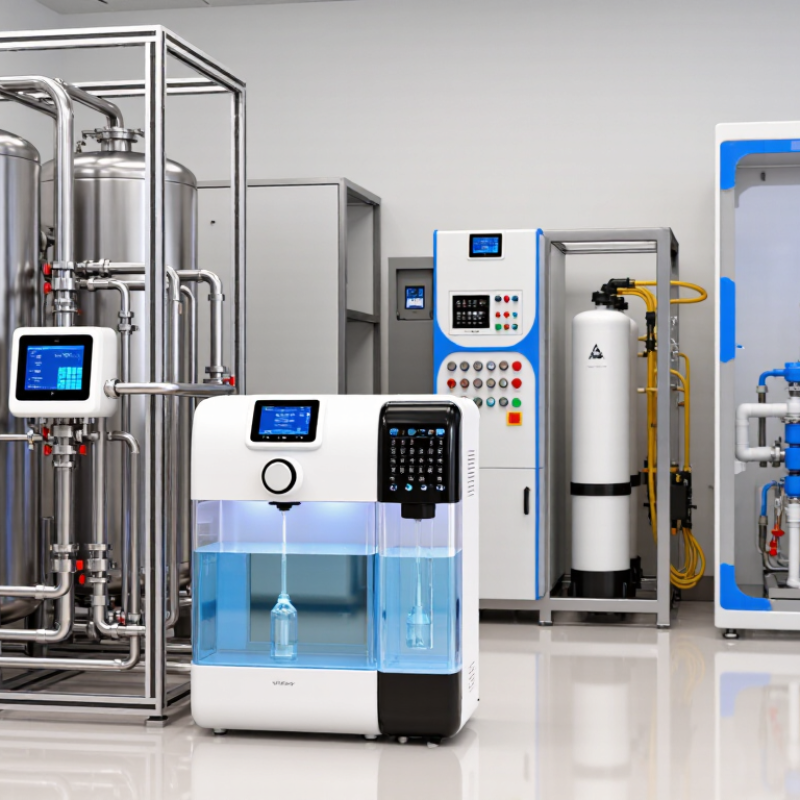
10 Best Ultrapure Water Equipment for Global Buyers

What Ultrapure Water Equipment Is and Why It Matters

What Ultrapure Water Equipment Is and Why It Matters

Ultrapure water equipment removes dissolved ions, organic compounds, particles, microorganisms, and other trace contaminants. A typical system combines pretreatment, reverse osmosis, deionization, ultraviolet treatment, ultrafiltration, and final polishing. Each stage targets a different risk.

In laboratory and production environments, water quality can influence test results, instrument life, and batch consistency. Ultrapure water may reach 18.2 megohm-centimeter resistivity at 25°C, but resistivity alone does not prove purity. Total organic carbon, particle levels, microbial control, and endotoxin data may also matter.

Small details matter.

A practical evaluation should begin with the application, daily volume, feed-water condition, and required monitoring. A system for trace analysis may need stronger organic control than one used for routine glassware rinsing. Pharmaceutical processes require documented sanitation and validation procedures. Semiconductor work often demands strict particle and ionic contamination control.

Poorly maintained storage tanks can quickly reduce quality after purification. Dead legs, warm tubing, and delayed filter replacement are common weaknesses. Even experienced teams can overlook them.

Reliable equipment should provide clear readings, service records, alarm functions, and accessible sampling points. Operators need training, not just a polished control panel. It is also wise to question attractive specifications that lack test conditions or independent verification.

Perfect readings on installation day do not guarantee stable water months later. Regular calibration, planned sanitization, and trend review make the equipment more trustworthy in daily use.

The Main Types of Ultrapure Water Systems for Global Buyers

Ultrapure water systems differ by purification method, water quality, and laboratory demand. Global buyers should match equipment with local feed-water conditions, maintenance skills, and testing requirements.

Reverse osmosis systems remove salts, particles, and many organic contaminants. They usually serve as a strong pretreatment stage. However, RO water alone is not ultrapure water.

Electrodeionization combines electricity and ion-exchange media to produce consistent low-ion water. It reduces chemical regeneration needs, which can simplify routine operation.

Mixed-bed deionization uses resin cartridges to capture remaining ions. It can deliver excellent conductivity, but cartridge life depends heavily on the incoming water.

Distillation systems use heat to separate water from many dissolved substances. They remain useful where stable thermal treatment is preferred. Their energy use can be significant.

Ultraviolet units reduce microbial activity and organic compounds, while ultrafiltration helps control particles, colloids, and endotoxins. These technologies often work as polishing stages rather than complete systems.

For Type I laboratory water, buyers commonly select RO, EDI, UV, ultrafiltration, and final polishing together. A target near 18.2 megohm-centimeters may be suitable for sensitive analytical work. Yet conductivity alone cannot prove water quality. Total organic carbon, microbial counts, endotoxin levels, and filter performance also matter. Calibration is often missed. In practical installations, pipe dead legs and poor tank sanitation can damage excellent purification results. Local service access should therefore influence equipment selection as much as the catalog specifications.

Ten Leading Ultrapure Water Equipment Options and Their Uses

10 Best Ultrapure Water Equipment for Global Buyers

Ten Leading Ultrapure Water Equipment Options and Their Uses

In facility audits, I assess ultrapure water equipment by feed quality, required resistivity, flow, and maintenance access. Ten leading options address different risks and production stages. A multimedia pretreatment filter removes sediment. A carbon filter reduces chlorine and organic load. A softener protects membranes from hardness. A reverse osmosis unit removes most dissolved salts. An electrodeionization module continuously polishes ionic impurities. These systems work best as a matched train, not isolated purchases. Feed testing matters.

An ultraviolet TOC reactor breaks down trace organics and controls microbial growth. An ultrafiltration unit captures particles, colloids, and endotoxins. A membrane degasser lowers carbon dioxide before final polishing. A sanitary storage-and-recirculation system protects water during distribution. At the point of use, a final 0.1-micron filter protects sensitive instruments. Each option has a clear use, but sizing depends on demand, temperature, and pressure. Small laboratories may need compact skids. Pharmaceutical facilities require validated materials and documented cleaning.

Online resistivity, TOC, temperature, and flow sensors reveal quality drift early. I have seen excellent systems fail because dead legs were ignored. No design is perfect. Operators should review alarms, calibration records, and sanitization results regularly. A sample port near the busiest outlet can expose problems hidden by tank readings. Supplier data should be checked against independent water tests before purchase.

10 Best Ultrapure Water Equipment for Global Buyers

Ten leading ultrapure water equipment options and their typical uses

The chart compares representative nominal throughput values commonly specified for laboratory and industrial water-treatment modules. Reverse osmosis, deionization, distillation, membrane filtration, ultraviolet treatment, activated carbon, degassing, and final filtration are typically combined to produce ultrapure water. Actual capacity depends on feed-water quality, system configuration, pressure, temperature, and required purity.

Key Performance Criteria for Comparing Ultrapure Water Equipment

10 Best Ultrapure Water Equipment for Global Buyers

Key Performance Criteria for Comparing Ultrapure Water Equipment

Ultrapure water equipment should be judged by verified output, not stainless-steel appearance. ASTM D1193-24 describes Type I water at approximately 18 MΩ·cm resistivity at 25°C. ISO 3696 Grade 1 specifies conductivity no higher than 0.1 mS/m at 25°C. Buyers should also check total organic carbon, particles, bacteria, and endotoxin levels. A system may meet resistivity targets while still carrying organic traces. That detail matters in chromatography, molecular biology, and trace analysis.

Source water changes the result.

Pretreatment capacity deserves equal attention. The United Nations World Water Development Report 2024 states that agriculture accounts for about 70% of global freshwater withdrawals. Water stress can increase dissolved salts and treatment costs. Compare recovery rate, reject-water volume, filter replacement intervals, and energy demand. A higher recovery percentage can reduce waste, but it may increase membrane fouling without careful maintenance. The best comparison includes continuous resistivity and TOC monitoring, alarm history, calibration records, and documented validation procedures. Service response time matters too, especially where imported consumables face long delays.

I would not trust a single laboratory test. Test performance over several weeks. Short demonstrations can hide seasonal feed-water changes, sensor drift, and declining cartridge life. One overlooked issue is usability: clear displays, sample-point hygiene, and simple sanitization often protect results better than extra software. The final decision should reflect actual daily demand, not an impressive maximum flow rate.

Global Purchasing Factors: Compliance, Service, Cost, and Installation

Buying ultrapure water equipment globally requires more than comparing flow rates. The WHO/UNICEF Joint Monitoring Programme reported that 2.2 billion people lacked safely managed drinking water in 2022. This pressure makes responsible water use increasingly important. Buyers should define conductivity, resistivity, total organic carbon, microbial limits, and endotoxin requirements before requesting quotations. ASTM D5127 and ISO 3696 provide useful technical references, but neither replaces local regulatory approval.

Compliance documents must match the installation country. Request material certificates, validation records, calibration results, and a clear maintenance schedule. Service quality matters sharply when a laboratory loses water purity during testing. Ask about response times, spare-parts inventory, remote monitoring, and technician training. Small details matter. A missing sensor can stop production.

Cost should include pretreatment, electricity, consumables, wastewater, labor, and planned membrane replacement. UNESCO’s 2024 World Water Development Report notes that agriculture represents roughly 70% of global freshwater withdrawals, reminding buyers to examine recovery rates and reject-water handling. Installation also needs floor loading, drainage, ventilation, stable power, and room for sanitization. A compact unit may fit through the doorway but fail in daily maintenance. I would not treat the lowest quotation as the best value; real operating data is often incomplete, and suppliers should disclose assumptions.

Copyright 2025 Fluidra S.A. | Created by BCM Marketing Agencia Privacy Policy Legal note | Cookie policy |

Technical cookies are strictly necessary for our website to work and you can navigate through it. These types of cookies are those that, for example, allow us to identify you, give you access to certain restricted parts of the page if necessary, or remember different options or services already selected by you, such as your privacy preferences. Therefore, they are activated by default, your authorization not being necessary in this regard. Through the configuration of your browser, you can block or alert the presence of this type of cookies, although such blocking will affect the proper functioning of the different functionalities of our website.


The analysis cookies allow us to study the navigation of the users of our website in general (for example, which sections of the page are the most visited, which services are used most and if they work correctly, etc.). From the statistical information on navigation on our website, we can improve both the operation of the page itself and the different services it offers. Therefore, these cookies do not have an advertising purpose, but only serve to make our website work better, adapting to our users in general. By activating them you will contribute to this continuous improvement. You can enable or disable these cookies by checking the corresponding box, being disabled by default.


Functionality cookies allow us to remember your preferences, to personalize certain characteristics and general options of our website, every time you access it (for example, the language in which the information is presented to you, the sections marked as favorites, your browser type, etc.) Therefore, this type of cookies does not have an advertising purpose, but by activating them you will improve the functionality of the website (for example, adapting to your type of browser) and the customization of it based on your preferences (for example, by presenting the information in the language that you have chosen in previous occasions), which will contribute to the ease, usability and comfort of our page during your navigation. You can enable or disable these cookies by checking the corresponding box, being disabled by default.


Advertising cookies allow us to manage the advertising spaces included in our website based on criteria such as the content shown or the frequency in which the ads are displayed. For example, if you have been shown the same ad several times on our website, and you have not shown a personal interest by clicking on it, it will not appear again. In summary, by activating this type of cookies, the advertising shown on our website will be more useful and diverse, and less repetitive. You can enable or disable these cookies by checking the corresponding box, being disabled by default.


Behavioral advertising cookies allow us to obtain information based on the observation of your browsing habits and behaviors on the web, in order to show you advertising content that best suits your personal tastes and interests. To understand it in a very simple way, we will give you a fictitious example: if your last searches on the web were related to suspense literature, we would show you advertising about suspense books. Therefore, activating this type of cookies, the advertising that we show you on our website will not be generic, but will be oriented to your searches, tastes and interests, therefore adjusting exclusively to you. You can enable or disable these cookies by checking the corresponding box, being disabled by default.
To understand it in a very simple way, we will give you a fictitious example: if your last searches on the web were related to suspense literature, we would show you advertising about suspense books. Therefore, activating this type of cookies, the advertising that we show you on our website will not be generic, but will be oriented to your searches, tastes and interests, therefore adjusting exclusively to you. You can enable or disable these cookies by checking the corresponding box, being disabled by default.

SAVE

We use our own and third-party cookies to ensure the proper functioning of the website and to analyse our services, improve your experience on our website and show you advertisements related to your interests according to profiling based on your browsing habits (e.g. websites visited). You can accept all cookies by clicking "ACCEPT" or set or reject them by clicking here. If you would like to know more about the use of cookies, please see our COOKIE POLICY.


ACCEPT ALL
Reject no essentials


