Best Thermistor Sensitivity Factors for Accurate Measurements?
In the realm of precision measurement, Thermistor Sensitivity plays a critical role. Dr. Alex Hart, an expert in thermal sensors, once stated, "The accuracy of thermistor readings hinges on sensitivity." This highlights how essential sensitivity is for reliable measurements.
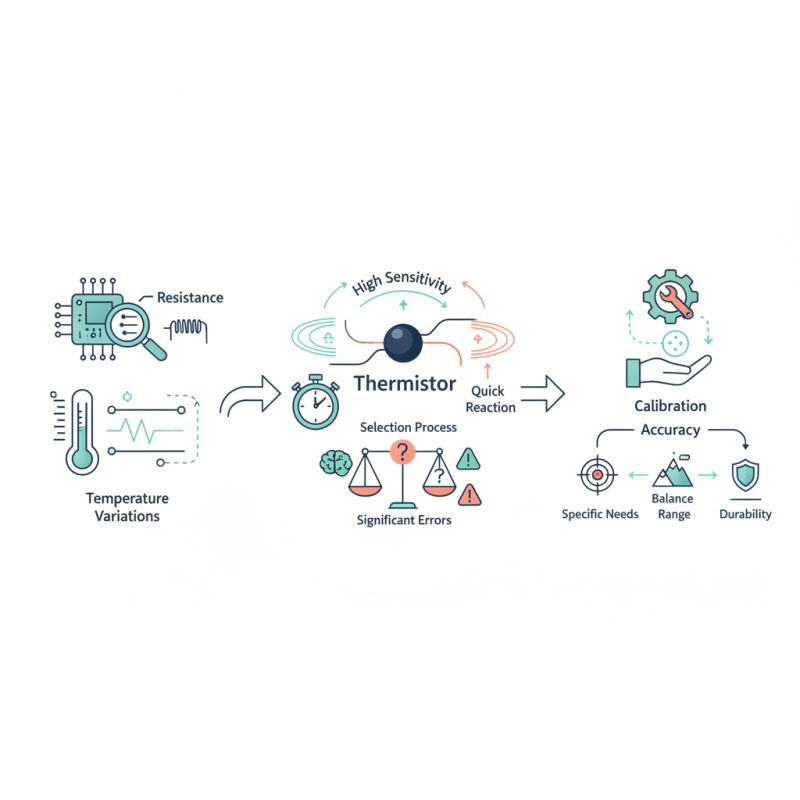
Understanding Thermistor Sensitivity involves grasping how temperature variations affect resistance. A high sensitivity thermistor reacts quickly, which is vital in various applications. However, not all thermistors are made equal. The selection process can be daunting, as incorrect choices lead to significant errors.
Moreover, manufacturers often overlook the calibration of thermistors. Calibration is not just a formality; it can greatly influence accuracy. The quest for the ideal thermistor necessitates careful consideration of specific needs. Creating a balance between sensitivity, range, and durability is indeed a challenging endeavor.
Understanding Thermistor Sensitivity: Key Factors for Measurement Accuracy
Thermistors are crucial in temperature measurement. Their sensitivity greatly affects accuracy. Several key factors influence how precise these measurements can be.
The type of thermistor plays a significant role. Negative Temperature Coefficient (NTC) thermistors offer high sensitivity within certain ranges. According to industry reports, NTC thermistors can have sensitivity factors ranging from 3 to 10% per degree Celsius in typical applications. This means even small temperature changes lead to notable resistance variations, enhancing measurement precision.
Environmental conditions also impact the performance of thermistors. For example, humidity can alter a thermistor's resistance, leading to errors. It's essential to consider such factors when using thermistors in critical applications. Additionally, the calibration process is often overlooked but is vital. Inaccurate calibration can create substantial discrepancies in readings, undermining the reliability of the data collected.
Thermistor Types: NTC vs. PTC and Their Sensitivity Characteristics
Thermistors are vital in temperature sensing. They come in two main types: NTC (Negative Temperature Coefficient) and PTC (Positive Temperature Coefficient). NTC thermistors decrease resistance as temperature rises. This feature allows for sensitive and rapid temperature changes detection. According to a study by the National Institute of Standards and Technology, NTC thermistors can achieve temperature sensitivity of about 0.1°C.
In contrast, PTC thermistors increase their resistance with temperature, making them less sensitive to small fluctuations. They are often used for overcurrent protection rather than precise temperature measurements. Research indicates PTC thermistors exhibit a sensitivity of around 0.5°C under constant environmental conditions.
**Tips:** When selecting a thermistor, consider your application. NTC types are ideal for precise measurements. Ensure you assess their resistance tolerance and temperature range. Also, remember that environmental factors can impact readings, so calibrating your thermistor regularly is essential.
Choosing the right thermistor requires careful consideration. Understand the sensitivity characteristics of each type. While NTCs are commonly favored for accuracy, their non-linear response may require complex circuitry. Weighing these factors will lead to better measurement reliability.
Thermistor Sensitivity Factors for Accurate Measurements
This chart illustrates the sensitivity factors of NTC (Negative Temperature Coefficient) and PTC (Positive Temperature Coefficient) thermistors. NTC thermistors typically exhibit higher sensitivity, making them suitable for precise temperature measurements.
Temperature Range Impact on Thermistor Sensitivity and Calibration Needs
Thermistors are temperature-sensitive resistors widely used for precise measurements. Their sensitivity varies significantly across temperature ranges. Understanding these variations is crucial for accurate data collection. For example, a thermistor might exhibit high sensitivity at lower temperatures, enabling finer resolution. In contrast, at extreme temperatures, its readings can become erratic or less reliable.
Calibration is fundamental for thermistors to function optimally. The calibration process involves testing the thermistor at specific temperatures and adjusting for discrepancies. Failure to calibrate properly can lead to misleading results, especially in critical applications like medical devices or industrial sensors. The calibration interval should also consider environmental factors, which might influence readings.
When selecting a thermistor, consider its operational range. Not all thermistors perform well beyond certain thresholds. Some may fail or yield inaccurate data if exposed to extreme conditions. This underlines the necessity of pairing the thermistor with a proper calibration protocol tailored to the expected temperature range. Balancing sensitivity with stability can be challenging, yet it is essential for achieving reliable measurements.
Material Selection in Thermistors: Effects on Sensitivity and Performance
Material selection plays a crucial role in the sensitivity and performance of thermistors. Common materials include metal oxides and polymers, each with distinct properties. According to recent industry reports, nickel oxide thermistors exhibit a high sensitivity factor, often exceeding 10,000—ideal for precise temperature measurements. In comparison, thermistors made from polymer materials may show lower sensitivity but offer advantages in a broader temperature range.
The thermal response of thermistors is also influenced by their manufacturing processes. For instance, the sintering temperature and duration can significantly affect resistance characteristics. A report by the International Thermoelectric Society highlights that variations in these parameters can lead to sensitivity differences of up to 25%. Such findings underscore the importance of optimizing fabrication techniques for enhanced accuracy.
Additionally, environmental factors can further complicate material performance. Humidity and mechanical stress may introduce measurement errors. The same report indicates that up to 15% of sensitivity may be compromised in high-humidity environments. Recognizing these limitations is crucial for engineers and researchers to refine thermistor applications and improve measurement reliability in diverse conditions.
Real-World Applications: Optimal Sensitivity for Precision Measurement Solutions
Thermistors are critical in many measurement applications. Their sensitivity plays a significant role in determining the precision of temperature readings. High sensitivity can lead to better accuracy, but it also introduces challenges. A small change in temperature can cause a large shift in resistance. This can lead to measurement errors if not handled properly.
In industrial settings, proper thermistor selection can impact overall system performance. For instance, in HVAC systems, a high-sensitivity thermistor can detect minute temperature changes. This ensures optimal climate control. However, sensitive devices can be prone to noise and fluctuations. This means that careful installation is necessary to mitigate errors.
Researchers and engineers must consider the environment. For instance, thermistors used in humid conditions may require additional protective measures. Understanding material properties is crucial. Using thermistors in well-controlled environments enhances their capabilities. However, this is not always feasible in real-world applications. Balancing sensitivity and environmental factors is an ongoing challenge for precise measurement solutions.
Best Thermistor Sensitivity Factors for Accurate Measurements
Cepex is the brand for the fluid handling market belonging to the Fluidra group. One of the leading european manufacturer of valves and fittings in thermoplastic materials.
Dedicated to the swimming pool, irrigation and industrial markets, we distribute our products worldwide with the Fluidra commercial network and presence in 46 countries with 136 sales branches.
Your data will be processed by CEPEX S.A., with address at C. Lluís Companys, 51-53, 08400, Granollers (Barcelona), and C.I.F. nº A-08928707, to send you communications about our products based on your interests. You can consult more information about the processing of your data and how to exercise your rights as described in the Privacy Policy.
Technical cookies are strictly necessary for our website to work and you can navigate through it. These types of cookies are those that, for example, allow us to identify you, give you access to certain restricted parts of the page if necessary, or remember different options or services already selected by you, such as your privacy preferences. Therefore, they are activated by default, your authorization not being necessary in this regard. Through the configuration of your browser, you can block or alert the presence of this type of cookies, although such blocking will affect the proper functioning of the different functionalities of our website.
The analysis cookies allow us to study the navigation of the users of our website in general (for example, which sections of the page are the most visited, which services are used most and if they work correctly, etc.). From the statistical information on navigation on our website, we can improve both the operation of the page itself and the different services it offers. Therefore, these cookies do not have an advertising purpose, but only serve to make our website work better, adapting to our users in general. By activating them you will contribute to this continuous improvement. You can enable or disable these cookies by checking the corresponding box, being disabled by default.
Functionality cookies allow us to remember your preferences, to personalize certain characteristics and general options of our website, every time you access it (for example, the language in which the information is presented to you, the sections marked as favorites, your browser type, etc.) Therefore, this type of cookies does not have an advertising purpose, but by activating them you will improve the functionality of the website (for example, adapting to your type of browser) and the customization of it based on your preferences (for example, by presenting the information in the language that you have chosen in previous occasions), which will contribute to the ease, usability and comfort of our page during your navigation. You can enable or disable these cookies by checking the corresponding box, being disabled by default.
Advertising cookies allow us to manage the advertising spaces included in our website based on criteria such as the content shown or the frequency in which the ads are displayed. For example, if you have been shown the same ad several times on our website, and you have not shown a personal interest by clicking on it, it will not appear again. In summary, by activating this type of cookies, the advertising shown on our website will be more useful and diverse, and less repetitive. You can enable or disable these cookies by checking the corresponding box, being disabled by default.
Behavioral advertising cookies allow us to obtain information based on the observation of your browsing habits and behaviors on the web, in order to show you advertising content that best suits your personal tastes and interests. To understand it in a very simple way, we will give you a fictitious example: if your last searches on the web were related to suspense literature, we would show you advertising about suspense books. Therefore, activating this type of cookies, the advertising that we show you on our website will not be generic, but will be oriented to your searches, tastes and interests, therefore adjusting exclusively to you. You can enable or disable these cookies by checking the corresponding box, being disabled by default. To understand it in a very simple way, we will give you a fictitious example: if your last searches on the web were related to suspense literature, we would show you advertising about suspense books. Therefore, activating this type of cookies, the advertising that we show you on our website will not be generic, but will be oriented to your searches, tastes and interests, therefore adjusting exclusively to you. You can enable or disable these cookies by checking the corresponding box, being disabled by default.
We use our own and third-party cookies to ensure the proper functioning of the website and to analyse our services, improve your experience on our website and show you advertisements related to your interests according to profiling based on your browsing habits (e.g. websites visited). You can accept all cookies by clicking "ACCEPT" or set or reject them by clicking here. If you would like to know more about the use of cookies, please see our COOKIE POLICY.