
What Is the Best Single Jersey Machine in 2026?
FLUID HANDLING EXPERTS

Blog, all our news

What Is the Best Single Jersey Machine in 2026?

In 2026, the best single Jersey machine depends less on headline speed than on the fabric you need. A mill producing lightweight T-shirts may value different settings from one knitting ribbed or heavier fabrics. Gauge, cylinder diameter, feeder count, yarn compatibility, and electronic controls all affect what a machine can reliably produce. Small details matter. So does local support.

A useful comparison starts with verified specifications, then checks them against real production needs. Ask suppliers for sample fabric knitted with your intended yarn, and inspect stitch consistency, fabric weight, and visible defects. If possible, review the machine running at a realistic speed—not only its maximum rating. Listen for unusual vibration. Check how easily operators can change settings, clean the knitting area, and access replacement parts. These checks give a clearer picture than a brochure alone.

There is no universal winner. A faster machine may not be the best fit if it raises setup complexity or requires service your team cannot readily access. Compare purchase price with energy use, maintenance needs, operator training, and expected downtime. Request written specifications and clarify what is included in the quoted price. Even careful research has limits: sample results may differ with yarn, operator skill, and factory conditions. Treat the final choice as a practical balance, not a perfect answer.
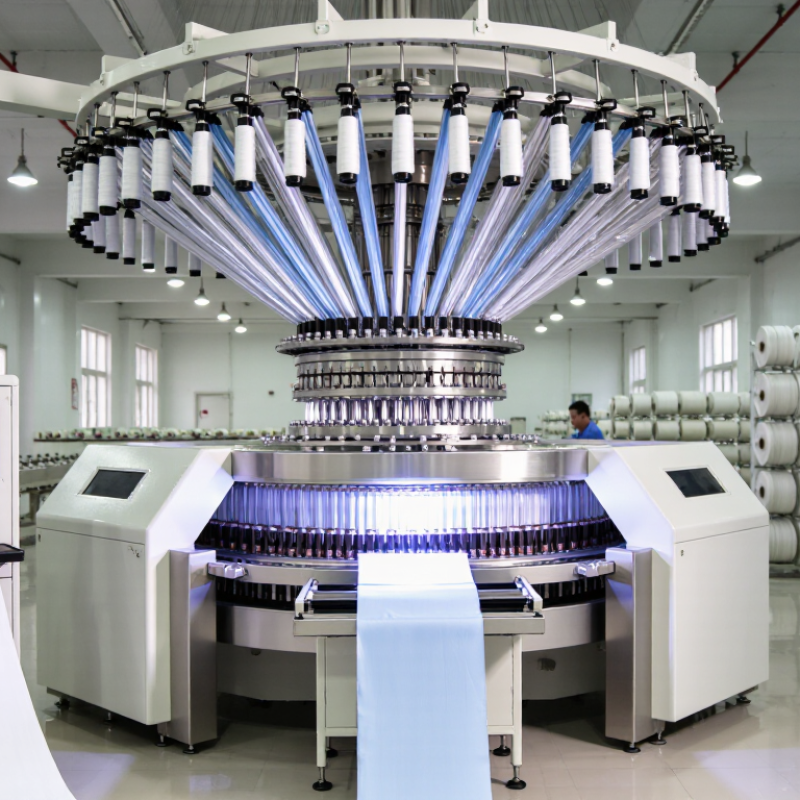
What Is the Best Single Jersey Machine in 2026?

What a Single Jersey Machine Is and How It Works

A single jersey machine is a circular knitting machine that forms fabric with one set of needles arranged around a cylinder. Each needle draws yarn into a new loop, connecting it with the loops already formed. The result is a lightweight knitted fabric with a smooth face and a more textured back. It is commonly used for T-shirts, underwear, and other everyday garments.

Here is the basic action. The cylinder rotates while yarn feeders guide yarn to the needles. Cams lift and lower each needle, controlling when it catches yarn and releases a finished loop. As the fabric grows, a take-down system pulls it downward and keeps the knitting area clear. Small changes matter. Uneven yarn tension or a worn needle can leave visible lines, dropped stitches, or holes in the fabric.

Machine settings depend on the fabric required, including its gauge, yarn type, and desired weight. Operators check yarn tension, needle condition, and fabric take-down during production, rather than relying on one setup for every job. The process sounds straightforward, but diagnosing a faint vertical line can take patience. And judgment. A single jersey fabric may curl at its edges, so finishing and garment construction also affect the final result. There is no universally best setup; the right machine is the one that consistently meets the fabric specification.

Main Types of Single Jersey Machines and Their Fabric Uses

Single-jersey machines form fabric with one needle bed, producing a smooth face and looped back. Standard circular models make lightweight plain jersey for T-shirts, underwear, and linings. The cylinder diameter and needle gauge affect fabric width, stitch density, and yarn choice. A finer gauge can create a smoother surface, but it may require finer yarn and closer tension control.

Special configurations expand the fabric options. Electronic jacquard machines select needles to knit patterns, useful for graphic panels and patterned sportswear. Terry versions use sinkers to form loops on the fabric face, creating absorbent material for casualwear or towels. Open-width machines deliver fabric in a flatter form, which can simplify inspection and cutting. Fast setup matters.

Choose by fabric, not by the machine label alone. For a basic cotton jersey, check stitch consistency across the width and inspect for dropped stitches under steady lighting. For patterned or looped fabrics, test the intended yarn and settings before a long run. A sample may look even on the table, then distort after washing; that part is easy to underestimate. Machine speed is only useful when the fabric remains stable.

Key Criteria for Evaluating Machines in 2026

In 2026, the best single jersey machine depends on the fabric you need and the hours it must run. Compare cylinder diameter and gauge with your target fabric weight; a mismatch can cause uneven loops or limit your product range. Check feeder count, stitch adjustment, and operating speed, but judge speed under sustained production, not during a brief demonstration. Ask to inspect a sample knitted at your intended settings. Look for consistent loop size, clean edges, and few visible defects. A showroom run can mislead.

Maintenance access matters as much as output. Check whether operators can reach needles, cams, and oiling points without awkward dismantling. Review setup instructions, fault alerts, and the availability of replacement parts. If possible, speak with technicians who service similar machines. Compare energy use and fabric waste across realistic shifts, rather than relying on a single quoted figure. I would not treat any checklist as perfect; production conditions vary, and that complicates neat comparisons.

Tips: Bring your yarn. Request a full-shift trial. Record stoppages and fabric defects. Small details count. A machine that is easy to clean may save time, though that advantage is easy to overlook when comparing headline output. Decide which trade-offs your team can actually manage.

Leading Single Jersey Machine Options Compared

Choosing a single jersey machine in 2026 starts with the fabric, not the brochure. For basic cotton T-shirts, a standard circular model can offer steady output and simpler setup. An electronic jacquard option adds pattern control, but raises costs and requires stronger programming skills. Need elastane? Check feeder compatibility, plating consistency, and stitch stability at the intended speed. Small details matter. Compare usable diameter, gauge, feeder count, and changeover time using your own yarn and fabric. Speed claims mean little without specified yarn, stitch length, and downtime allowances.

Industry data offers context, not a winner. ITMF’s International Textile Machinery Shipment Statistics reported that large circular knitting machine shipments fell 16% to about 28,000 units in 2022. That category is broader than single jersey, so it cannot rank individual machine designs. Still, the decline suggests buyers should weigh utilization and service access, not just rated speed. An open-width take-down may help control curling; tubular delivery may suit compact lines and familiar workflows. Ask for trial fabric, measured output, needle-change time, and energy use per kilogram. Then inspect the roll under real lighting. That gap matters. An inexpensive machine may be harder to tune, while added automation can sit idle when styles change slowly.

How to Choose a Machine for Your Production Needs

The best single jersey machine is the one that matches your orders, not the one with the highest advertised speed. Start with fabric specifications: target gauge, finished width, yarn count, and GSM range. A fine-gauge machine may suit lightweight tees, while heavier basics can require a different setup. Ask suppliers to knit your actual yarn, then inspect the swatch for barre, holes, and uneven loops.

ITMF’s 2023 International Textile Machinery Shipment Statistics recorded 25,846 large circular knitting machines shipped worldwide, about 30% fewer than in 2022. This category is broader than single jersey, so the figure is not a machine-quality ranking. It does, however, underline the value of matching investment to realistic demand.

Compare usable output, changeover time, energy use, and operator requirements—not just maximum RPM. Test real fabric.

Consider your production mix. Frequent style changes make easy adjustment and dependable fabric settings more valuable; long runs may reward higher output and fewer interruptions. Check whether local technicians can service the controls and whether critical parts are readily available. Small details matter.

I would question any choice based mainly on speed: a fast machine that needs repeated stops can miss delivery targets. Ask for a production trial using your yarn and target construction, and record output, defects, and adjustment time across a full shift.

Copyright 2025 Fluidra S.A. | Created by BCM Marketing Agencia Privacy Policy Legal note | Cookie policy |

Technical cookies are strictly necessary for our website to work and you can navigate through it. These types of cookies are those that, for example, allow us to identify you, give you access to certain restricted parts of the page if necessary, or remember different options or services already selected by you, such as your privacy preferences. Therefore, they are activated by default, your authorization not being necessary in this regard. Through the configuration of your browser, you can block or alert the presence of this type of cookies, although such blocking will affect the proper functioning of the different functionalities of our website.


The analysis cookies allow us to study the navigation of the users of our website in general (for example, which sections of the page are the most visited, which services are used most and if they work correctly, etc.). From the statistical information on navigation on our website, we can improve both the operation of the page itself and the different services it offers. Therefore, these cookies do not have an advertising purpose, but only serve to make our website work better, adapting to our users in general. By activating them you will contribute to this continuous improvement. You can enable or disable these cookies by checking the corresponding box, being disabled by default.


Functionality cookies allow us to remember your preferences, to personalize certain characteristics and general options of our website, every time you access it (for example, the language in which the information is presented to you, the sections marked as favorites, your browser type, etc.) Therefore, this type of cookies does not have an advertising purpose, but by activating them you will improve the functionality of the website (for example, adapting to your type of browser) and the customization of it based on your preferences (for example, by presenting the information in the language that you have chosen in previous occasions), which will contribute to the ease, usability and comfort of our page during your navigation. You can enable or disable these cookies by checking the corresponding box, being disabled by default.


Advertising cookies allow us to manage the advertising spaces included in our website based on criteria such as the content shown or the frequency in which the ads are displayed. For example, if you have been shown the same ad several times on our website, and you have not shown a personal interest by clicking on it, it will not appear again. In summary, by activating this type of cookies, the advertising shown on our website will be more useful and diverse, and less repetitive. You can enable or disable these cookies by checking the corresponding box, being disabled by default.


Behavioral advertising cookies allow us to obtain information based on the observation of your browsing habits and behaviors on the web, in order to show you advertising content that best suits your personal tastes and interests. To understand it in a very simple way, we will give you a fictitious example: if your last searches on the web were related to suspense literature, we would show you advertising about suspense books. Therefore, activating this type of cookies, the advertising that we show you on our website will not be generic, but will be oriented to your searches, tastes and interests, therefore adjusting exclusively to you. You can enable or disable these cookies by checking the corresponding box, being disabled by default.
To understand it in a very simple way, we will give you a fictitious example: if your last searches on the web were related to suspense literature, we would show you advertising about suspense books. Therefore, activating this type of cookies, the advertising that we show you on our website will not be generic, but will be oriented to your searches, tastes and interests, therefore adjusting exclusively to you. You can enable or disable these cookies by checking the corresponding box, being disabled by default.

SAVE

We use our own and third-party cookies to ensure the proper functioning of the website and to analyse our services, improve your experience on our website and show you advertisements related to your interests according to profiling based on your browsing habits (e.g. websites visited). You can accept all cookies by clicking "ACCEPT" or set or reject them by clicking here. If you would like to know more about the use of cookies, please see our COOKIE POLICY.


ACCEPT ALL
Reject no essentials


