
7 Best LFP Battery BMS for Solar Energy Storage
FLUID HANDLING EXPERTS

Blog, all our news

7 Best LFP Battery BMS for Solar Energy Storage

A solar storage system depends on more than its battery cells. The battery management system monitors cell voltage, temperature, and current during everyday charging and discharging. An Lfp Battery Bms can also help prevent overcharge, excessive discharge, and unsafe operating conditions. These safeguards matter when a battery sits in a hot garage, runs overnight, or supplies a sudden load. Small settings matter. A protection feature is only useful when it suits the battery pack and inverter.

This guide compares seven LFP battery BMS options for solar energy storage, focusing on practical specifications rather than impressive-sounding claims. We consider continuous and peak current ratings, cell balancing, temperature sensors, communication support, and configuration flexibility. Compatibility deserves close attention: a BMS may support CAN or RS485, yet still fail to communicate correctly with a particular inverter. Check the battery maker’s voltage limits and wiring guidance before choosing a unit. A low purchase price can be appealing, but unclear documentation or limited support may create extra work later. The best option is not automatically the one with the most features. It is the one that matches your battery, solar setup, and monitoring needs—with enough reliable protection for real operating conditions. Some product specifications leave important details unclear, so verify them with the manufacturer before installation.
7 Best LFP Battery BMS for Solar Energy Storage

LFP Cell Fundamentals: 3.2 V Nominal Voltage and Typical Charge Limits

An LFP cell has a nominal voltage of 3.2 V. That is a reference value, not its voltage at every moment. A common upper charging limit is 3.65 V per cell, but the cell manufacturer’s data sheet should set the final limit. For a 16-cell series bank, those figures correspond to 51.2 V nominal and 58.4 V at the upper limit. Do not assume every battery or BMS uses the same settings.

Tips: Check voltage limits per cell, not just at pack level. Confirm that the charger and BMS settings agree.

For longer service life, some systems use a lower charge target, often around 3.45–3.55 V per cell. This is a practical range, not a universal rule; it can also affect when cell balancing occurs. During commissioning, compare individual cell readings near the top of charge. A pack-level reading can hide one cell reaching its limit early. LFP voltage stays relatively flat through much of its usable range, so voltage alone can also give a misleading state-of-charge estimate. It is easy to overlook that detail. Recheck settings after changing the number of series cells, and follow the limits for charging temperature in the cell documentation.

BMS Functions: Cell Monitoring, Temperature Sensing, and Balancing

7 Best LFP Battery BMS for Solar Energy Storage

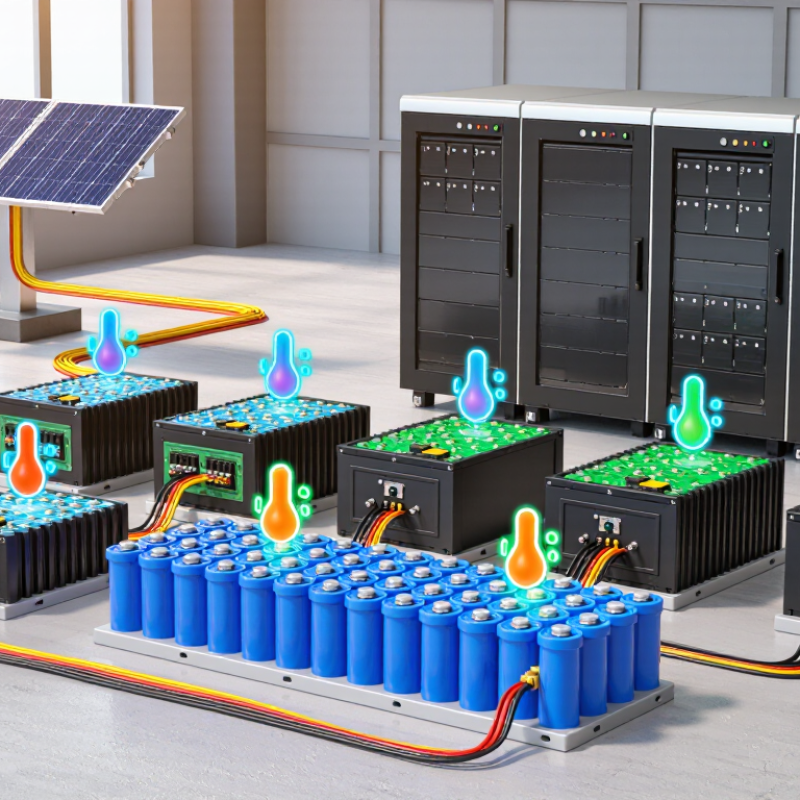
A dependable LFP battery management system begins with accurate cell monitoring. It tracks each cell’s voltage, rather than relying only on the battery’s overall reading. During charging, one cell can reach its upper limit before the others. The BMS can then reduce or stop charging to help protect the pack. Useful records of voltage changes may also help identify a weak connection or a cell that behaves differently over time.

Temperature sensing matters just as much. Sensors should monitor relevant areas of the battery, not just the enclosure’s coolest corner. If temperatures move outside the battery maker’s specified operating range, the BMS can limit charging or discharging. Cell balancing helps reduce voltage differences between cells, especially as the pack approaches full charge.

Passive balancing is simpler, but it can shed energy as heat. Active balancing transfers energy, though its added complexity may not suit every installation. Neither approach fixes a damaged cell. That distinction is easy to overlook.

Tips: Check that the BMS monitors individual cell voltages and has multiple temperature sensors. Review its alarm settings and balancing behavior before installation. Keep clear records; a tidy display can still hide a drifting cell.

Seven Solar LFP BMS Options Compared by Voltage, Current, and Connectivity

For solar LFP storage, choose a BMS by pack voltage, continuous current, and inverter communication—not headline amperage alone.
Seven practical fits are 12V/100A and 12V/200A units for compact systems; 24V/100A and 24V/200A units for mid-sized banks; 48V/100A and 48V/200A units for common home storage; and a high-voltage stack BMS for larger modular systems. These are selection categories, not universal ratings.
At 48V, 100A represents roughly 4.8kW before losses, so check the inverter’s sustained draw and surge demand. A rating printed on a case is not the whole story.

Connectivity can decide whether a technically suitable BMS works smoothly. CAN or RS-485 lets compatible inverters read battery limits and state-of-charge data; Bluetooth is useful for checking cell voltages beside the cabinet, but is not a substitute for system-level communication.
The IEA’s Batteries and Secure Energy Transitions report says battery storage capacity needs to reach 1,200GW by 2030 in its Net Zero pathway, underscoring the need for interoperable systems. NREL’s 2024 Annual Technology Baseline uses four-hour battery storage as a utility-scale reference. That is useful context, not a residential design rule.
A less glamorous check matters: confirm cell count, temperature-sensor inputs, parallel-battery support, and firmware compatibility. These details are easy to miss.

Selection Criteria: IEC 62619 Safety, CAN Bus, and System Expandability

A reliable LFP battery BMS should protect cells and communicate clearly with the inverter. IEC 62619 is a useful safety reference, but check exactly what the certificate covers. It may apply to the battery, cells, or tested configuration, not every component in a storage system. Ask for test documentation and confirm that the installed battery matches the certified design.

CAN Bus support matters only when devices can exchange the right information. Check the inverter’s supported protocol, message settings, and firmware requirements before buying. A matching connector does not guarantee compatibility. During commissioning, verify that the inverter reads battery voltage, state of charge, and alarm status correctly. Test it early. A quiet fault is still a fault.

For system expandability, review the BMS limits on parallel battery units, total current, and module count. Confirm how units are addressed and whether their firmware versions must match. Leave room for future cables and isolation equipment in the battery cabinet; cramped wiring is easy to regret. More capacity is not always a simple addition. Recheck the manufacturer’s configuration guidance whenever the system grows.

Solar Storage Efficiency: DOE Reports 85–95% Round-Trip Efficiency for Li-Ion Batteries

For solar storage, round-trip efficiency shows how much energy remains after charging and discharging. The U.S. Department of Energy’s 2022 Grid Energy Storage Technology Cost and Performance Assessment uses about 85% efficiency for lithium-ion systems. Higher figures, sometimes near 95%, can describe favorable conditions or narrower measurement boundaries. They should not be treated as a guaranteed home-system result. Small losses add up.

A well-configured LFP battery management system can support efficiency by balancing cells, monitoring temperature, and limiting unsafe current. But the BMS is only one part of the path. Inverter conversion, wiring, cooling, standby power, and charge rate also affect usable energy. NREL’s Annual Technology Baseline likewise models utility-scale battery storage at roughly 85% round-trip efficiency. Compare systems using the same measurement boundary and operating conditions. A warm battery room and moderate charging may perform differently from a cold garage and rapid charging. That difference matters. A BMS display can also report estimates, not laboratory measurements, so real-world tracking deserves some skepticism. When sizing solar storage, check whether quoted efficiency includes the inverter and auxiliary loads, and whether the figure applies across the battery’s full operating range.

7 Best LFP Battery BMS for Solar Energy Storage

Solar Storage Efficiency: DOE Reports 85–95% Round-Trip Efficiency for Li-Ion Batteries

Selection Priority Relevant Technical Data Why It Matters for Solar Storage What to Check
1. Correct series-cell configuration A common 16-series (16S) LFP pack has a nominal voltage of about 51.2 V, using 3.2 V nominal per cell. The BMS cell-count configuration must match the battery pack. A mismatch can cause incorrect voltage protection and charging behavior. Confirm the BMS supports the pack’s exact series count and the inverter’s battery-voltage range.
2. Cell-voltage protection Many LFP cell specifications list 3.65 V per cell as an upper charging-voltage limit. The cell manufacturer’s limits take precedence. Per-cell monitoring can detect an individual cell reaching its voltage limit before the overall pack voltage appears abnormal. Check configurable overvoltage and undervoltage thresholds, measurement accuracy, and recovery behavior.
3. Balancing suited to the pack BMS designs may use passive balancing, which dissipates excess energy as heat, or active balancing, which transfers energy between cells. Balancing helps keep cell voltages aligned; it does not increase the cells’ rated capacity or replace proper charging limits. Review balancing start conditions, balancing current, and whether balancing operates during charging, standby, or both.
4. Current protection matched to the system Allowable charge and discharge current depends on the cells, pack wiring, busbars, inverter, and protective devices; there is no single suitable rating for every system. Solar charging and inverter loads can impose different current demands. Protection must be coordinated with the complete system. Compare continuous and peak current ratings with the battery and inverter specifications, and verify short-circuit protection requirements.
5. Temperature monitoring and charge limits Charging temperature limits are cell-specific. Many standard LFP cells are not to be charged below 0°C (32°F) unless the cell specification explicitly permits it. Outdoor and unheated installations may encounter temperatures that require the BMS to stop charging or activate an approved heating system. Check sensor placement, low- and high-temperature cutoffs, and any permitted heater-control function against the cell datasheet.
6. Verified inverter communications Battery systems may use CAN or RS-485 communications, but using the same interface does not guarantee protocol compatibility. Correct communication can provide battery limits and status to a compatible inverter; unsupported protocols may prevent reliable coordination. Verify the exact protocol, wiring, firmware requirements, and supported charge/discharge settings for the intended inverter.
7. Useful monitoring and fault records Depending on the design, a BMS may report cell voltages, pack current, temperature, state estimates, alarms, and protection events. Clear monitoring can help identify imbalance, temperature issues, or protection trips that affect system availability. Check which data are available locally and remotely, how alarms are retained, and whether access works without cloud connectivity.

Efficiency context: The 85–95% round-trip-efficiency range in the title is a broad reference for lithium-ion battery systems, not a guaranteed efficiency for every LFP installation or a measure of BMS efficiency alone. Actual system performance depends on the battery, inverter, operating conditions, auxiliary loads, and measurement boundaries. Confirm cell-specific voltage, current, and temperature limits in the battery manufacturer’s datasheet.

Copyright 2025 Fluidra S.A. | Created by BCM Marketing Agencia Privacy Policy Legal note | Cookie policy |

Technical cookies are strictly necessary for our website to work and you can navigate through it. These types of cookies are those that, for example, allow us to identify you, give you access to certain restricted parts of the page if necessary, or remember different options or services already selected by you, such as your privacy preferences. Therefore, they are activated by default, your authorization not being necessary in this regard. Through the configuration of your browser, you can block or alert the presence of this type of cookies, although such blocking will affect the proper functioning of the different functionalities of our website.


The analysis cookies allow us to study the navigation of the users of our website in general (for example, which sections of the page are the most visited, which services are used most and if they work correctly, etc.). From the statistical information on navigation on our website, we can improve both the operation of the page itself and the different services it offers. Therefore, these cookies do not have an advertising purpose, but only serve to make our website work better, adapting to our users in general. By activating them you will contribute to this continuous improvement. You can enable or disable these cookies by checking the corresponding box, being disabled by default.


Functionality cookies allow us to remember your preferences, to personalize certain characteristics and general options of our website, every time you access it (for example, the language in which the information is presented to you, the sections marked as favorites, your browser type, etc.) Therefore, this type of cookies does not have an advertising purpose, but by activating them you will improve the functionality of the website (for example, adapting to your type of browser) and the customization of it based on your preferences (for example, by presenting the information in the language that you have chosen in previous occasions), which will contribute to the ease, usability and comfort of our page during your navigation. You can enable or disable these cookies by checking the corresponding box, being disabled by default.


Advertising cookies allow us to manage the advertising spaces included in our website based on criteria such as the content shown or the frequency in which the ads are displayed. For example, if you have been shown the same ad several times on our website, and you have not shown a personal interest by clicking on it, it will not appear again. In summary, by activating this type of cookies, the advertising shown on our website will be more useful and diverse, and less repetitive. You can enable or disable these cookies by checking the corresponding box, being disabled by default.


Behavioral advertising cookies allow us to obtain information based on the observation of your browsing habits and behaviors on the web, in order to show you advertising content that best suits your personal tastes and interests. To understand it in a very simple way, we will give you a fictitious example: if your last searches on the web were related to suspense literature, we would show you advertising about suspense books. Therefore, activating this type of cookies, the advertising that we show you on our website will not be generic, but will be oriented to your searches, tastes and interests, therefore adjusting exclusively to you. You can enable or disable these cookies by checking the corresponding box, being disabled by default.
To understand it in a very simple way, we will give you a fictitious example: if your last searches on the web were related to suspense literature, we would show you advertising about suspense books. Therefore, activating this type of cookies, the advertising that we show you on our website will not be generic, but will be oriented to your searches, tastes and interests, therefore adjusting exclusively to you. You can enable or disable these cookies by checking the corresponding box, being disabled by default.

SAVE

We use our own and third-party cookies to ensure the proper functioning of the website and to analyse our services, improve your experience on our website and show you advertisements related to your interests according to profiling based on your browsing habits (e.g. websites visited). You can accept all cookies by clicking "ACCEPT" or set or reject them by clicking here. If you would like to know more about the use of cookies, please see our COOKIE POLICY.


ACCEPT ALL
Reject no essentials


