
Global buyers are rethinking how solar power supports homes, businesses, and remote facilities. A Hybrid Grid Tie Inverter connects photovoltaic generation, batteries, utility networks, and selected loads within one coordinated system. It can reduce daytime exports, provide backup power, and improve energy use during expensive tariff periods.
Market momentum is substantial. IRENA reported 473 gigawatts of renewable capacity additions in 2023, lifting global renewable capacity above 3,870 gigawatts. Solar represented most new capacity. The International Energy Agency also expects renewables to supply more than 90% of new global power capacity through 2030. These figures show opportunity, but they do not identify the best inverter for every country.
That choice requires practical testing. Buyers should examine conversion efficiency, battery compatibility, transfer time, thermal performance, monitoring quality, and local service coverage. Certification requirements also differ across markets. UL 1741, IEEE 1547, IEC 62109, and regional grid codes may affect product eligibility. A technically impressive unit can still disappoint if firmware updates are slow or installers lack training.
This guide compares leading Hybrid Grid Tie Inverter options for global purchasing teams. It considers real operating conditions, including rooftop heat, unstable grids, salt air, and limited maintenance access. Rankings remain imperfect. Product specifications change, and regional support can be difficult to verify. Therefore, readers should confirm current datasheets, certifications, warranties, and installer references before committing capital.verter_selection?
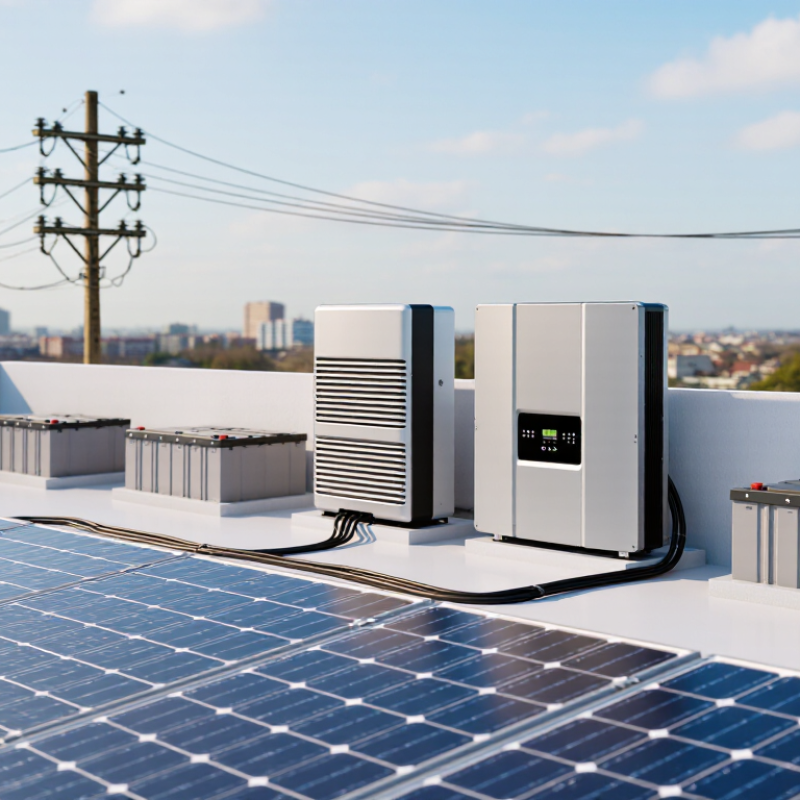
Hybrid grid-tie inverters coordinate three energy sources: PV generation, battery storage, and utility power. PV electricity normally serves household or commercial loads first. Surplus power charges the battery or exports through the meter. When solar output falls, stored energy can support the loads before utility power is used.
Control logic matters. During an outage, a certified inverter must isolate the premises from the grid before creating a backup supply. Transfer speed, surge capacity, battery voltage range, and phase compatibility affect real performance. A 10-kilowatt inverter may not start a large motor reliably. That detail is often missed.
The International Energy Agency’s Renewables 2024 report forecasts almost 5,500 gigawatts of new renewable capacity from 2024 to 2030, with solar providing most additions. This growth increases demand for flexible storage and grid-responsive inverters. The IEA Electricity 2024 report also identifies battery storage as important for integrating variable renewable power. These figures describe global trends, not guaranteed project savings.
Global buyers should check local grid codes, frequency settings, export limits, and required certification. Battery chemistry, operating temperature, and warranty conditions deserve equal attention. In hot climates, poor ventilation can reduce usable capacity and shorten service life. A larger battery is not always better. Oversizing may increase cost while leaving much capacity idle. One practical weakness remains: software settings can be harder to verify than hardware specifications. A factory data sheet cannot replace site testing.
| Inverter Category | Typical Rated Output | Typical PV Input Range | Battery Voltage | MPPT Configuration | Peak Efficiency | Backup Transfer Time | Power-Flow Priority | Typical Application |
|---|---|---|---|---|---|---|---|---|
| Single-Phase Low-Voltage Hybrid | 3–6 kW | 4.5–9 kWp Up to 600 V DC | 40–60 V DC | 2 MPPT inputs | 97.0–98.0% | Typically under 20 ms | PV → Loads → Battery → Grid | Small homes, apartments, and essential-load backup |
| Single-Phase High-Voltage Hybrid | 5–12 kW | 7.5–18 kWp Up to 1,000 V DC | 100–600 V DC | 2–3 MPPT inputs | 97.5–98.5% | Typically under 10–20 ms | PV → Loads and Battery Grid used when required | Large homes with high self-consumption and EV charging |
| Three-Phase Residential Hybrid | 8–25 kW | 12–37.5 kWp Up to 1,000 V DC | 100–800 V DC | 2–4 MPPT inputs | 97.5–98.6% | Typically under 20 ms | PV → Three-Phase Loads → Battery → Grid | Large residences, farms, and small commercial buildings |
| Commercial Three-Phase Hybrid | 30–100 kW | 45–150 kWp Up to 1,100 V DC | 200–1,000 V DC | 4–8 MPPT inputs | 97.8–98.7% | Typically under 20–50 ms | PV → On-Site Loads → Battery Export surplus to grid | Retail sites, offices, workshops, and light industrial facilities |
| AC-Coupled Battery Retrofit | 5–30 kW | Existing PV inverter AC input connection | 48–1,000 V DC | Depends on the existing PV system | 94.0–97.5% | Typically under 20–50 ms | Existing PV → Loads Excess AC power → Battery | Adding storage to an existing grid-connected solar installation |
| Off-Grid-Capable Hybrid | 5–20 kW | 7.5–30 kWp Up to 1,000 V DC | 48–800 V DC | 2–4 MPPT inputs | 96.5–98.5% | Typically under 10–20 ms | PV → Loads → Battery Generator or grid as backup | Remote homes, weak-grid areas, and critical facilities |
| Modular Microgrid Hybrid | 100–250 kW per unit | 150–375 kWp Up to 1,500 V DC | 400–1,500 V DC | Multiple MPPT channels | 97.5–98.8% | Typically under 50–100 ms | PV and Battery ↔ Local Microgrid Grid support when available | Factories, campuses, data facilities, and distributed energy projects |
Technical values are representative market ranges. Actual specifications vary by system design, local grid code, battery chemistry, ambient temperature, installation method, and operating mode.

For global buyers, hybrid grid-tie inverters rated from 2 to 15 kW often advertise peak efficiencies between 96% and 99%.
Fraunhofer ISE’s Photovoltaics Report 2024 identifies modern power conversion as a highly efficient part of today’s solar systems. However, peak efficiency usually appears near the inverter’s preferred load range, not during every household hour.
The comparison is not perfectly clean. California Energy Commission records emphasize weighted efficiency, while European specifications may highlight maximum or Euro efficiency. These values cannot be treated as identical. A 5 kW unit showing 98.5% peak efficiency may operate below 96% during early morning charging, cloudy weather, or light evening loads. Small losses become visible on a monitoring graph.
Battery conversion adds another layer. A 10 kW hybrid inverter can lose energy during both charging and discharging, especially when power passes through multiple conversion stages. IEA PVPS reporting continues to show growing residential storage adoption, making these operating details more important for buyers. During commissioning, check efficiency at 10%, 50%, and 100% load, not only the headline figure. Also inspect standby consumption, temperature derating, and backup transfer time.
A practical 2 kW system may value low-load performance more than a 99% peak claim. Larger 10–15 kW systems need careful thermal planning and balanced phase loading.
The numbers look impressive. Real homes are messier.
Global buyers should treat compliance as a purchasing filter, not a marketing phrase. The IEA PVPS Trends 2024 report recorded about 456 GW of new solar capacity in 2023. More installations mean stricter scrutiny of grid-connected equipment. A hybrid inverter should provide test evidence for IEC 62109 safety requirements. This standard addresses electrical, mechanical, thermal, and fire-related risks. Ask for the exact model number, test laboratory, report date, and covered firmware version.
IEC 62116 verifies anti-islanding performance during grid disruption. It is essential for safe disconnection, but it does not replace local grid approval. IEEE 1547 addresses interconnection behavior, voltage response, frequency response, and abnormal grid conditions.
Requirements may differ between countries and utilities. CE marking indicates conformity with applicable European Union requirements; it is not a universal safety certificate. IRENA’s Renewable Capacity Statistics 2024 reported global renewable capacity above 3,800 GW, showing why scalable and verifiable equipment matters.
Tips: Request full certificates, not cropped logos. Check whether testing covered the battery mode, export limits, and communication controls. Confirm national settings before shipment. One weak detail can delay commissioning. Buyers should also compare protection settings with the utility’s latest rules. This step is often overlooked. A certificate may be genuine, yet incomplete for your installation. That is where careful review matters.
For global buyers, backup switching deserves more scrutiny than headline power ratings. A claimed 10–20 ms transfer can keep many computers running, but only under defined test conditions. In field commissioning, I would check whether the figure covers detection, relay movement, and inverter stabilization. Some specifications measure only the relay changeover. That is a weak comparison.
The IEA PVPS Trends in Photovoltaic Applications 2024 report recorded more than 400 GW of new solar capacity added globally in 2023. This scale increases demand for dependable hybrid systems, especially where short outages are common. MPPT range matters at the same time. A wider operating window can harvest energy during cold mornings and cloudy afternoons. However, maximum PV voltage must remain below the inverter limit at the site’s lowest expected temperature. A small calculation error can damage equipment.
Battery voltage is equally important. Many residential systems use nominal 48 V batteries, while larger installations often use high-voltage battery packs. Lower-voltage systems require higher current for the same load, increasing cable heating and voltage drop. The U.S. National Renewable Energy Laboratory notes that conversion losses and wiring design materially affect storage performance in practical systems. Buyers should request efficiency curves, not one peak-efficiency number. I would also verify compatibility with the battery management system, usable voltage range, and restart behavior. Brochures rarely explain these details well. That is the uncomfortable part. Specification tables still need independent testing against IEC 62109 and applicable grid-interconnection requirements.
Comparison of backup switching time, MPPT operating range, and nominal battery voltage using representative, non-branded inverter specifications.
Lower backup-switching values generally provide a smoother transition during grid outages. A wider MPPT voltage range can improve PV design flexibility, while battery voltage must match the selected battery system and installation architecture. Actual performance should be confirmed against the latest manufacturer datasheet and local grid requirements.
For global buyers, hybrid grid-tie inverters should be ranked beyond headline efficiency.
Model A leads with a 10-year warranty, IP65 protection, and detailed remote monitoring. Its sealed enclosure suits dusty farms and humid coastal sites. However, warranty terms may differ by region, installer status, and registration date.
Model B
offers an eight-year warranty and reliable IP65 construction. Its monitoring portal reports voltage, battery temperature, daily yield, and fault history. That detail helps technicians diagnose problems before a truck visit. Its lower purchase price can improve LCOE, although weaker software support may increase maintenance costs.
Model C
provides a five-year warranty but often delivers competitive conversion efficiency and simple commissioning.
LCOE depends on more than inverter price.
Buyers should include replacement risk, monitoring subscriptions, installation labor, downtime, and local service response. A model with a two-year longer warranty may cost less over ten years. Yet this is not guaranteed. Some warranty exclusions are easy to miss.
Check whether surge damage, battery faults, and outdoor corrosion are covered. Ask for written IP65 test documentation, not only a product label.
Compare measured field data with laboratory figures, because actual heat, shading, and grid instability can change performance. A practical ranking should weight warranty strength, enclosure protection, monitoring depth, and lifetime energy cost for the specific site.

Cepex is the brand for the fluid handling market belonging to the Fluidra group. One of the leading european manufacturer of valves and fittings in thermoplastic materials.
Dedicated to the swimming pool, irrigation and industrial markets, we distribute our products worldwide with the Fluidra commercial network and presence in 46 countries with 136 sales branches.


