
7 Best Aluminum Profiles for Solar Panel Frames
FLUID HANDLING EXPERTS

Blog, all our news

7 Best Aluminum Profiles for Solar Panel Frames

Choosing the right Aluminum Profile For Solar Panel Frame is a practical decision that affects panel support, installation, and long-term durability. A frame must hold the module securely while facing wind, rain, temperature changes, and repeated handling. Small details matter. Profile shape, wall thickness, alloy, and surface finish can all influence how well a frame performs in a particular system.

This guide introduces seven common aluminum profile options for solar panel frames, from compact sections for lightweight modules to stronger designs for larger panels. Each option has different trade-offs in stiffness, weight, fabrication, and mounting convenience. A deeper channel may improve rigidity, for example, but it can also add material and affect assembly. The right choice depends on panel dimensions, support spacing, mounting hardware, exposure conditions, and the manufacturer’s specifications. There is no universal winner.

In practice, compare profile drawings and verified material data rather than relying on appearance alone. Check dimensions, alloy and temper information, coating details, and compatibility with the intended clamps. If a supplier cannot provide clear specifications, ask before committing. That step is easy to skip. It should not be. This overview offers a starting point, not a substitute for engineering review or product-specific installation guidance. Some designs may look efficient on paper yet prove awkward during assembly; that possibility deserves honest attention. Use the seven profiles as a shortlist, then confirm that the selected frame suits the actual module and mounting system.
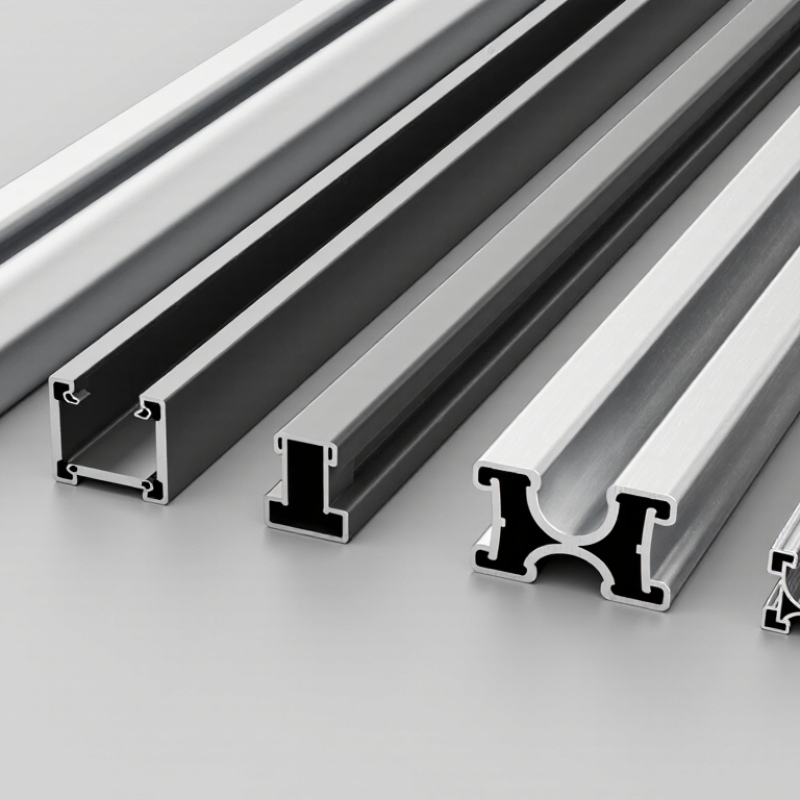
7 Best Aluminum Profiles for Solar Panel Frames

What Aluminum Profiles Do in Solar Panel Frames

Aluminum profiles form the rigid perimeter around a solar module. They help hold the glass, cells, and backsheet together, while protecting fragile laminate edges during transport and installation. Their channels also provide mounting surfaces for clamps and rails. Small details matter. A poorly placed clamp can concentrate force near the glass edge, so profile geometry and approved clamping zones must work together.

The need for reliable frame design is growing with deployment. IRENA’s Renewable Capacity Statistics 2025 reports that global solar capacity reached about 1,865 GW by the end of 2024, after roughly 452 GW was added that year. This figure describes solar capacity, not frame performance, but it shows the scale at which consistent component design matters. Extruded profiles are often selected for their balance of low weight, stiffness, and corrosion resistance. Alloy temper, wall thickness, corner joints, and surface treatment still affect performance. A heavier profile is not automatically safer; support spacing and fastener placement matter too. Not by itself. Drainage paths should also let water escape rather than collect inside the frame. Designers should verify the module’s tested load limits and installation instructions, because one profile cannot suit every climate or mounting system. Even a sound design deserves a second check.

7 Best Aluminum Profiles for Solar Panel Frames — What Aluminum Profiles Do in Solar Panel Frames

The profile dimensions below are indicative design ranges, not universal specifications. Actual sections depend on the module, glass and laminate thickness, mounting system, loads, and applicable standards. Confirm dimensions and alloy temper with the profile supplier and module design.

Aluminum profile type Typical section dimensions (mm) Common alloy and temper What it does in a solar panel frame Advantages Design considerations
1. Standard perimeter frame Frame depth: about 30–40; visible face width: about 8–15 Common extrusion choices include 6005-T5 and 6063-T5 Encloses the module edges, supports the glass-and-laminate assembly, and provides a practical interface for mounting. Widely adaptable to conventional framed modules; balances stiffness, weight, and material use. Match the channel and retaining lips to the module stack thickness, sealant or gasket, and corner-joint method.
2. Deep-section perimeter frame Frame depth: about 40–50; visible face width: about 10–18 Often specified in 6005-T5 or 6061-T6, depending on design requirements Provides a deeper section for applications where added frame rigidity or a taller mounting interface is needed. Greater section depth can improve bending stiffness without requiring a solid section. More depth may add material and module thickness; structural performance still depends on geometry, alloy, joints, and support spacing.
3. Low-profile perimeter frame Frame depth: about 25–35; visible face width: about 8–15 Commonly 6063-T5 or 6005-T5 Frames modules where a lower edge profile or reduced overall frame depth is preferred. Can reduce frame height and material compared with a deeper section. Reduced section depth can limit stiffness; verify structural loads, handling requirements, and mounting compatibility.
4. Wide-lip retaining profile Frame depth: about 30–40; retaining lip or face width: about 12–20 Common choices include 6063-T5 and 6005-T5 Uses a broader retaining face to overlap and secure the module edge, subject to the module’s approved frame design. Offers a larger contact area for edge retention and can accommodate some assembly designs with wider frame faces. Keep the retaining geometry clear of the active cell area and ensure it does not create excessive stress on the glass edge.
5. Drainage-channel profile Frame depth: about 30–45; channel dimensions are design-specific Commonly 6005-T5 or 6063-T5 Incorporates a channel or openings intended to help manage water at the module perimeter. Can provide a defined path for water to exit the frame area when correctly designed and installed. Drainage details must avoid water traps and remain compatible with the module orientation, seals, and cleaning conditions.
6. Reinforced-corner-compatible profile Frame depth: about 30–45; internal joint features vary by corner design Often 6005-T5 or 6063-T5 Provides internal pockets, grooves, or shoulders designed to work with corner keys or other frame-joining methods. Supports repeatable assembly and helps keep frame corners aligned. Corner strength depends on the complete joint, including the key or fastener, fit, tolerances, and assembly process.
7. Mounting-interface-integrated profile Frame depth: about 30–50; mounting groove or slot is system-specific Commonly 6005-T5 or 6063-T5 Includes a groove, channel, or shaped surface intended to engage compatible clamps or mounting hardware. Can simplify the interface between the module frame and a compatible mounting system. Check clamp position, engagement, fastener loads, and installation instructions; a profile feature alone does not establish system compatibility.

Key Criteria for Evaluating Solar Frame Profiles

A solar frame profile should be judged by more than its weight or price. Check the alloy and temper, then compare the supplier’s mechanical data with the project’s expected wind, snow, and handling loads. A lightweight section may look efficient but flex too much across a long span. Ask for test data or engineering calculations rather than relying on appearance.

Corrosion protection matters at cut edges, bolt holes, and drainage channels, where water can collect. In coastal or humid settings, inspect the coating specification and consider contact with dissimilar metals. Small details matter. Examine the clamp zones, wall thickness, and dimensional tolerances; slight variation can make assembly uneven or loosen panel support. I have seen drainage treated as an afterthought, though trapped water can undermine an otherwise sound design.

Also compare profile geometry with the panel dimensions, mounting hardware, and thermal movement expected across the installation. Aluminum expands with temperature changes, so connection details should allow suitable movement without stressing the glass or loosening fasteners. There is no single profile that suits every roof or ground mount. A sample section is useful, but one sample cannot reveal production consistency; that part deserves a closer check.

Seven Aluminum Profile Types for Solar Panel Frames

Seven aluminum profile types serve different roles in solar panel frames and mounting structures. T-slot extrusions allow adjustable brackets and neat cable clips. Rectangular hollow sections resist bending while keeping weight manageable. Square tubes offer a simple, sturdy option for short support spans. Fit matters.

C-channels provide a flat mounting face and open access for bolts. U-channels can cradle panel edges or smaller rails, but their orientation affects drainage. L-angles work well as corner braces and simple edge supports. Z-sections create an offset between the panel and mounting surface, useful when clearance is needed. Not every roof agrees.

Purpose-designed solar frame extrusions often include grooves for clamps and drainage paths. They may be preferable for module edges, while common structural profiles suit racks and secondary supports. Check alloy, wall thickness, span, fastener fit, and the module maker’s clamp zones before choosing. A thicker profile is not automatically safer; poor connections can still flex. Wind and snow loads vary by site, so sizing should follow a qualified structural design rather than guesswork. The detail that is easy to miss is water: trapped moisture can collect around joints and fasteners.

7 Best Aluminum Profile Types for Solar Panel Frames

Cross-section geometry: open sides and enclosed cells

Counts describe the cross-section shapes shown, not standardized product dimensions or a performance ranking. Open profiles can simplify access and drainage; hollow profiles enclose one or more cells. The best choice depends on the frame design, loads, connections, and drainage requirements.

How Profile Shape Affects Strength and Installation

Profile shape changes how a solar panel frame handles bending, twisting, and installation loads. A rectangular hollow profile can provide good stiffness when its taller side faces the load. Rotate it the wrong way, and the frame may flex more than expected. Small details matter. Check the profile’s dimensions and rated span against panel size, support spacing, wind exposure, and the system designer’s specifications.

Open channels can make clamps and wiring easier to reach, but they may resist twisting less effectively than closed sections. T-slot profiles allow adjustable fasteners, which helps when rail positions need fine alignment. Yet extra joints add parts to inspect and tighten. There is no perfect shape for every roof. A profile that looks sturdy can still be awkward to handle or difficult to align on uneven supports.

Tips: Dry-fit the rails before tightening. Check that mounting faces sit flush, and leave room for thermal movement where the design requires it. Avoid forcing a misaligned frame into place; that can introduce stress. Installation details vary, so follow the project’s engineering documents and fastener guidance.

How to Match a Profile to Project Requirements

Matching an aluminum profile to a solar frame starts with the loads it must carry. A roof-mounted panel faces wind uplift, vibration, and uneven support. A ground-mounted array may need longer rails and stronger connections. Small details matter. Compare the profile’s section depth, wall thickness, and alloy temper, not just its outside dimensions. A deeper rectangular extrusion can resist bending, while a T-slot profile offers flexible mounting points. Yet added material can increase weight and cost without solving the real problem.

Check how each profile connects to the panel, clamps, and support structure. A narrow channel may suit compact modules, but leave too little room for fasteners or drainage. For coastal or humid sites, consider the finish and how cut edges will be protected. Ask suppliers for load data and tolerances, then verify that those figures match the actual span and support spacing. They are easy to overlook. Installation access matters, too: a theoretically strong profile is awkward if a tool cannot reach its bolts. I would not select from a catalog sketch alone. A sample assembly can reveal fit issues, though it will not replace structural review. Choose among standard, slotted, reinforced, or custom profiles only after the project’s loads, layout, and maintenance needs are clear.

Copyright 2025 Fluidra S.A. | Created by BCM Marketing Agencia Privacy Policy Legal note | Cookie policy |

Technical cookies are strictly necessary for our website to work and you can navigate through it. These types of cookies are those that, for example, allow us to identify you, give you access to certain restricted parts of the page if necessary, or remember different options or services already selected by you, such as your privacy preferences. Therefore, they are activated by default, your authorization not being necessary in this regard. Through the configuration of your browser, you can block or alert the presence of this type of cookies, although such blocking will affect the proper functioning of the different functionalities of our website.


The analysis cookies allow us to study the navigation of the users of our website in general (for example, which sections of the page are the most visited, which services are used most and if they work correctly, etc.). From the statistical information on navigation on our website, we can improve both the operation of the page itself and the different services it offers. Therefore, these cookies do not have an advertising purpose, but only serve to make our website work better, adapting to our users in general. By activating them you will contribute to this continuous improvement. You can enable or disable these cookies by checking the corresponding box, being disabled by default.


Functionality cookies allow us to remember your preferences, to personalize certain characteristics and general options of our website, every time you access it (for example, the language in which the information is presented to you, the sections marked as favorites, your browser type, etc.) Therefore, this type of cookies does not have an advertising purpose, but by activating them you will improve the functionality of the website (for example, adapting to your type of browser) and the customization of it based on your preferences (for example, by presenting the information in the language that you have chosen in previous occasions), which will contribute to the ease, usability and comfort of our page during your navigation. You can enable or disable these cookies by checking the corresponding box, being disabled by default.


Advertising cookies allow us to manage the advertising spaces included in our website based on criteria such as the content shown or the frequency in which the ads are displayed. For example, if you have been shown the same ad several times on our website, and you have not shown a personal interest by clicking on it, it will not appear again. In summary, by activating this type of cookies, the advertising shown on our website will be more useful and diverse, and less repetitive. You can enable or disable these cookies by checking the corresponding box, being disabled by default.


Behavioral advertising cookies allow us to obtain information based on the observation of your browsing habits and behaviors on the web, in order to show you advertising content that best suits your personal tastes and interests. To understand it in a very simple way, we will give you a fictitious example: if your last searches on the web were related to suspense literature, we would show you advertising about suspense books. Therefore, activating this type of cookies, the advertising that we show you on our website will not be generic, but will be oriented to your searches, tastes and interests, therefore adjusting exclusively to you. You can enable or disable these cookies by checking the corresponding box, being disabled by default.
To understand it in a very simple way, we will give you a fictitious example: if your last searches on the web were related to suspense literature, we would show you advertising about suspense books. Therefore, activating this type of cookies, the advertising that we show you on our website will not be generic, but will be oriented to your searches, tastes and interests, therefore adjusting exclusively to you. You can enable or disable these cookies by checking the corresponding box, being disabled by default.

SAVE

We use our own and third-party cookies to ensure the proper functioning of the website and to analyse our services, improve your experience on our website and show you advertisements related to your interests according to profiling based on your browsing habits (e.g. websites visited). You can accept all cookies by clicking "ACCEPT" or set or reject them by clicking here. If you would like to know more about the use of cookies, please see our COOKIE POLICY.


ACCEPT ALL
Reject no essentials



