
7 Best 22kW Car Chargers for Home and Business
FLUID HANDLING EXPERTS

Blog, all our news

7 Best 22kW Car Chargers for Home and Business

A 22kw Car Charger can make sense when several vehicles need reliable charging, or when a business wants shorter parking-to-charging windows. But the number on the casing does not tell the whole story. A vehicle must support the available AC charging rate, and the site needs a suitable electrical supply. For some homes, that means an electrician must assess the panel, wiring, and installation route before a model is chosen.

This guide compares seven 22kW chargers for home and business use. It looks at practical details: connector type, cable length, app controls, energy monitoring, weather protection, and load management. A seven-meter cable, for example, may reach a driveway spot that a shorter lead cannot. For a workplace, access controls and clear usage records can matter more than a polished screen. Small details count.

Specifications still need context. A charger’s maximum output may not match the vehicle’s actual charging speed, and installation costs are not always included in the product price. That part is easy to overlook. The right choice depends on daily driving, parking habits, electrical capacity, and who will use the charger. Sometimes a lower-powered unit is the more sensible option. This list highlights strengths and trade-offs, rather than treating the highest rating as an automatic winner.
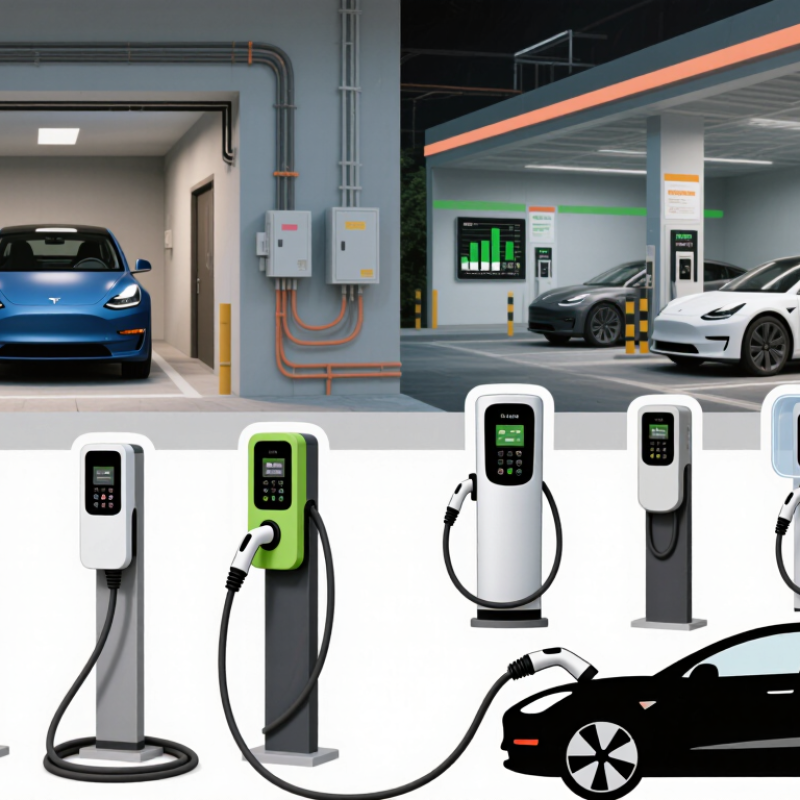
7 Best 22kW Car Chargers for Home and Business

How 22 kW AC Charging Works: 400 V Three-Phase at 32 A

A 22 kW AC charger is usually rated for 400 V three-phase supply at 32 A per phase.

The calculation is √3 × 400 × 32, which gives about 22.2 kW.

That is the theory. The charging unit supplies AC; the car’s onboard charger converts it into battery-ready DC. If that onboard charger accepts only 11 kW, a 22 kW wall unit will not double the car’s charging speed. Check the vehicle specification before choosing equipment.

Real output also depends on supply voltage, cable limits, installation settings, and other site loads. A qualified installer should confirm the available three-phase capacity and configure suitable protection. For a business, several vehicles charging together can make load management important.

Not every car. The International Energy Agency’s Global EV Outlook 2024 reports that public charging points worldwide exceeded four million in 2023, rising by about 40% in one year.

That growth signals rising demand, but it does not mean every site needs maximum power. A smaller connection may suit overnight charging better. The figures are clean; actual charging is less tidy. A cold battery, shared power, or a vehicle’s own limit can lower the rate.

Which Standards Apply: IEC 61851 and IEC 62196-2 Type 2

For a 22 kW charger, two standards answer different questions. IEC 61851-1 covers conductive charging equipment, including electrical safety and control functions. IEC 62196-2 specifies AC plugs, socket outlets, connectors, and inlets, including Type 2 interfaces. They are complementary, not interchangeable. A Type 2 connector alone does not prove that a unit supports 22 kW or meets every installation requirement.

At roughly 400 volts three-phase and 32 amps, the theoretical output is about 22 kW. Real charging speed may be lower. The vehicle’s onboard charger, supply capacity, and charger settings all matter. The IEA’s Global EV Outlook 2024 reports that public charging points grew by more than 40% in 2023. That growth makes clear compatibility checks increasingly useful, though public-network data cannot predict home charging performance. A compliant label can still leave a mismatch between the car and the supply. That detail is easy to miss.

Tips: Check the charger’s datasheet for IEC 61851 compliance and Type 2 compatibility under IEC 62196-2. Confirm three-phase availability and the vehicle’s AC charging limit. Ask a qualified electrician to assess the circuit before purchase. Don’t rely on connector shape alone.

7 Best 22kW Car Chargers for Home and Business

Three-phase AC charging power at 400 V by phase current

Values are calculated using P = √3 × 400 V × current: 16 A ≈ 11.1 kW, 20 A ≈ 13.9 kW, 25 A ≈ 17.3 kW, and 32 A ≈ 22.2 kW (commonly rated as 22 kW). IEC 61851 covers conductive charging systems; IEC 62196-2 specifies Type 2 connectors. Actual charging power depends on the vehicle, electrical supply, and installation.

How to Compare Seven Chargers: Power Sharing, Safety, and Connectivity

A 22kW charger can refill a compatible vehicle quickly, but the number on the casing is only part of the story. Many homes need a suitable three-phase supply to reach that output, and some vehicles accept less. Compare seven chargers by checking real charging power, cable length, and whether the unit can reduce output when household demand rises. Power sharing matters in a business car park, too: several vehicles can charge without pushing the site beyond its available capacity. Ask how the system divides power when every bay is occupied.

Safety details deserve a close look. Check for certified electrical protection, temperature monitoring, and an enclosure suited to the installation location. Installation should be assessed by a qualified electrician; a high-power charger is not a simple socket upgrade. Connectivity also varies. Wi-Fi may be enough for one driveway, while a workplace may benefit from Ethernet, user access controls, and charging records. App functions are useful, but signal dropouts happen. A charger should still behave predictably when the network fails.

Tips: Compare warranty terms, offline operation, and load-management limits—not just app screenshots. Confirm that the charger’s protections and installation requirements fit your local electrical supply. One detail is easy to miss: a tidy cable arrangement can make daily charging safer, but it does not replace proper installation.

Home and Business Installation: Three-Phase Supply and Load Management

A 22 kW home charger needs more than a suitable wall and a short cable. It typically relies on a three-phase supply and a vehicle capable of accepting 22 kW AC. Check both before planning installation. Otherwise, the charger may deliver less power than expected.

Load management helps keep charging within the site’s available capacity. A meter can monitor demand from ovens, heat pumps, machinery, or other chargers, then adjust charging power as loads change. At home, this can reduce the chance of exceeding the property’s configured limit during a busy evening. At a business, it can distribute available power across several parked vehicles. Small changes matter.

A qualified installer should assess the supply, cable route, protective equipment, and expected peak demand. For example, a workshop running equipment at shift change may leave less capacity for vehicle charging than a quiet overnight period. That estimate is not a guarantee; actual demand varies. A tidy plan can still overlook an expanding site. Allow room for future loads, and confirm how the system responds if communication with its meter is interrupted.

How to Match Charger Output to a Vehicle’s AC Charging Limit

A 22 kW charger describes the maximum AC power it can supply, not what every car will accept. The vehicle’s onboard charger sets its own limit. A car rated for 11 kW AC will generally draw no more than that, even when connected to a 22 kW unit. Check the car’s manual. Also confirm whether its AC limit is single-phase or three-phase; the same kilowatt rating can require different electrical arrangements.

For example, a three-phase 22 kW charger typically supplies up to 32 amps per phase on a suitable supply. If a vehicle accepts only 7.4 kW AC, the extra capacity will not make that car charge faster. The charger, vehicle, cable, and available building supply all matter. The lowest limit governs. That detail is easy to miss when comparing headline numbers.

A higher-output unit can still make sense for a shared workplace or a future vehicle, but only if the site can support it. Have a qualified installer assess the panel, wiring distance, and simultaneous building loads. Load management may help when several chargers share limited capacity. I used to assume a bigger rating always meant less waiting. Not quite. Charging time also depends on the battery’s state of charge and temperature, so real-world results can vary from a neat estimate on paper.

Copyright 2025 Fluidra S.A. | Created by BCM Marketing Agencia Privacy Policy Legal note | Cookie policy |

Technical cookies are strictly necessary for our website to work and you can navigate through it. These types of cookies are those that, for example, allow us to identify you, give you access to certain restricted parts of the page if necessary, or remember different options or services already selected by you, such as your privacy preferences. Therefore, they are activated by default, your authorization not being necessary in this regard. Through the configuration of your browser, you can block or alert the presence of this type of cookies, although such blocking will affect the proper functioning of the different functionalities of our website.


The analysis cookies allow us to study the navigation of the users of our website in general (for example, which sections of the page are the most visited, which services are used most and if they work correctly, etc.). From the statistical information on navigation on our website, we can improve both the operation of the page itself and the different services it offers. Therefore, these cookies do not have an advertising purpose, but only serve to make our website work better, adapting to our users in general. By activating them you will contribute to this continuous improvement. You can enable or disable these cookies by checking the corresponding box, being disabled by default.


Functionality cookies allow us to remember your preferences, to personalize certain characteristics and general options of our website, every time you access it (for example, the language in which the information is presented to you, the sections marked as favorites, your browser type, etc.) Therefore, this type of cookies does not have an advertising purpose, but by activating them you will improve the functionality of the website (for example, adapting to your type of browser) and the customization of it based on your preferences (for example, by presenting the information in the language that you have chosen in previous occasions), which will contribute to the ease, usability and comfort of our page during your navigation. You can enable or disable these cookies by checking the corresponding box, being disabled by default.


Advertising cookies allow us to manage the advertising spaces included in our website based on criteria such as the content shown or the frequency in which the ads are displayed. For example, if you have been shown the same ad several times on our website, and you have not shown a personal interest by clicking on it, it will not appear again. In summary, by activating this type of cookies, the advertising shown on our website will be more useful and diverse, and less repetitive. You can enable or disable these cookies by checking the corresponding box, being disabled by default.


Behavioral advertising cookies allow us to obtain information based on the observation of your browsing habits and behaviors on the web, in order to show you advertising content that best suits your personal tastes and interests. To understand it in a very simple way, we will give you a fictitious example: if your last searches on the web were related to suspense literature, we would show you advertising about suspense books. Therefore, activating this type of cookies, the advertising that we show you on our website will not be generic, but will be oriented to your searches, tastes and interests, therefore adjusting exclusively to you. You can enable or disable these cookies by checking the corresponding box, being disabled by default.
To understand it in a very simple way, we will give you a fictitious example: if your last searches on the web were related to suspense literature, we would show you advertising about suspense books. Therefore, activating this type of cookies, the advertising that we show you on our website will not be generic, but will be oriented to your searches, tastes and interests, therefore adjusting exclusively to you. You can enable or disable these cookies by checking the corresponding box, being disabled by default.

SAVE

We use our own and third-party cookies to ensure the proper functioning of the website and to analyse our services, improve your experience on our website and show you advertisements related to your interests according to profiling based on your browsing habits (e.g. websites visited). You can accept all cookies by clicking "ACCEPT" or set or reject them by clicking here. If you would like to know more about the use of cookies, please see our COOKIE POLICY.


ACCEPT ALL
Reject no essentials


