
7 Tips for Buying Stainless Steel Forgings?
FLUID HANDLING EXPERTS

Blog, all our news

7 Tips for Buying Stainless Steel Forgings?

Buying stainless steel forgings is not simply a matter of comparing prices. The right choice depends on strength, corrosion resistance, dimensional accuracy, and production consistency. A polished sample may look impressive, yet hidden laps, poor grain flow, or incorrect heat treatment can create serious problems later.

George E. Totten, a recognized specialist in forging and heat treatment, offers a useful principle: “Heat treatment is not an afterthought; it is part of the forging.” This idea matters when selecting a supplier. Buyers should examine the steel grade, forging method, heat-treatment records, inspection reports, and material traceability. They should also confirm whether the supplier understands the component’s real service conditions, including pressure, temperature, vibration, and exposure to chemicals.

This guide presents seven practical tips for buying stainless steel forgings with greater confidence. It covers supplier qualifications, material certificates, grain structure, tolerances, surface quality, testing, and total cost. Ask specific questions. Request evidence, not promises. Small details matter, such as heat numbers stamped on the report or machining allowance left around a flange.

There is no perfect purchase decision. A lower-cost forging may reduce the initial budget but increase machining waste or replacement risk. Even experienced buyers can overlook one requirement. Careful review remains essential. The best supplier is not always the cheapest one. It is the supplier that delivers consistent quality, clear documentation, and dependable technical support.
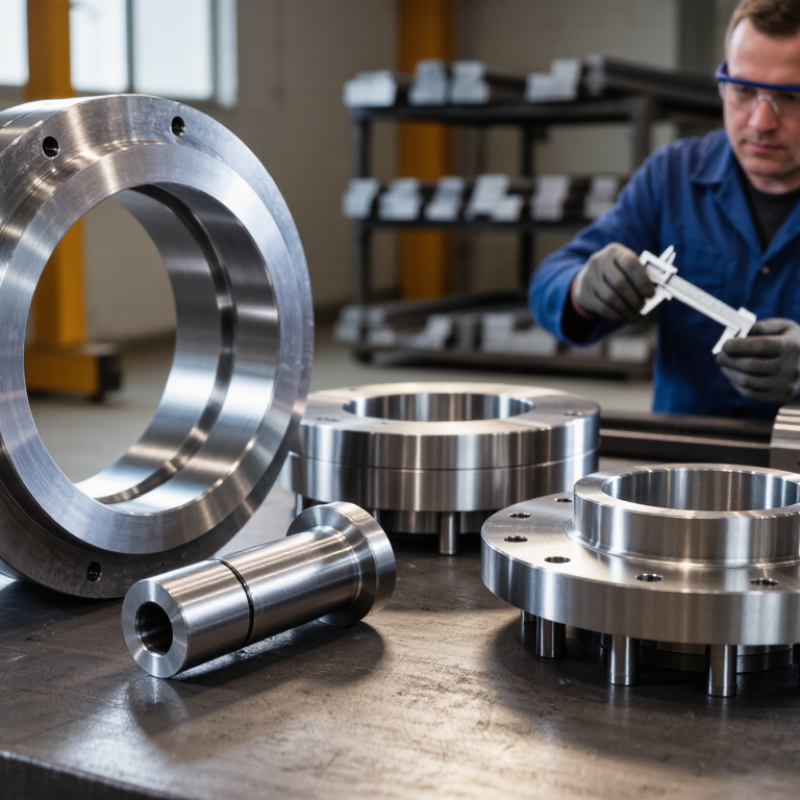
7 Tips for Buying Stainless Steel Forgings?

Choose the Grade by Service: 304 Uses 18–20% Cr; 316L Contains 2–3% Mo

Service conditions should guide every stainless steel forging purchase. Tip: Confirm the fluid, temperature, pressure, and chloride exposure before comparing prices. Grade 304 typically contains 18–20% chromium and performs well in clean, mildly corrosive environments. It suits indoor frames, food equipment, and general process fittings. Tip: Do not choose 304 only because it costs less. Chlorides can cause staining, pitting, and early failure.

Tip: Consider 316L when salt, seawater mist, or chemical exposure is expected. It usually contains 16–18% chromium and 2–3% molybdenum. The molybdenum improves resistance to localized corrosion. Its low carbon content also supports better weld-area corrosion resistance. Tip: Ask for the actual mill test certificate, not a verbal grade claim. Tip: Check heat numbers on the certificate, forging, and packing label. Traceability matters when service conditions become disputed.

Tip: Specify heat treatment and applicable acceptance requirements in the purchase order. Tip: Review grain flow, dimensional tolerances, surface condition, and non-destructive testing needs. Tip: Request samples from the same production route, when practical. A polished sample can hide forging laps or shallow defects. I have seen buyers focus on chemistry and overlook machining allowance. That mistake is easy to make. Tip: Compare total service risk, not just the initial quotation. A cheaper 304 forging may become costly in a salty installation. Even 316L needs sensible design, cleaning, and inspection. No grade is maintenance-proof.

Set Compliance Targets: Specify ASTM A182, ASME B16.5, and EN 10204 3.1

7 Tips for Buying Stainless Steel Forgings: Set Compliance Targets

Stainless steel forgings need more than a bright surface and attractive price. The International Stainless Steel Forum reported roughly 58 million tonnes of stainless steel production in 2023. That scale increases supplier choice, but it also increases traceability risks. Set ASTM A182 as the material target for pressure-containing forgings. Confirm the exact grade, heat treatment, chemistry, and mechanical results.

Tip: Match the flange to ASME B16.5. Check nominal size, pressure class, facing, bore, and dimensional tolerances. A forged ring can look correct while failing a bolt-hole or facing requirement. Request calibrated inspection records, not only photographs. In practical purchasing, the pressure class is often checked late. That timing is a mistake.

Require an EN 10204 3.1 inspection certificate for every heat or traceable batch. The document should identify the manufacturer, product, heat number, test results, and authorized certification representative. Link that heat number to markings on the forging and packing list. Positive material identification may add confidence, especially for mixed stainless inventories. It does not replace the required certificate. A certificate alone is not enough. Review the actual values. Some buyers, including experienced teams, accept familiar wording without checking limits against the purchase order. I still find this area needs more discipline. Reliability comes from matching standards, records, dimensions, and physical markings before shipment.

Check Forging Controls: Hot-Work Windows Commonly Span About 900–1200°C

When buying stainless steel forgings, ask how the supplier controls the hot-work window. Many operations work near 900–1200°C, but this range is not universal. The correct temperature depends on the stainless grade, section size, die design, and reduction ratio. A supplier should provide the forging temperature range, reheating practice, and final forging temperature. Do not guess.

Look for calibrated thermocouples, furnace uniformity checks, and time-temperature records. Ask whether operators measure the billet core, not only its bright surface. A billet can look ready while its center remains too cold. Excessive heat creates grain growth, scaling, or surface decarburization. Too little heat increases forming loads and may encourage laps or internal cracking. Records matter. Request sample charts linked to your production lot.

Cooling control also deserves attention. Some grades require controlled air cooling, while others need specific solution treatment after forging. Confirm how the supplier prevents mixed lots, skipped reheating, and prolonged furnace holding. Traceability should connect each forging to its heat number and inspection results. I have learned that a clean-looking surface can hide poor temperature control. Visual checks alone are weak evidence. Look closer.

Ask for hardness data, dimensional results, and non-destructive testing when the application requires it. Review the acceptance criteria before production begins. A practical trial forging can reveal die fill, scale behavior, and distortion more clearly than paperwork. Hot-work windows vary, and treating 900–1200°C as a fixed rule would be an avoidable mistake.

7 Tips for Buying Stainless Steel Forgings? — Check Forging Controls: Hot-Work Windows Commonly Span About 900–1200°C
Tip What to Check Practical Benchmark or Requirement Documents or Inspection Evidence Risk if Uncontrolled
1 Material grade and traceability Confirm the exact stainless steel grade, heat or cast number, product form, and applicable material specification before production. Review the material test certificate for chemical composition, mechanical properties, heat number, and specification compliance. Match the certificate to the forging identification. An incorrect grade or lost traceability can cause unsuitable corrosion resistance, strength, heat treatment, or service performance.
2 Hot-work temperature window Many stainless forging operations use a hot-working range broadly around 900–1200°C, but the acceptable range depends on the grade, billet size, and supplier process. The grade-specific forging temperature must govern. Request the approved forging procedure, furnace calibration records, temperature charts, and confirmation of the minimum finishing temperature for the selected grade. Overheating may promote excessive grain growth, oxidation, or incipient melting. Forging below the suitable range can increase deformation resistance, cracking, and non-uniform properties.
3 Heating uniformity and furnace control Heating should be controlled to reduce excessive temperature gradients between the surface and core. Furnace set points should not be treated as proof of the workpiece temperature. Check thermocouple calibration, furnace uniformity surveys where applicable, load records, soak-time criteria, and actual workpiece temperature monitoring. Uneven heating can produce internal stresses, localized overheating, incomplete deformation, dimensional variation, and inconsistent microstructure.
4 Forging reduction and deformation practice The supplier should define the forging route, reduction sequence, die fill requirements, and any minimum deformation needed to close internal discontinuities and achieve the specified shape. Review process-flow diagrams, forging-strategy records, billet and finished dimensions, press or hammer records, and dimensional inspection results. Insufficient or poorly distributed deformation may leave porosity, segregation, laps, or an unfavorable grain flow in critical sections.
5 Heat treatment after forging Specify the required solution annealing, quenching, tempering, or aging condition according to the grade and application. Austenitic grades commonly require solution treatment when specified; precipitation-hardening grades require tightly controlled aging cycles. Request heat-treatment charts showing time, temperature, cooling method, furnace identification, load number, and calibration status, together with hardness or mechanical-test results where required. Improper heat treatment can reduce corrosion resistance, hardness, strength, toughness, or dimensional stability and may create harmful precipitates.
6 Surface quality and non-destructive testing Define acceptance criteria for scale, laps, seams, cracks, underfill, and machining allowance. Select liquid penetrant, magnetic-particle, ultrasonic, or visual inspection according to the alloy and component geometry. Review inspection procedures, personnel qualifications, calibration records, NDT reports, indications maps, and repair or rejection records. Unidentified surface or internal discontinuities may initiate fatigue cracks, leakage, premature corrosion, or in-service failure.
7 Final dimensions, hardness, and acceptance records Agree on drawing tolerances, machining allowance, flatness or runout limits, hardness range, sampling frequency, packaging, and marking before placing the order. Require a final inspection report containing dimensional results, hardness data, material certificates, heat-treatment records, NDT results, and complete traceability. Unclear acceptance criteria can lead to assembly problems, hidden nonconformities, delayed approval, and disputes over responsibility.
Note: Temperature ranges are general purchasing guidance only. Always use the approved forging and heat-treatment parameters for the specific stainless steel grade and component design.

Verify Quality Evidence: Use PMI, Hardness Tests, and ASTM A388 Ultrasonics

Buying stainless steel forgings requires evidence, not attractive paperwork. World Steel Association data recorded about 1.89 billion tonnes of crude steel production in 2023. That scale makes traceability important. Ask for the heat number, chemistry, forging reduction, heat-treatment record, and final inspection results. A certificate can look complete and still miss the actual forging.

Tip 1: Require positive material identification (PMI) on the finished forging. X-ray fluorescence can quickly screen alloy chemistry, while optical emission testing offers stronger verification for critical elements. Compare the report with the purchase specification and mill certificate. Check several locations, not only one polished surface. Small sampling errors happen.

Tip 2: Request hardness testing using an accepted method, such as ASTM E18 or ASTM E10. Record the method, scale, test locations, and readings. Hardness variation may reveal uneven heat treatment or mixed material. Do not accept only “passed” as a result. I would ask for the raw values.

Tip 3: Specify ultrasonic examination to ASTM A388/A388M, including scan coverage, calibration block, probe frequency, sensitivity, and acceptance criteria. ASTM A388 addresses ultrasonic examination of heavy steel forgings, but the purchase order must define the inspection level. Ask for a map showing indications and repaired areas. Review the examiner’s qualification and equipment calibration date. ASTM standards guide inspection; they do not replace engineering judgment.

7 Tips for Buying Stainless Steel Forgings: Verify Quality Evidence

Use Positive Material Identification (PMI) to confirm alloy chemistry. The chart shows typical chromium ranges specified for common stainless steel grades used in forgings.

Chromium ranges are representative composition requirements found in ASTM A276/A479 and related grade specifications: 304 stainless steel typically contains 17.5–19.5% Cr, 316 contains 16.0–18.0% Cr, 410 contains 11.5–13.5% Cr, and 17-4 PH contains 15.0–17.5% Cr. PMI verifies chemistry, while hardness testing confirms the specified mechanical condition. ASTM A388 ultrasonic testing should be performed to the acceptance criteria defined in the purchase specification.

Compare Suppliers on Total Cost: Include Tolerances, Traceability, and 3.1 MTCs

Stainless steel forgings can look inexpensive until inspection, documentation, and rework costs appear. World Stainless reported about 58.4 million tonnes of stainless crude steel production in 2023. That scale increases material availability, but not supplier consistency. Compare quotations using total cost, not only price per kilogram.

Tip 1: Check tolerances before comparing prices. A tighter tolerance may require extra machining, inspection, or ultrasonic testing. Ask for the inspection method, gauge accuracy, and sampling plan. ISO 14253-1 stresses decision rules when measurement uncertainty affects conformity. Small wording differences can create large costs.

Tip 2: Treat traceability as a production requirement. Request heat numbers on raw material certificates, forging records, and final markings. EN 10204 defines inspection documents, while a 3.1 certificate links results to the specific product. Confirm that the heat number survives cutting, heat treatment, and machining. It sounds basic. It is often missed.

Tip 3: Review the 3.1 MTC before placing the order. Check chemistry, mechanical properties, heat-treatment condition, standard edition, and authorized certification. A certificate without matching test results is weak evidence. In my experience, buyers sometimes accept a clean-looking PDF too quickly. That is a mistake worth revisiting. Ask for sample documents and a traceability map before approval. Include packaging, expedited freight, retesting, and possible rejection costs in the comparison.

Copyright 2025 Fluidra S.A. | Created by BCM Marketing Agencia Privacy Policy Legal note | Cookie policy |

Technical cookies are strictly necessary for our website to work and you can navigate through it. These types of cookies are those that, for example, allow us to identify you, give you access to certain restricted parts of the page if necessary, or remember different options or services already selected by you, such as your privacy preferences. Therefore, they are activated by default, your authorization not being necessary in this regard. Through the configuration of your browser, you can block or alert the presence of this type of cookies, although such blocking will affect the proper functioning of the different functionalities of our website.


The analysis cookies allow us to study the navigation of the users of our website in general (for example, which sections of the page are the most visited, which services are used most and if they work correctly, etc.). From the statistical information on navigation on our website, we can improve both the operation of the page itself and the different services it offers. Therefore, these cookies do not have an advertising purpose, but only serve to make our website work better, adapting to our users in general. By activating them you will contribute to this continuous improvement. You can enable or disable these cookies by checking the corresponding box, being disabled by default.


Functionality cookies allow us to remember your preferences, to personalize certain characteristics and general options of our website, every time you access it (for example, the language in which the information is presented to you, the sections marked as favorites, your browser type, etc.) Therefore, this type of cookies does not have an advertising purpose, but by activating them you will improve the functionality of the website (for example, adapting to your type of browser) and the customization of it based on your preferences (for example, by presenting the information in the language that you have chosen in previous occasions), which will contribute to the ease, usability and comfort of our page during your navigation. You can enable or disable these cookies by checking the corresponding box, being disabled by default.


Advertising cookies allow us to manage the advertising spaces included in our website based on criteria such as the content shown or the frequency in which the ads are displayed. For example, if you have been shown the same ad several times on our website, and you have not shown a personal interest by clicking on it, it will not appear again. In summary, by activating this type of cookies, the advertising shown on our website will be more useful and diverse, and less repetitive. You can enable or disable these cookies by checking the corresponding box, being disabled by default.


Behavioral advertising cookies allow us to obtain information based on the observation of your browsing habits and behaviors on the web, in order to show you advertising content that best suits your personal tastes and interests. To understand it in a very simple way, we will give you a fictitious example: if your last searches on the web were related to suspense literature, we would show you advertising about suspense books. Therefore, activating this type of cookies, the advertising that we show you on our website will not be generic, but will be oriented to your searches, tastes and interests, therefore adjusting exclusively to you. You can enable or disable these cookies by checking the corresponding box, being disabled by default.
To understand it in a very simple way, we will give you a fictitious example: if your last searches on the web were related to suspense literature, we would show you advertising about suspense books. Therefore, activating this type of cookies, the advertising that we show you on our website will not be generic, but will be oriented to your searches, tastes and interests, therefore adjusting exclusively to you. You can enable or disable these cookies by checking the corresponding box, being disabled by default.

SAVE

We use our own and third-party cookies to ensure the proper functioning of the website and to analyse our services, improve your experience on our website and show you advertisements related to your interests according to profiling based on your browsing habits (e.g. websites visited). You can accept all cookies by clicking "ACCEPT" or set or reject them by clicking here. If you would like to know more about the use of cookies, please see our COOKIE POLICY.


ACCEPT ALL
Reject no essentials


