
7 Best Camera Based Inspection Systems for Buyers
FLUID HANDLING EXPERTS

Blog, all our news

7 Best Camera Based Inspection Systems for Buyers

Choosing a Camera Based Inspection System is no longer just a matter of comparing image resolution. Buyers must consider inspection speed, lighting, software, integration, and the cost of missed defects. A scratched metal surface, a misaligned label, or a missing component can look very different under changing light. Small details matter.

Industry figures show why these decisions are increasingly relevant. The International Federation of Robotics reported 553,052 industrial robots installed worldwide in 2022, a 5% increase from the previous year. More automated production creates greater demand for reliable, repeatable inspection. MarketsandMarkets’ Machine Vision Market report projected the global market would reach $12.5 billion by 2028, reflecting the expanding use of vision technologies across industries. These figures describe broader automation and machine-vision trends, not camera inspection alone. Buyers should treat them as context, not a guarantee of performance.

AI researcher Andrew Ng has said, “AI is the new electricity.” His observation speaks to AI’s broad influence, including image analysis, but it does not mean every inspection line needs AI. A well-lit image and a carefully tested rule-based system may be enough. That distinction is easy to overlook. This guide compares seven camera-based inspection systems through practical buyer concerns: application fit, accuracy, throughput, integration, and support. No system catches everything. The right choice depends on the defect, the product, and the conditions on the production floor.
7 Best Camera Based Inspection Systems for Buyers

What Camera-Based Inspection Systems Are

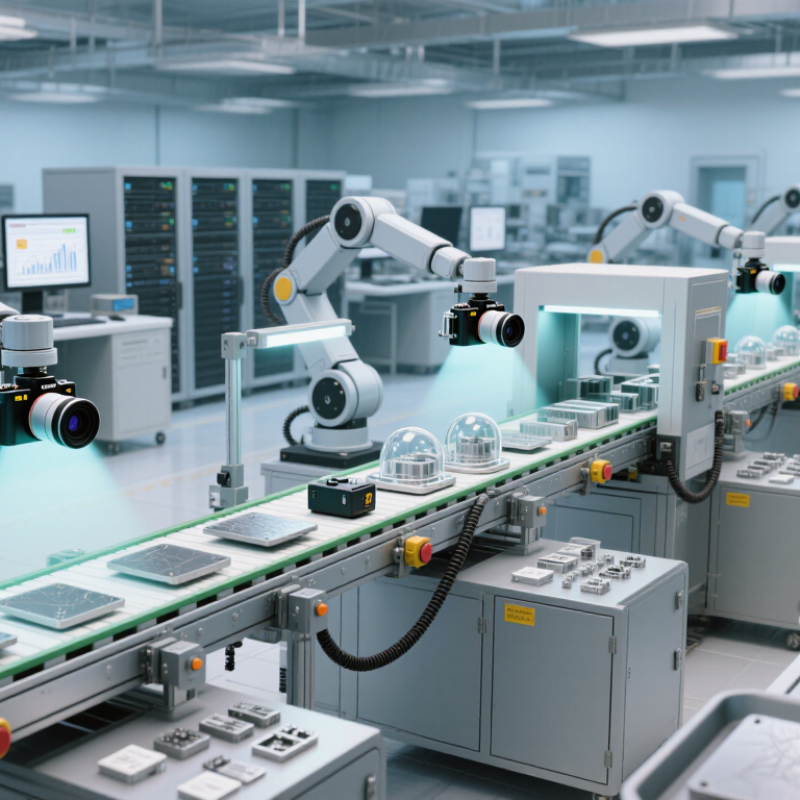
Camera-based inspection systems use cameras, lenses, lighting, and image-processing software to check products during production. They capture images of a part, then compare visible features with programmed criteria. A system may detect missing components, surface marks, incorrect labels, or dimensional variation. Some setups inspect every item; others sample products at set intervals. Results can trigger an alert, log a measurement, or signal equipment to remove a failed item. The camera is only one piece. Stable lighting, a suitable lens, and clear acceptance rules matter just as much.

The Association for Advancing Automation’s 2023 year-end market report recorded a 4% decline in North American machine-vision sales. That figure describes market activity, not inspection accuracy, but it highlights why buyers should match system capability to a real production need. A shiny metal edge can confuse a camera; dust, vibration, and changing ambient light can also distort images. Even a well-tuned system may miss defects that are hidden from its viewing angle. It is worth testing representative parts, including borderline examples, before setting pass-or-fail thresholds.

Tips: Test under actual line lighting and speed. Keep sample images of acceptable and defective parts. Review false rejects after installation; they may reveal weak lighting or overly strict criteria. Calibration can drift. Plan checks.

How Camera-Based Inspection Systems Capture and Analyze Images

Camera-based inspection starts with a controlled image capture. A lens frames the part, while lighting reveals edges, surface marks, or missing features. A sensor converts reflected light into digital pixels. The system may trigger the camera when a part reaches a fixed position, helping keep images consistent. Light matters. Even a small change in glare can make a clean surface look defective.

Software then compares the image with measurements, limits, or trained examples. For a machined component, it might check hole diameter, part orientation, and visible scratches. Some systems use edge detection and thresholding; others classify patterns using machine-learning models. The chosen method should match the defect and production speed. A high-resolution image is not automatically useful if motion blur hides the detail.

Buyers should ask how the system handles changing part positions, lighting, and surface finishes. They should also review sample images, false-reject rates, and how inspection results are stored. Not every defect is visible. Internal cracks or marks hidden beneath a fixture may require another inspection method. In practice, testing with real production parts is essential, and the first setup may need adjustment. That uncertainty deserves attention before purchase.

Key Types of Camera-Based Inspection Systems

Camera-based inspection systems differ by how they capture a product and what defects they can reveal. Area-scan cameras take a full image at once, making them useful for checking labels, caps, and surface marks on stationary or indexed items. Line-scan systems build an image one narrow strip at a time. They suit continuous materials such as paper, film, or fabric moving beneath the camera. Motion and lighting must stay consistent. Otherwise, images can stretch or show false defects.

Three-dimensional systems measure height as well as width and length. They can detect uneven seals, missing components, or dents that a flat image may miss. Their setup can be more demanding, especially around reflective or dark surfaces.

Smart vision systems use image-processing software to classify features and flag likely defects. Some also combine several cameras or lighting angles. That sounds efficient, but poor sample images can teach the system the wrong pattern. Test it with real production parts, including borderline examples.

No system is perfect. A useful choice depends on product speed, defect size, surface finish, and the cost of missed rejects. The simplest camera may be enough; sometimes it is not.

Seven Camera-Based Inspection Systems for Buyers to Consider

Seven camera-based inspection systems suit different defects and production speeds. A 2D area-scan camera captures a full image of labels, seals, or surface marks. A line-scan system builds images of moving webs, such as paper or metal. A 3D structured-light system measures height and shape, while laser triangulation checks profiles with precise distance readings. Multispectral imaging separates materials that look similar under ordinary light. Thermal cameras reveal heat patterns in components or processes. Smart cameras combine imaging and processing in one unit, reducing extra hardware.

The International Federation of Robotics reported 553,052 industrial robots installed worldwide in 2022, a 5% rise over 2021. This is useful automation context, not a camera-inspection market statistic. Buyers should match the system to defect size, line speed, lighting, and reject tolerance. Test real samples, including scratched, dusty, and poorly positioned parts. Real lines are less tidy. Check whether the system stores images, tracks inspection results, and connects to existing controls. Also compare lens costs, calibration effort, and operator training. A technically impressive camera can still disappoint when lighting changes or products vary. No setup is perfect. Pilot trials often expose these gaps before full installation.

Seven Camera-Based Inspection Systems for Buyers to Consider

System Type Best Suited For Imaging Method Typical Inspection Tasks Key Strengths Buying Considerations
2D Area-Scan Vision Discrete parts, packaging, labels, and stationary or indexed production lines Captures a two-dimensional image of an area in a single exposure Presence or absence checks, label and code reading, surface-defect detection, and dimensional checks on visible features Versatile and straightforward to integrate when parts can be presented consistently Image quality depends on focus, contrast, part positioning, and suitable lighting; it does not directly measure height or depth
Line-Scan Vision Continuous materials such as paper, film, textiles, metal strip, and web products Builds an image one line at a time as the material or camera moves Longitudinal surface inspection, print or coating checks, and detection of streaks, holes, or repeating defects Can inspect wide, continuously moving surfaces at high image resolution across the direction of travel Requires synchronized motion and image capture; performance depends on stable material speed and alignment
3D Structured-Light Vision Parts with complex shapes or features that require height information Projects a known light pattern and uses camera images to calculate surface shape Height and profile measurement, surface-form checks, volume estimation, and assembly verification Provides depth information that ordinary 2D imaging cannot directly supply Highly reflective, transparent, dark, or moving surfaces may require careful setup; cycle time and measurement range vary by system
Laser-Profile Inspection Parts and processes where a cross-sectional profile or height measurement is needed Uses a camera to observe a laser line projected onto the target and derives a profile from its position Step-height measurement, gap and flush checks, bead or weld profile inspection, and edge positioning Well suited to measuring profiles without physical contact Usually measures a profile at a time; full 3D coverage may require relative motion or multiple sensors
Thermal Imaging Inspection Electrical, mechanical, process, and material checks involving temperature patterns Detects infrared radiation and maps apparent surface temperature Hot-spot detection, heat-distribution checks, and monitoring of thermal processes Can reveal temperature differences without touching the inspected object Emissivity, reflections, viewing angle, and environmental conditions affect readings; it is not a substitute for visible-light defect inspection
Industrial Borescope Inspection Internal spaces, cavities, pipes, and assemblies that are difficult to access directly A small camera and illumination source are carried on a rigid or flexible insertion probe Internal surface checks, foreign-object detection, corrosion observation, and assembly inspection Allows visual inspection of confined areas with limited disassembly Field of view and image quality can be limited by probe size, working distance, lighting, and access path
Multispectral or Hyperspectral Imaging Materials or products that are difficult to distinguish by visible appearance alone Captures image information in multiple wavelength bands, including bands beyond ordinary visible color Material classification, contamination screening, and detection of selected composition or moisture differences Can reveal spectral differences that a standard color camera may not show Requires application-specific calibration and analysis; cost, data volume, and validation needs are generally greater than for basic vision inspection

Capabilities are typical of each system category. Actual results depend on the target material, inspection speed, optics, lighting, environment, and application-specific validation.

How to Evaluate and Select an Inspection System

A camera-based inspection system should be selected against the defect, not the sales demonstration. Define the smallest flaw that matters, its location, and the line speed. The International Federation of Robotics’ World Robotics 2024 report counted 4.28 million industrial robots operating worldwide in 2023, highlighting the scale of automated production. Inspection systems must keep pace with real production conditions. Grand View Research estimated the global machine vision market at $19.6 billion in 2023, reflecting broad investment in visual automation. That is context, not a buying rule.

Set measurable acceptance criteria before comparing systems. Test representative parts, including dark surfaces, reflective edges, and harmless variation between batches. Record missed defects and false rejects against a checked sample. Keep the images. They reveal more than a polished demo. Ask whether the system can capture the smallest required feature at the actual inspection distance and cycle time. Check lens choice, lighting consistency, camera resolution, and processing speed together; improving one cannot always compensate for another. A clean test bench can mislead.

Review integration and ongoing support, too. Confirm the system can send inspection results to existing production software and store traceable images when needed. Ask how operators will review uncertain results and update inspection settings after product changes. Request a trial using your own parts, then repeat it across shifts and lighting conditions. No setup stays perfect. A little manual review may remain necessary, and that trade-off should be stated clearly before purchase.

Copyright 2025 Fluidra S.A. | Created by BCM Marketing Agencia Privacy Policy Legal note | Cookie policy |

Technical cookies are strictly necessary for our website to work and you can navigate through it. These types of cookies are those that, for example, allow us to identify you, give you access to certain restricted parts of the page if necessary, or remember different options or services already selected by you, such as your privacy preferences. Therefore, they are activated by default, your authorization not being necessary in this regard. Through the configuration of your browser, you can block or alert the presence of this type of cookies, although such blocking will affect the proper functioning of the different functionalities of our website.


The analysis cookies allow us to study the navigation of the users of our website in general (for example, which sections of the page are the most visited, which services are used most and if they work correctly, etc.). From the statistical information on navigation on our website, we can improve both the operation of the page itself and the different services it offers. Therefore, these cookies do not have an advertising purpose, but only serve to make our website work better, adapting to our users in general. By activating them you will contribute to this continuous improvement. You can enable or disable these cookies by checking the corresponding box, being disabled by default.


Functionality cookies allow us to remember your preferences, to personalize certain characteristics and general options of our website, every time you access it (for example, the language in which the information is presented to you, the sections marked as favorites, your browser type, etc.) Therefore, this type of cookies does not have an advertising purpose, but by activating them you will improve the functionality of the website (for example, adapting to your type of browser) and the customization of it based on your preferences (for example, by presenting the information in the language that you have chosen in previous occasions), which will contribute to the ease, usability and comfort of our page during your navigation. You can enable or disable these cookies by checking the corresponding box, being disabled by default.


Advertising cookies allow us to manage the advertising spaces included in our website based on criteria such as the content shown or the frequency in which the ads are displayed. For example, if you have been shown the same ad several times on our website, and you have not shown a personal interest by clicking on it, it will not appear again. In summary, by activating this type of cookies, the advertising shown on our website will be more useful and diverse, and less repetitive. You can enable or disable these cookies by checking the corresponding box, being disabled by default.


Behavioral advertising cookies allow us to obtain information based on the observation of your browsing habits and behaviors on the web, in order to show you advertising content that best suits your personal tastes and interests. To understand it in a very simple way, we will give you a fictitious example: if your last searches on the web were related to suspense literature, we would show you advertising about suspense books. Therefore, activating this type of cookies, the advertising that we show you on our website will not be generic, but will be oriented to your searches, tastes and interests, therefore adjusting exclusively to you. You can enable or disable these cookies by checking the corresponding box, being disabled by default.
To understand it in a very simple way, we will give you a fictitious example: if your last searches on the web were related to suspense literature, we would show you advertising about suspense books. Therefore, activating this type of cookies, the advertising that we show you on our website will not be generic, but will be oriented to your searches, tastes and interests, therefore adjusting exclusively to you. You can enable or disable these cookies by checking the corresponding box, being disabled by default.

SAVE

We use our own and third-party cookies to ensure the proper functioning of the website and to analyse our services, improve your experience on our website and show you advertisements related to your interests according to profiling based on your browsing habits (e.g. websites visited). You can accept all cookies by clicking "ACCEPT" or set or reject them by clicking here. If you would like to know more about the use of cookies, please see our COOKIE POLICY.


ACCEPT ALL
Reject no essentials


