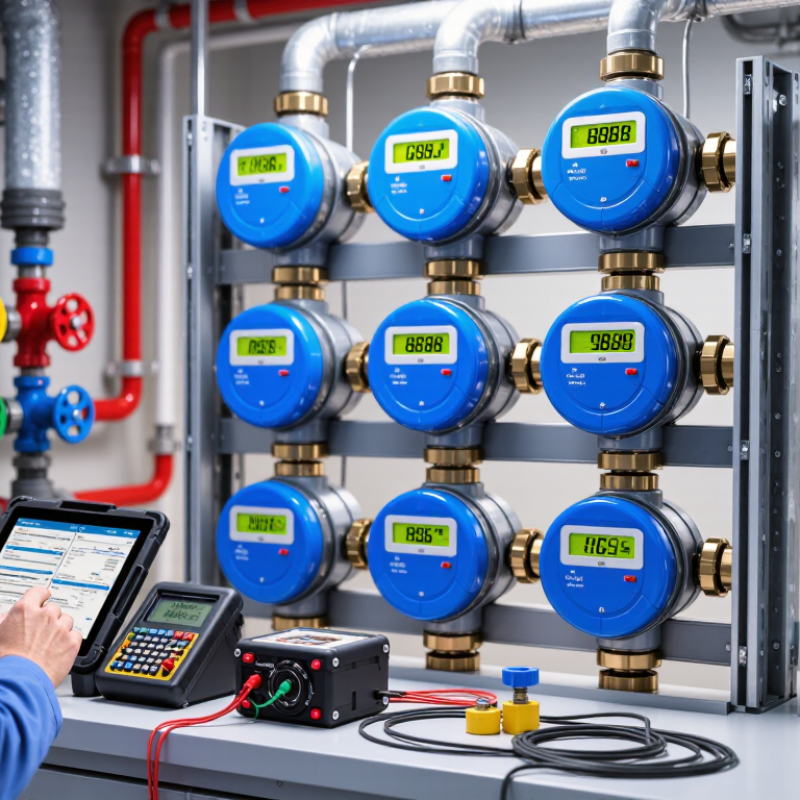
2026 Best Digital Smart Water Meter Manufacturers
FLUID HANDLING EXPERTS

Blog, all our news

2026 Best Digital Smart Water Meter Manufacturers

Choosing the 2026 Best Digital Smart Water Meter Manufacturers requires more than comparing product brochures. Utilities need dependable readings, stable communication, secure data handling, and practical field support. A meter may appear advanced on a test bench, yet struggle in a basement with condensation, sediment, or weak wireless signals. Real performance matters.

Dr. Steve Buchberger, a respected water-distribution researcher, has described the meter as “the cash register of the water utility.” That simple comparison remains useful. A Digital Smart Water Meter affects billing accuracy, leak detection, customer trust, and daily maintenance decisions. The strongest manufacturers therefore combine ultrasonic or electromagnetic measurement with long battery life, remote reading, tamper alerts, and clear diagnostic tools. They also provide calibration records, installation guidance, firmware updates, and responsive technical service.

This guide examines manufacturers through an experience-based lens. It considers accuracy across low and changing flows, communication reliability, cybersecurity practices, interoperability, and total ownership cost. Certifications matter, but they do not tell the whole story. Field testing matters more.

No ranking is permanent. Markets change quickly.

Some manufacturers market intelligence before proving durability. Others offer fewer features but stronger support. That difference can decide whether a utility gains useful data or inherits another maintenance burden. The following overview highlights companies that demonstrate credible engineering, transparent specifications, and practical value for residential, commercial, and municipal water networks. It also identifies limitations, because even the best Digital Smart Water Meter can perform poorly when installation, network coverage, or data management is overlooked.

2026 Best Digital Smart Water Meter Manufacturers

What Defines a Digital Smart Water Meter in 2026?

A digital smart water meter in 2026 does more than display consumption. It measures flow electronically, records time-based data, and sends readings through a secure communication network. Many systems use ultrasonic sensing, cellular IoT, or low-power radio technology. Battery life, signal stability, and measurement accuracy matter in real installations.

The U.S. Environmental Protection Agency reports that household leaks can waste nearly 1 trillion gallons of water annually in the United States. Smart meters help identify unusual night flow, continuous leakage, and sudden pressure changes. They can also support remote billing and faster service investigations. However, data alone does not repair a broken pipe. That assumption needs scrutiny.

The World Bank has repeatedly identified non-revenue water as a major utility challenge, with losses often reaching about 30 percent of supplied water worldwide. A capable meter should therefore provide more than frequent readings. It needs tamper alerts, audit trails, encryption, and practical data integration. The International Water Association also emphasizes digital monitoring, asset management, and operational resilience in modern utilities. Installation quality remains critical. A perfectly designed meter may still produce poor results when pipes contain air, sensors are badly positioned, or communication networks fail. Real field performance deserves more attention than impressive specifications.

ISO 4064, OIML R49, and Key Accuracy Standards for Smart Meters

The best digital smart water meter manufacturers in 2026 should prove accuracy through recognized standards, not attractive dashboards. ISO 4064 defines metrological requirements, test methods, flow conditions, and installation criteria for water meters. Its framework examines accuracy across the measuring range, including low-flow performance. OIML R49 adds international legal-metrology requirements for cold potable water meters. It uses parameters such as Q1, Q3, and the ratio between them to describe measurement capability.

Small flows matter.

A meter may appear accurate during laboratory testing yet under-register a slow night-time leak. The U.S. EPA WaterSense program estimates that household leaks can waste nearly 10,000 gallons of water annually. This makes low-flow sensitivity a practical purchasing issue, not merely a certification detail. Buyers should request test results, uncertainty data, temperature limits, pressure conditions, and evidence of compliance with ISO 4064 or OIML R49. They should also confirm whether the stated accuracy applies before or after wireless communication is added.

The UN World Water Development Report 2024 identifies agriculture as responsible for roughly 70% of global freshwater withdrawals. Better measurement supports tighter allocation, but standards do not solve poor installation. Pipe vibration, air pockets, incorrect sizing, and unstable pressure can distort readings. I would be cautious with any datasheet showing one impressive accuracy figure. Real networks are messier. Independent verification, seal integrity, data security, and periodic field checks deserve equal attention when comparing manufacturers.

2026 Best Digital Smart Water Meter Manufacturers - ISO 4064, OIML R49, and Key Accuracy Standards for Smart Meters

Evaluation Dimension Applicable Standard or Requirement Verified Technical Data Why It Matters for Smart-Meter Selection Recommended Evidence from a Manufacturer
Core metrology standard ISO 4064 series International requirements for water-meter terminology, metrological performance, technical characteristics, test methods, and installation conditions. The series covers meters for cold potable water and hot water. Provides a globally recognized technical basis for comparing meter performance and laboratory test results. Applicable ISO 4064 test reports, type-test documentation, and a clear statement of the edition used.
Legal-metrology recommendation OIML R 49 OIML R 49 establishes metrological and technical requirements, test procedures, and pattern-evaluation considerations for water meters used for metering cold potable water and hot water. Useful for regulated billing applications and for markets that recognize OIML-based approvals. OIML pattern-evaluation documentation or national approval based on OIML R 49, where applicable.
Accuracy class OIML R 49 / ISO 4064 accuracy classification OIML R 49 commonly defines Accuracy Class 1 and Accuracy Class 2. Class 1 has tighter maximum permissible errors than Class 2. Class selection affects billing confidence, leakage analysis, and low-flow measurement performance. Type-approval certificate showing the declared accuracy class and the complete error curve across the operating range.
Maximum permissible error OIML R 49 accuracy limits For Accuracy Class 2, the typical maximum permissible error is ±2% from Q2 to Q4 and ±5% from Q1 to below Q2. Class 1 uses tighter limits: typically ±1% from Q2 to Q4 and ±3% from Q1 to below Q2. Shows whether a meter can maintain reliable readings at both normal demand and very low flow. Independent laboratory results identifying Q1, Q2, Q3, Q4, water temperature, and test uncertainty.
Flow-rate terminology ISO 4064 and OIML R 49 Q1 is the minimum flow rate; Q2 is the transitional flow rate; Q3 is the permanent flow rate; Q4 is the overload flow rate. The ratio R is calculated as Q3/Q1. Q1 and the R ratio are especially important when detecting night flow, small leaks, and intermittent household consumption. Data sheet listing Q1, Q2, Q3, Q4, R, nominal size, and approved installation orientation.
Flow-range capability Declared Q3 and R values A higher R value indicates a wider certified measuring range because R = Q3/Q1. The actual suitable range depends on meter size, technology, and approval configuration. Helps utilities match meter capacity to real demand without sacrificing low-flow sensitivity. Certified flow-range tables for each nominal diameter, connection type, and software or sensor configuration.
Measurement technology Technology-neutral under ISO 4064/OIML R 49 Ultrasonic, electromagnetic, and mechanical meter designs may be evaluated against the applicable metrological requirements. The standards do not require one specific sensing technology. Allows buyers to compare durability, pressure loss, moving parts, maintenance needs, and performance under low flow. Principle-of-operation description, accuracy test results, pressure-loss data, and long-term stability evidence.
Communication interface Project and utility specification Wireless M-Bus, NB-IoT, LTE-M, LoRaWAN, cellular, wired M-Bus, and pulse outputs are application options rather than a universal ISO 4064 or OIML R 49 requirement. Determines network compatibility, reading frequency, installation cost, and data availability. Communication protocol documentation, interoperability results, coverage assumptions, and cybersecurity statement.
Data and alarm functions Utility specification and software validation Common smart-meter functions include cumulative volume, reverse-flow detection, leak or continuous-flow alarms, tamper alerts, battery status, and event logs. These functions are not automatically guaranteed by metrology certification. Improves non-revenue-water management and supports proactive maintenance. Feature list, alarm definitions, timestamp behavior, data-retention policy, and sample dashboard or API documentation.
Installation requirements ISO 4064 installation provisions and approval documents Performance can depend on pipe configuration, flow disturbance, installation orientation, upstream and downstream conditions, and whether a straight-pipe requirement applies to the approved design. Correct installation is essential for achieving the laboratory accuracy shown in the approval documents. Installation manual, approved orientation limits, flow-direction marking, pipework requirements, and commissioning checklist.
Pressure-loss performance Product and type-test specification Pressure loss varies by nominal size, meter design, flow rate, strainer configuration, and valve arrangement. It must be checked at the project design flow rather than assumed from meter size alone. Excessive pressure loss can reduce available pressure and increase pumping energy. Pressure-loss curve or declared pressure-loss class for each approved meter configuration.
Temperature range Cold-water or hot-water approval scope Cold-water and hot-water meters are approved for different temperature conditions. The permitted range must be taken from the specific type approval and product marking. Prevents the use of a cold-water model in applications that require hot-water certification. Temperature class, approved medium, maximum operating temperature, and relevant test certificate.
Environmental protection Product specification and applicable electrical/environmental testing Ingress protection, humidity resistance, vibration resistance, electromagnetic compatibility, and storage limits depend on the product design and applicable regional requirements; they are not defined solely by ISO 4064 or OIML R 49. Important for meter pits, outdoor cabinets, flood-prone locations, and dense radio environments. IP rating, environmental test reports, EMC documentation, operating-temperature range, and installation-enclosure requirements.
Battery life Manufacturer declaration and project conditions Battery life depends on reading frequency, radio technology, transmission power, temperature, alarm activity, and battery capacity. A single generic lifetime cannot be assumed for every installation. Directly affects maintenance planning and total cost of ownership. Battery-life calculation based on a stated duty cycle, replaceability information, low-battery alarm threshold, and warranty terms.
Verification and calibration National legal-metrology rules ISO 4064 and OIML R 49 provide technical foundations, but verification, sealing, re-verification intervals, and acceptance procedures are determined by the applicable jurisdiction. Ensures that meters are legally usable for billing in the target market. Country-specific approval, conformity assessment route, verification mark or seal requirements, and service procedures.
Cybersecurity and data governance Regional cybersecurity and privacy requirements Metrological standards do not by themselves certify cloud security, encryption, identity management, firmware security, or personal-data compliance. Protects consumption data and reduces operational risk in connected deployments. Encryption details, secure update process, access-control model, vulnerability-management policy, and data-hosting information.
Overall procurement benchmark Multi-criteria technical evaluation A strong specification should combine approved accuracy class, suitable Q1/Q3 range, verified installation requirements, communication interoperability, environmental suitability, battery performance, cybersecurity, and local legal approval. Prevents a low purchase price or a high advertised R value from becoming the only selection criterion. Complete technical submittal, third-party certificates, sample test data, references for comparable installations, warranty, and lifecycle-cost analysis.

Note: Certification scope, accuracy limits, temperature classes, communication options, and legal-use requirements must always be confirmed against the current edition of the applicable standard and the approval documents for the exact meter configuration.

10-Year Battery Life, IP68 Protection, and AMI Connectivity Benchmarks

A reliable smart water meter must survive a decade in a damp, buried environment. Ten-year battery claims need a clear duty cycle, not optimistic laboratory language. Testing should include hourly readings, frequent network handshakes, leak alarms, and cold-weather conditions. A small display is helpful, but power budgets matter more.

According to the World Bank, water losses can reach 30–50% of supply in some systems. That figure explains the demand for accurate, connected metering. However, battery life alone cannot reduce losses. The meter needs stable measurement performance, tamper detection, and timely data delivery. Independent verification against ISO 4064 or OIML R49 provides stronger evidence than marketing specifications.

IP68 protection is another practical benchmark. It indicates resistance to long-term dust exposure and immersion under defined test conditions. It does not guarantee endless performance in every installation. Cable glands, covers, and connectors still require inspection. AMI connectivity should support two-way communication, scheduled reads, firmware management, and rapid leak alerts. Reports from Berg Insight identify continuing growth in smart water deployments across Europe and North America, driven by remote reading and network efficiency. Yet coverage gaps remain. Rural locations can expose weak radio planning and unexpected battery drain. A manufacturer that publishes field data, test limits, and failure rates appears more credible than one offering only a ten-year headline.

This manufacturer-neutral benchmark highlights three reference requirements for digital smart water meters: a 10-year battery-life target, IP68 enclosure protection, and AMI connectivity readiness. IP68 is shown as the numeric IEC 60529 protection code, while AMI readiness is represented as 1 for supported.

How to Evaluate the Best Smart Water Meter Manufacturers

2026 Best Digital Smart Water Meter Manufacturers

How to Evaluate the Best Smart Water Meter Manufacturers

Choosing a smart water meter manufacturer requires more than comparing display screens or wireless features. The meter must remain accurate during low night flows, pressure changes, and dirty water conditions. Request independent test results, not only laboratory claims. Accuracy should be checked across the full operating range, including the first few litres per hour.

The UNESCO World Water Development Report 2024 states that agriculture represents about 70% of global freshwater withdrawals. This makes reliable measurement increasingly important for utilities and large facilities. The WHO and UNICEF Joint Monitoring Programme also reported that 2.2 billion people lacked safely managed drinking water in 2022. Manufacturers should therefore demonstrate practical water-saving value, not just digital convenience. Evaluate leak alerts, data intervals, battery life, and performance during communication outages.

Look closely at certification and software governance. ISO-compliant metrology testing, tamper detection, encrypted transmission, and clear data ownership should be documented. Ask whether the platform supports open protocols and existing billing systems. A pilot installation is essential. Test meters in older pipes, basement chambers, and weak-signal areas. Industry guidance from the International Water Association encourages structured water-balance analysis, which can reveal whether reported savings are genuine. A polished dashboard may still conceal inaccurate readings. I would also question unusually long battery claims. Field conditions are rarely perfect, and maintenance records often matter more than brochures.

2026 Manufacturer Comparison: Accuracy, Data Security, and Total Cost

2026 Best Digital Smart Water Meter Manufacturers

A serious 2026 comparison should begin with measured accuracy, not product brochures. Test meters at low, normal, and peak flow rates. Household leaks often hide below the meter’s preferred operating range. A laboratory result can look excellent, yet field performance may change with pressure swings, pipe vibration, or air pockets. Look for independent test reports, traceable calibration records, and clear error limits. No meter is perfect.

Data security deserves equal attention. Reliable manufacturers use encrypted communication, signed firmware, role-based access, and strong device authentication. They should explain where readings are stored and how long data remains available. Audit logs make unusual access easier to investigate. Some suppliers promise “secure cloud management” without describing key protection or breach response. That is not enough. Ask for practical documentation, not marketing language.

Total cost extends beyond the purchase price. Include installation labor, network subscriptions, battery replacement, calibration checks, software fees, and eventual disposal. A cheaper meter may require frequent site visits, especially in damp basements or remote utility chambers. Battery life also depends on transmission frequency and signal strength. Request a five-year cost model from each manufacturer. It may reveal unexpected fees. One useful warning: projected savings are often based on ideal flow conditions, while real buildings contain blocked strainers, aging valves, and irregular consumption. Procurement teams should compare verified field data with promised performance before selecting equipment.

Copyright 2025 Fluidra S.A. | Created by BCM Marketing Agencia Privacy Policy Legal note | Cookie policy |

Technical cookies are strictly necessary for our website to work and you can navigate through it. These types of cookies are those that, for example, allow us to identify you, give you access to certain restricted parts of the page if necessary, or remember different options or services already selected by you, such as your privacy preferences. Therefore, they are activated by default, your authorization not being necessary in this regard. Through the configuration of your browser, you can block or alert the presence of this type of cookies, although such blocking will affect the proper functioning of the different functionalities of our website.


The analysis cookies allow us to study the navigation of the users of our website in general (for example, which sections of the page are the most visited, which services are used most and if they work correctly, etc.). From the statistical information on navigation on our website, we can improve both the operation of the page itself and the different services it offers. Therefore, these cookies do not have an advertising purpose, but only serve to make our website work better, adapting to our users in general. By activating them you will contribute to this continuous improvement. You can enable or disable these cookies by checking the corresponding box, being disabled by default.


Functionality cookies allow us to remember your preferences, to personalize certain characteristics and general options of our website, every time you access it (for example, the language in which the information is presented to you, the sections marked as favorites, your browser type, etc.) Therefore, this type of cookies does not have an advertising purpose, but by activating them you will improve the functionality of the website (for example, adapting to your type of browser) and the customization of it based on your preferences (for example, by presenting the information in the language that you have chosen in previous occasions), which will contribute to the ease, usability and comfort of our page during your navigation. You can enable or disable these cookies by checking the corresponding box, being disabled by default.


Advertising cookies allow us to manage the advertising spaces included in our website based on criteria such as the content shown or the frequency in which the ads are displayed. For example, if you have been shown the same ad several times on our website, and you have not shown a personal interest by clicking on it, it will not appear again. In summary, by activating this type of cookies, the advertising shown on our website will be more useful and diverse, and less repetitive. You can enable or disable these cookies by checking the corresponding box, being disabled by default.


Behavioral advertising cookies allow us to obtain information based on the observation of your browsing habits and behaviors on the web, in order to show you advertising content that best suits your personal tastes and interests. To understand it in a very simple way, we will give you a fictitious example: if your last searches on the web were related to suspense literature, we would show you advertising about suspense books. Therefore, activating this type of cookies, the advertising that we show you on our website will not be generic, but will be oriented to your searches, tastes and interests, therefore adjusting exclusively to you. You can enable or disable these cookies by checking the corresponding box, being disabled by default.
To understand it in a very simple way, we will give you a fictitious example: if your last searches on the web were related to suspense literature, we would show you advertising about suspense books. Therefore, activating this type of cookies, the advertising that we show you on our website will not be generic, but will be oriented to your searches, tastes and interests, therefore adjusting exclusively to you. You can enable or disable these cookies by checking the corresponding box, being disabled by default.

SAVE

We use our own and third-party cookies to ensure the proper functioning of the website and to analyse our services, improve your experience on our website and show you advertisements related to your interests according to profiling based on your browsing habits (e.g. websites visited). You can accept all cookies by clicking "ACCEPT" or set or reject them by clicking here. If you would like to know more about the use of cookies, please see our COOKIE POLICY.


ACCEPT ALL
Reject no essentials