
2026 Top Dishwasher Stamping Die Suppliers for Buyers
FLUID HANDLING EXPERTS

Blog, all our news

2026 Top Dishwasher Stamping Die Suppliers for Buyers

Demand for efficient, well-finished appliances puts pressure on manufacturers to produce sheet-metal parts consistently. Grand View Research’s Dishwasher Market Size, Share & Trends Analysis Report estimates that the global dishwasher market reached USD 7.10 billion in 2022 and could grow at a 4.5% compound annual rate through 2030. That forecast is not a guarantee, but it signals continuing investment in production capacity and tooling.

For buyers, a Dishwasher Stamping Die supplier affects more than the initial tool price. Dies shape visible panels, inner tubs, brackets, and other formed components. Small errors can lead to uneven gaps, rejected parts, or extra press adjustments. Fit comes first. Buyers should compare suppliers on engineering support, material selection, dimensional inspection, tryout capability, delivery planning, and access to replacement parts. Ask how the supplier controls springback and verifies repeatability across production runs. A polished sample is useful, but stable output matters more.

This 2026 guide examines suppliers through practical purchasing criteria, not marketing claims alone. It considers die design, press compatibility, quality systems, communication, and after-sales service. Buyers should also request project references and clarify what testing is included before approving a tool. One limitation deserves attention: published market forecasts describe appliance demand, not stamping-die orders. Supplier selection still depends on part geometry, production volume, budget, and the buyer’s own validation process. The best choice is rarely the cheapest quote.
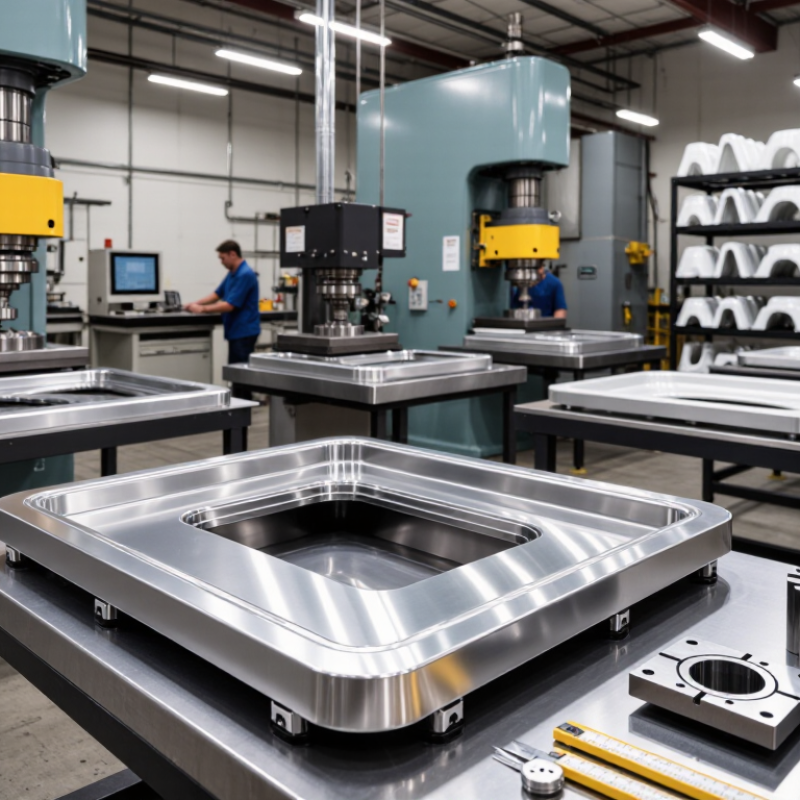
2026 Top Dishwasher Stamping Die Suppliers for Buyers

Dishwasher Stamping Dies: Purpose, Design, and Key Components

A dishwasher stamping die forms sheet metal parts such as inner panels, brackets, and support rails. It applies controlled force to cut, bend, or draw the metal into a repeatable shape. That sounds simple. In production, small changes in sheet thickness or springback can affect how a panel fits against the tub and door assembly.

The die’s design depends on the part geometry, material, and required production rate. A progressive die performs several operations as a strip moves through stations; a transfer die moves separate blanks between forming stages. Common components include the die shoe, punch, die block, guide pins, stripper plate, and springs. Each has a job. Guide pins help align the tool, while the stripper plate holds the sheet and releases it after the stroke. Clearances must suit the material and operation, not just the drawing.

Design reviews should check draw depth, bend radii, access for lubrication, and scrap removal. A sharp corner may look efficient in CAD but can cause tearing or difficult forming. Tryout measurements reveal what the model misses. Even then, one adjustment can shift another feature, so teams should document each change and recheck fit with representative parts.

Common Die Types and Their Dishwasher Applications

Progressive dies suit high-volume, small dishwasher parts such as latch plates, brackets, and reinforcement clips. Several stations pierce and form each part as the steel strip advances. Compound dies cut flat features in one stroke, making them useful for simple, symmetrical components. Transfer and deep-drawing dies handle larger shells and inner tubs, where draw depth, corner radii, and wrinkle control matter. Not every tub is metal; material and construction vary by design.

Material choice shapes the tooling plan. The International Stainless Steel Forum reported 58.4 million tonnes of global stainless-steel melt-shop production in 2023, a useful indicator of the material’s industrial scale, not dishwasher demand. World Steel Association data put 2023 crude-steel output at 1,892.2 million tonnes. For buyers, these figures reinforce the need to specify grade, thickness, and surface condition before comparing die proposals. Ask suppliers how they control springback, burrs, and draw marks, and request trial-part measurements. A polished CAD model is not enough. Coil variation can still expose weak assumptions, and tool trials may require revisions.

How to Evaluate Dishwasher Stamping Die Suppliers in 2026

2026 Top Dishwasher Stamping Die Suppliers for Buyers

How to Evaluate Dishwasher Stamping Die Suppliers in 2026

When evaluating dishwasher stamping die suppliers, start with the part requirements, not the sales presentation. Share drawings, material grade, sheet thickness, annual volume, and critical tolerances. A capable supplier should explain how the die layout supports each feature, including deep draws, ribs, and mounting holes. Ask how they will control springback and burrs. Small details matter.

Review evidence from comparable projects, such as sample-part measurements, trial reports, and documented corrective actions. Ask which press tonnage and feed conditions were used during testing. A supplier’s inspection plan should identify measuring tools, sampling frequency, and acceptance limits.

Request details on die materials, heat treatment, wear surfaces, and expected maintenance intervals. The answers should be specific, not just reassuring.

Before approval, inspect trial parts from several positions in the production run. Check fit, edge quality, and repeatability—not only one carefully selected sample. Confirm that spare inserts, repair guidance, and change records will be available after delivery. A clean sample can still hide process variation. One useful question is how the supplier responds when results drift after a tool adjustment. No evaluation catches everything; buyers should record open concerns and agree on measurable follow-up checks before production begins.

Leading Supplier Profiles and Manufacturing Capabilities

Strong dishwasher stamping-die suppliers are defined by process control, not brochure claims. World Steel Association’s World Steel in Figures 2024 reports 1,892.2 million tonnes of crude steel output in 2023. That scale makes material traceability and coil variation important when dies form door panels, tubs, brackets, and stiffeners. Ask for documented strip layouts, forming simulations, tool-steel specifications, and tryout records. Details matter. Supplier profiles should also show press tonnage, bed size, feed-line limits, die protection, and in-house inspection equipment. These facts reveal whether a tool can run on the buyer’s actual line.

Manufacturing depth is more than machining capacity. Check whether the supplier combines CAD/CAE, CNC milling, wire EDM, spotting, and controlled die assembly under one quality plan. The International Federation of Robotics’ World Robotics 2024 reports 541,302 industrial robot installations worldwide in 2023. Automation can support repeatability, but it does not replace skilled die spotting. Ask for capability data, not automation photos. Review sample-part measurements, springback corrections, scrap rates, changeover time, and response plans for die wear. A witnessed trial helps. Supplier data can be uneven, so verify figures against signed inspection reports and a production run.

Buyer Checklist: Pricing, Quality, Delivery, and After-Sales Support

A 2026 dishwasher stamping die quote should be compared by scope, not headline price. Check whether it includes design changes, tryout hours, spare inserts, and operator training. A quote can mislead. Ask for a cost breakdown and confirm the steel grade, die life assumptions, and replacement-part prices. World Steel Association’s World Steel in Figures 2024 reports 1,892.2 million tonnes of crude steel production in 2023. That figure shows the scale of the material supply chain, but it does not guarantee consistent sheet properties. Ask suppliers how they verify incoming material and adjust tooling when thickness or hardness varies.

Quality checks need measurable evidence. Request dimensional inspection records, trial-run samples, burr limits, and documented corrective actions. For delivery, compare a dated schedule covering design approval, machining, assembly, and production trials. Build in time for revisions; a missed sample approval can shift the whole launch.

Small delays compound. Deloitte’s 2024 Smart Manufacturing Survey found that 86% of surveyed manufacturing executives viewed smart manufacturing as a primary competitiveness driver over the next five years. For buyers, this makes digital inspection records and clear revision tracking useful questions, not automatic proof of quality. One weakness in many evaluations is overlooking after-sales response. Agree on response times, remote troubleshooting, on-site support, and critical spare availability before ordering. Then test the arrangement with a realistic service scenario.

Copyright 2025 Fluidra S.A. | Created by BCM Marketing Agencia Privacy Policy Legal note | Cookie policy |

Technical cookies are strictly necessary for our website to work and you can navigate through it. These types of cookies are those that, for example, allow us to identify you, give you access to certain restricted parts of the page if necessary, or remember different options or services already selected by you, such as your privacy preferences. Therefore, they are activated by default, your authorization not being necessary in this regard. Through the configuration of your browser, you can block or alert the presence of this type of cookies, although such blocking will affect the proper functioning of the different functionalities of our website.


The analysis cookies allow us to study the navigation of the users of our website in general (for example, which sections of the page are the most visited, which services are used most and if they work correctly, etc.). From the statistical information on navigation on our website, we can improve both the operation of the page itself and the different services it offers. Therefore, these cookies do not have an advertising purpose, but only serve to make our website work better, adapting to our users in general. By activating them you will contribute to this continuous improvement. You can enable or disable these cookies by checking the corresponding box, being disabled by default.


Functionality cookies allow us to remember your preferences, to personalize certain characteristics and general options of our website, every time you access it (for example, the language in which the information is presented to you, the sections marked as favorites, your browser type, etc.) Therefore, this type of cookies does not have an advertising purpose, but by activating them you will improve the functionality of the website (for example, adapting to your type of browser) and the customization of it based on your preferences (for example, by presenting the information in the language that you have chosen in previous occasions), which will contribute to the ease, usability and comfort of our page during your navigation. You can enable or disable these cookies by checking the corresponding box, being disabled by default.


Advertising cookies allow us to manage the advertising spaces included in our website based on criteria such as the content shown or the frequency in which the ads are displayed. For example, if you have been shown the same ad several times on our website, and you have not shown a personal interest by clicking on it, it will not appear again. In summary, by activating this type of cookies, the advertising shown on our website will be more useful and diverse, and less repetitive. You can enable or disable these cookies by checking the corresponding box, being disabled by default.


Behavioral advertising cookies allow us to obtain information based on the observation of your browsing habits and behaviors on the web, in order to show you advertising content that best suits your personal tastes and interests. To understand it in a very simple way, we will give you a fictitious example: if your last searches on the web were related to suspense literature, we would show you advertising about suspense books. Therefore, activating this type of cookies, the advertising that we show you on our website will not be generic, but will be oriented to your searches, tastes and interests, therefore adjusting exclusively to you. You can enable or disable these cookies by checking the corresponding box, being disabled by default.
To understand it in a very simple way, we will give you a fictitious example: if your last searches on the web were related to suspense literature, we would show you advertising about suspense books. Therefore, activating this type of cookies, the advertising that we show you on our website will not be generic, but will be oriented to your searches, tastes and interests, therefore adjusting exclusively to you. You can enable or disable these cookies by checking the corresponding box, being disabled by default.

SAVE

We use our own and third-party cookies to ensure the proper functioning of the website and to analyse our services, improve your experience on our website and show you advertisements related to your interests according to profiling based on your browsing habits (e.g. websites visited). You can accept all cookies by clicking "ACCEPT" or set or reject them by clicking here. If you would like to know more about the use of cookies, please see our COOKIE POLICY.


ACCEPT ALL
Reject no essentials


