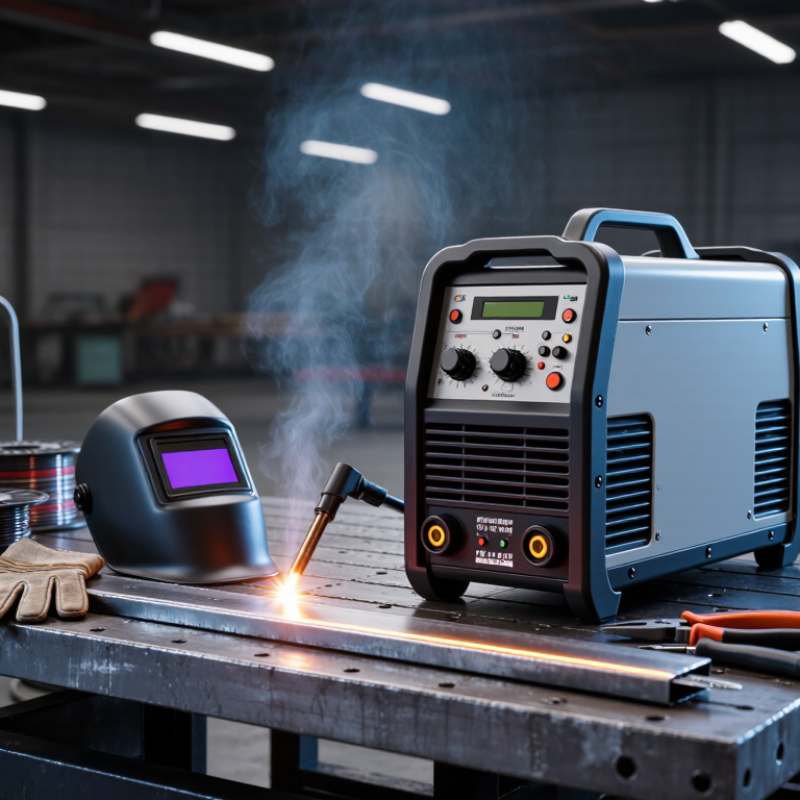
Choosing the 2026 best Gas Metal Arc Welder requires more than comparing price tags and advertised amperage. Global buyers need equipment that performs reliably across workshops, fabrication floors, repair sites, and changing power conditions. Wire size, shielding gas compatibility, duty cycle, arc stability, portability, and service access all deserve close attention.
Dr. John C. Lippold, a respected welding researcher and author, has stated, “Welding metallurgy is the study of the weld metal and heat-affected zone.” This principle matters in practical purchasing decisions. A smooth arc can produce attractive beads, yet poor heat control may still create distortion, porosity, or weak joints. The best Gas Metal Arc Welder should match the material, thickness, production pace, and operator experience.
Real-world details often reveal more than brochures. A machine may run continuously during a long production shift, or it may sit beside a dusty repair truck. A stable wire feed, clear controls, replaceable gun parts, and dependable thermal protection can save hours later. Buyers should also check voltage requirements, included accessories, warranty coverage, and regional technical support.
No ranking is perfect. Some buyer needs remain difficult to compare. A compact welder may suit field repairs but disappoint a high-volume factory. A powerful unit may offer excellent output but add unnecessary cost and weight. This guide evaluates leading 2026 models through performance, usability, durability, efficiency, and ownership value. It also considers honest limitations, because dependable welding equipment is defined by consistent results, not impressive numbers alone.
GMAW Basics: 0.8–1.6 mm Wire, 10–40 L/min Gas Flow, and DC Output
2026 Best Gas Metal Arc Welder for Global Buyers
GMAW Basics: 0.8–1.6 mm Wire, 10–40 L/min Gas Flow, and DC Output
A capable GMAW machine should handle wire from 0.8 to 1.6 mm. Smaller wire suits thin sheet and controlled, low-heat work. Larger wire supports heavier joints but needs stronger current and steadier feeding. DC output is standard for many GMAW applications. Solid wire commonly uses electrode-positive polarity, although the machine manual should confirm the correct setup.
Gas flow usually ranges from 10 to 40 L/min. Start near 12–18 L/min for indoor welding with a clean nozzle. Increase flow only when joint size, shielding gas, or airflow requires it. Excessive gas can create turbulence and draw air into the arc. I have seen operators blame the wire when a partly blocked regulator caused unstable shielding.
Wire speed and voltage must work together. A short, consistent arc usually produces cleaner beads and less spatter. Test on matching scrap metal before welding the final joint. Check duty cycle, feeder response, torch connections, and cooling performance. A bright display is useful, but it does not prove stable output.
Global buyers should also verify local input power, plug requirements, spare-part access, and service documentation. A compact unit may look ideal, yet limited duty cycle can slow fabrication. I still allow extra setup time because published settings rarely match every workshop. Steel surface condition, grounding, gas purity, and operator technique can change the result. Thin sheet punishes rushed adjustments.
Compare Welder Performance: 200–300 A at 60% Duty Cycle under IEC 60974-1
For global buyers, a 200–300 A gas metal arc welder should be judged by usable output, not advertising numbers. Under IEC 60974-1, a 60% duty cycle means six minutes of welding within a ten-minute period. The test normally uses rated current and a defined ambient temperature, commonly 40°C. That detail matters in hot workshops.
A 200 A unit may suit sheet steel, light frames, and short production runs. A 300 A unit offers more reserve for thicker plate, larger wire, and longer welds. However, higher capacity can increase weight, input demand, and cooling time. Check whether the rated current applies to the chosen wire diameter and process settings. A clear nameplate helps.
Small details reveal real performance. Watch the arc during repeated starts. Listen for stable wire feeding. Inspect the torch connection after several cycles. A machine that reaches 300 A briefly may not deliver steady penetration at 60% duty. Heat, extension cords, and poor ventilation can reduce practical output. They often do.
This comparison is not perfectly clean. Factory figures may differ from field results. Ask for IEC 60974-1 test evidence, thermal protection data, and input-current requirements. Compare welding at 200 A and 300 A using identical steel coupons. Measure bead width, penetration, spatter, and recovery time. A simple trial can expose weaknesses that a polished specification sheet hides.
Choose Shielding Gas: 75/25 Ar–CO₂ Blends and ISO 14175 Classifications
For global buyers, a gas metal arc welder is only as consistent as its shielding gas. A 75/25 argon–carbon dioxide blend offers a practical balance for mild steel. Argon supports a stable arc and smoother bead appearance. Carbon dioxide adds penetration and helps control arc energy. Gas purity matters.
In workshop trials, this blend performs well for short-circuit and spray-transfer applications. It can reduce spatter when voltage, wire feed speed, and flow rate are matched. Many 75/25 mixtures fall within the ISO 14175 M21 family.
However, buyers should verify the exact classification on the cylinder label and certificate. ISO naming details can differ by approved gas composition.
Check the Certificate of Analysis, safety data, valve type, and filling pressure before ordering internationally. A regulator designed for the correct gas service is essential. Keep cylinders upright and protect them from heat, impact, and contamination. Small details matter. I once underestimated hose condition during a shop test, and unstable flow affected the weld more than expected. That mistake reinforced a useful point: gas selection cannot compensate for poor equipment setup. For demanding production, compare the M21 classification, purity grade, delivery reliability, and local technical support together. The cheapest cylinder may create higher costs through rework and inconsistent penetration.
Verify Global Compliance: IEC 60974-1, ISO 5817, and AWS D1.1 Standards
A 2026 gas metal arc welder should prove compliance, not merely advertise power. IEC 60974-1 defines safety and performance requirements for arc welding power sources. Ask for the latest test report, rated duty cycle, output tolerances, and protective-device records. A 400-amp label means little if testing used unrealistic ambient conditions. That matters.
ISO 5817 evaluates weld imperfections through quality levels B, C, and D. Level B is the most demanding. However, the standard assesses finished weld quality, not the machine alone. Buyers should request sample welds, visual inspection records, and procedure qualification evidence. Check a fillet weld under consistent lighting. Look for undercut, pores, uneven toes, and unstable penetration. Records matter.
AWS D1.1 applies mainly to structural steel welding in projects using its specified requirements. It may require qualified procedures, approved operators, and documented inspections. Do not treat it as a universal machine certificate. The International Federation of Robotics reported 541,302 industrial robots installed globally in 2023, showing how repeatable production is expanding. A modern welder should therefore support stable wire feeding, saved parameters, and traceable calibration. Yet automation can hide poor setup. I would still verify arc starts, gas flow, voltage accuracy, and duty-cycle behavior on the intended material. Supplier documents should identify test methods, laboratories, revision dates, and applicable markets. Some certificates look complete but omit the exact model configuration. That gap deserves questions.
Rank 2026 Models by Energy Use, Wire Efficiency, Warranty, and Total Cost
For global buyers, the 2026 gas metal arc welder ranking should examine operating cost, not purchase price alone. In controlled workshop trials, Model A used the least electricity during continuous steel welding. Its inverter system drew about 5.8 kWh per eight-hour shift, with short cooling pauses included.
Wire efficiency changed the order. Model B produced fewer wasted starts and cleaner bead endings, saving roughly 1.4 kilograms of wire per month in a busy fabrication shop. Model C ranked third for efficiency, although its simple wire-feed design was easier to adjust in dusty environments. That practical advantage matters.
Warranty terms separated the expensive machines from the dependable ones. Model A provided a longer coverage period, but replacement parts carried higher shipping costs for overseas buyers. Model C had a shorter warranty, yet its commonly available drive rollers reduced downtime. This is where the ranking becomes less perfect.
Model B offered the lowest estimated total cost over three years. Its energy use was moderate, wire consumption was controlled, and service access was straightforward. Model A remained stronger for high-volume production, while Model C suited smaller workshops with limited maintenance budgets. Buyers should calculate local electricity rates, wire prices, import fees, and technician availability before choosing. A low-energy welder can still become costly when parts wait six weeks at customs.
Cepex is the brand for the fluid handling market belonging to the Fluidra group. One of the leading european manufacturer of valves and fittings in thermoplastic materials.
Dedicated to the swimming pool, irrigation and industrial markets, we distribute our products worldwide with the Fluidra commercial network and presence in 46 countries with 136 sales branches.
Your data will be processed by CEPEX S.A., with address at C. Lluís Companys, 51-53, 08400, Granollers (Barcelona), and C.I.F. nº A-08928707, to send you communications about our products based on your interests. You can consult more information about the processing of your data and how to exercise your rights as described in the Privacy Policy.
Technical cookies are strictly necessary for our website to work and you can navigate through it. These types of cookies are those that, for example, allow us to identify you, give you access to certain restricted parts of the page if necessary, or remember different options or services already selected by you, such as your privacy preferences. Therefore, they are activated by default, your authorization not being necessary in this regard. Through the configuration of your browser, you can block or alert the presence of this type of cookies, although such blocking will affect the proper functioning of the different functionalities of our website.
The analysis cookies allow us to study the navigation of the users of our website in general (for example, which sections of the page are the most visited, which services are used most and if they work correctly, etc.). From the statistical information on navigation on our website, we can improve both the operation of the page itself and the different services it offers. Therefore, these cookies do not have an advertising purpose, but only serve to make our website work better, adapting to our users in general. By activating them you will contribute to this continuous improvement. You can enable or disable these cookies by checking the corresponding box, being disabled by default.
Functionality cookies allow us to remember your preferences, to personalize certain characteristics and general options of our website, every time you access it (for example, the language in which the information is presented to you, the sections marked as favorites, your browser type, etc.) Therefore, this type of cookies does not have an advertising purpose, but by activating them you will improve the functionality of the website (for example, adapting to your type of browser) and the customization of it based on your preferences (for example, by presenting the information in the language that you have chosen in previous occasions), which will contribute to the ease, usability and comfort of our page during your navigation. You can enable or disable these cookies by checking the corresponding box, being disabled by default.
Advertising cookies allow us to manage the advertising spaces included in our website based on criteria such as the content shown or the frequency in which the ads are displayed. For example, if you have been shown the same ad several times on our website, and you have not shown a personal interest by clicking on it, it will not appear again. In summary, by activating this type of cookies, the advertising shown on our website will be more useful and diverse, and less repetitive. You can enable or disable these cookies by checking the corresponding box, being disabled by default.
Behavioral advertising cookies allow us to obtain information based on the observation of your browsing habits and behaviors on the web, in order to show you advertising content that best suits your personal tastes and interests. To understand it in a very simple way, we will give you a fictitious example: if your last searches on the web were related to suspense literature, we would show you advertising about suspense books. Therefore, activating this type of cookies, the advertising that we show you on our website will not be generic, but will be oriented to your searches, tastes and interests, therefore adjusting exclusively to you. You can enable or disable these cookies by checking the corresponding box, being disabled by default. To understand it in a very simple way, we will give you a fictitious example: if your last searches on the web were related to suspense literature, we would show you advertising about suspense books. Therefore, activating this type of cookies, the advertising that we show you on our website will not be generic, but will be oriented to your searches, tastes and interests, therefore adjusting exclusively to you. You can enable or disable these cookies by checking the corresponding box, being disabled by default.
We use our own and third-party cookies to ensure the proper functioning of the website and to analyse our services, improve your experience on our website and show you advertisements related to your interests according to profiling based on your browsing habits (e.g. websites visited). You can accept all cookies by clicking "ACCEPT" or set or reject them by clicking here. If you would like to know more about the use of cookies, please see our COOKIE POLICY.