
2026 Top Andersen Storm Door Handle Replacement Types
FLUID HANDLING EXPERTS

Blog, all our news

2026 Top Andersen Storm Door Handle Replacement Types

Choosing a replacement handle for an Andersen storm door is not just a style decision. The wrong latch can leave the door difficult to close, even when the new handle looks nearly identical. Model, door thickness, handing, and lock setup all matter. Small parts, big consequences.

The broader repair market offers useful context, but not a precise forecast for handle sales. In its fourth-quarter 2024 Remodeling Market Index, the National Association of Home Builders reported a score of 65. Scores above 50 indicate that more surveyed remodelers reported improving activity than declining activity. This is a broad remodeling measure, not evidence of storm-door-handle demand. That distinction matters. Homeowner repair spending is growing, yet reliable public data rarely separates one small replacement part from the larger project.

This guide to 2026 Top Andersen Storm Door Handle Replacement Types compares common handle and latch styles, explains fit details, and highlights checks to make before ordering. The keyword Storm Door Handle Andersen may describe a search, but it does not identify one universal part. Andersen doors have different models and hardware configurations. A product photo can help, but the label or serial information on the door is usually more dependable. Measure carefully. If the old hardware is worn or damaged, note how the latch connects before removing it. One imperfect reality: parts that appear interchangeable may not be. A little verification can prevent a second order—and an afternoon spent staring at a door that still will not latch.
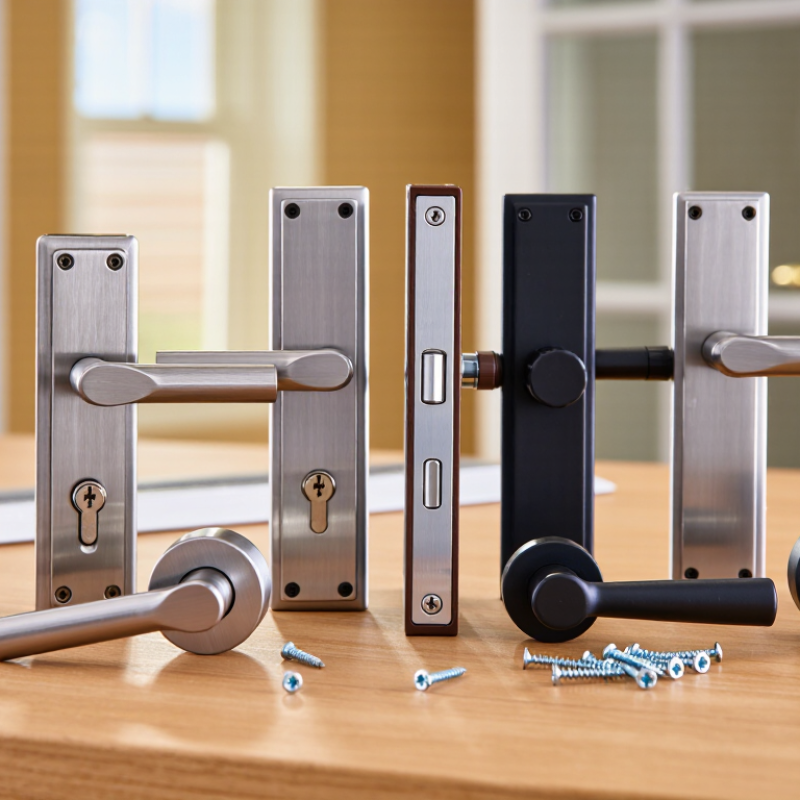
2026 Top Andersen Storm Door Handle Replacement Types

Identify Andersen Handle Types by Style: Traditional, Modern, and Contemporary

Traditional storm-door handles usually have a curved lever, visible mounting screws, and a warm metal finish. They suit raised-panel doors and older trim. Modern styles tend toward straight lines, narrow escutcheons, and matte finishes. Contemporary designs may use squared levers or minimal rosettes, creating a sharper look on smooth doors. Style is only part of the fit: measure the screw spacing, spindle, and backset before choosing a replacement. A sleek handle that does not match the existing holes can leave awkward marks.

The 2024 Houzz & Home Study reported that 54% of surveyed U.S. homeowners completed a renovation project in 2023. That broad activity reflects ongoing interest in home upgrades, but it does not prove that handle replacements are growing. For a storm door, also check handing, latch position, and door thickness. Finish can look different outdoors, too; satin metal may show fewer fingerprints than polished metal, but weather exposure still affects its appearance. Small details matter.

Tips: Photograph the handle from both sides, then measure between the mounting screws. Compare the new lever’s shape with nearby door hardware, not just online images. If the old spindle is worn, measure it carefully; I have seen a good-looking replacement feel loose because that detail was overlooked. Style labels can mislead. Compatibility comes first.

Classify Lock Functions Using ANSI/BHMA A156.2 Bored-Lock Terminology

A replacement storm-door handle should be classified by what its lock does, not by its shape. ANSI/BHMA A156.2 uses bored-lock function terminology, including passage, privacy, entry, and storeroom functions. Passage sets latch without locking; privacy functions add a simple interior lock. Entry functions typically use a keyed exterior cylinder, while storeroom functions remain locked from outside. Details vary by product.

The standard also sets performance benchmarks: BHMA’s A156.2 grade criteria include 800,000 operational cycles for Grade 1, 400,000 for Grade 2, and 200,000 for Grade 3. These figures describe tested bored locks, not every storm-door handle. Check the actual latch, cylinder, and strike before ordering. A keyed handle may still use a different mounting pattern.

Look at the door edge and both handle sides. Does the inside thumb-turn retract the latch, or only lock it? Is there a key cylinder outside? Those details help distinguish functions when photos are unclear. I have seen similar-looking handles use different backsets, so appearance alone can mislead. Treat ANSI/BHMA terminology as a useful classification guide, not proof that a storm-door set is interchangeable with a standard bored lock.

Compare Keyed, Non-Keyed, and Deadbolt Options for Andersen Storm Doors

A keyed handle suits a storm door that needs controlled access from outside. It can help when a side entrance is used by several people, but keys add a small daily hassle. A non-keyed handle is simpler for a porch or secondary door where the main entry already provides security. Fit matters. The FBI’s 2019 Uniform Crime Report recorded forcible entry in 55.7% of burglaries, while 37.8% involved unlawful entry without force. These figures describe reported burglary offenses, not the risk at any single home, but they show why a latch alone should not be treated as a complete security plan.

A deadbolt option adds a separate locking point, provided the door and frame accept its hardware. Check the backset, screw spacing, door thickness, and clearance before ordering; even a small mismatch can leave the latch rubbing against the strike plate. The Builders Hardware Manufacturers Association’s ANSI/BHMA A156.5 standard sets performance tests for lock cylinders. Look for documented testing rather than relying on a polished finish or a heavy-feeling knob. A deadbolt may also be awkward if the storm door is thin or its frame flexes.

Choose based on how the door is used. For frequent entry, a keyed handle may be practical; for quick access to a screened porch, non-keyed hardware may be enough. If added resistance is the goal, compare deadbolt compatibility with the existing frame. The trade-off is easy to miss: more locking hardware can mean more alignment problems. I would measure twice, then check the manufacturer’s fit guide.

2026 Storm Door Handle Replacement Types: Compare Keyed, Non-Keyed, and Deadbolt Options

Handle Type How It Works Typical Advantages Things to Consider Best Suited For
Keyed Handle A keyed cylinder controls the handle’s locking function, allowing the door to be locked or unlocked with a key from the exterior. Provides key-operated access control and can help limit entry through the storm door when it is locked. Keyed handle sets vary in cylinder design and mounting layout. Confirm that the replacement matches the door’s existing holes and lock mechanism. Entrances where exterior key access is useful, such as when the storm door is used as an additional access-control layer.
Non-Keyed Handle Operates the latch without an exterior key cylinder. Depending on the set, it may have an interior push-button or turn-button lock. Simple to operate and avoids the need to carry or manage a separate key for the storm-door handle. Locking features vary by model. A latch lock is not the same as a separate deadbolt, and the storm door should not be treated as a substitute for a primary entry-door lock. Doors where convenient latching is the priority and exterior key locking is not needed.
Handle Set with Deadbolt Combines a handle and latch with a separate bolt that extends into a compatible strike when locked. Offers a distinct locking point in addition to the latch; the bolt is operated separately from the handle. Requires compatible door preparation and strike alignment. Check the door’s cutouts, mounting pattern, thickness, and available space before choosing a replacement. Doors where a separate bolt is desired and the door is designed to accept a compatible deadbolt handle set.

Fit check: Before ordering, compare the existing handle’s mounting-hole spacing, backset, door thickness, latch type, handing, and interior/exterior configuration with the replacement specifications. Storm-door handle sets are not universally interchangeable.

Match Replacement Kits to the Door’s Measured Thickness and Existing Cutouts

2026 Top Andersen Storm Door Handle Replacement Types

Match Replacement Kits to the Door’s Measured Thickness and Existing Cutouts

A replacement handle must fit the door, not merely resemble the old one. Measure the door slab at an exposed edge, then record the distance between the handle’s mounting holes. Check the latch opening, spindle position, and backset too. A surface-mount kit may use different holes from a mortise-style set. Small differences matter.

Use calipers for thickness when possible. If unavailable, measure carefully with a ruler and note the result in fractions or millimeters. Compare every measurement with the kit’s stated fit range before ordering. Do not assume a newer door matches a familiar size. Older doors may have enlarged screw holes, worn cutouts, or a latch sitting slightly off-center. That can make a compatible-looking handle bind.

The 2024 Cost vs. Value Report estimates a 188.1% cost recoup for steel entry-door replacement, based on its national project-cost and resale-value estimates. That figure concerns entry-door replacement, not storm-door handles, so it cannot predict a handle project’s return. It does underline why accurate fit matters during exterior-door work. A rushed measurement is easy to regret. Check the thickness and cutout pattern twice, and keep the old handle nearby for comparison.

Storm-Door Handle Replacement: Thickness Checkpoints

Compare your measured door thickness with common nominal storm-door thicknesses before choosing a replacement handle kit.

The bars show common nominal thickness checkpoints, not guaranteed kit compatibility. Measure the door itself, then check the replacement kit’s stated thickness range and compare its mounting-hole pattern, spindle, and existing cutouts. Surface-mount, mortise, and push-button handle kits can have different requirements.

Check Handle Accessibility Against ADA 2010 §309.4’s 5-Pound Force Limit

2026 Top Storm Door Handle Replacement Types

Storm door replacements commonly use lever handles, push-button latches, or thumb-operated sets. Lever styles can reduce finger pinching, but shape alone does not prove accessibility. Under the 2010 ADA Standards for Accessible Design, §309.4, an applicable operable part must require no more than 5 pounds of force. It must also work with one hand, without tight grasping, pinching, or wrist twisting. A small digital force gauge can check the force needed to release the latch; test the handle in its installed position, not loose on a workbench. Five pounds is the limit, not a target.

Look closely at the details. A stiff spring, misaligned strike, or swollen door can make a new handle difficult to operate. A long lever may offer useful leverage, while a recessed thumb latch can demand concentrated finger pressure. The U.S. Access Board’s guidance for §309.4 repeats the 5-pound maximum and explains the required operating method. This is a technical accessibility criterion, not a guarantee that every residential door falls under ADA requirements. Check the relevant project standards. And test it again. A slightly uneven installation can change the reading; I would not trust a single measurement taken before the door settles.

Copyright 2025 Fluidra S.A. | Created by BCM Marketing Agencia Privacy Policy Legal note | Cookie policy |

Technical cookies are strictly necessary for our website to work and you can navigate through it. These types of cookies are those that, for example, allow us to identify you, give you access to certain restricted parts of the page if necessary, or remember different options or services already selected by you, such as your privacy preferences. Therefore, they are activated by default, your authorization not being necessary in this regard. Through the configuration of your browser, you can block or alert the presence of this type of cookies, although such blocking will affect the proper functioning of the different functionalities of our website.


The analysis cookies allow us to study the navigation of the users of our website in general (for example, which sections of the page are the most visited, which services are used most and if they work correctly, etc.). From the statistical information on navigation on our website, we can improve both the operation of the page itself and the different services it offers. Therefore, these cookies do not have an advertising purpose, but only serve to make our website work better, adapting to our users in general. By activating them you will contribute to this continuous improvement. You can enable or disable these cookies by checking the corresponding box, being disabled by default.


Functionality cookies allow us to remember your preferences, to personalize certain characteristics and general options of our website, every time you access it (for example, the language in which the information is presented to you, the sections marked as favorites, your browser type, etc.) Therefore, this type of cookies does not have an advertising purpose, but by activating them you will improve the functionality of the website (for example, adapting to your type of browser) and the customization of it based on your preferences (for example, by presenting the information in the language that you have chosen in previous occasions), which will contribute to the ease, usability and comfort of our page during your navigation. You can enable or disable these cookies by checking the corresponding box, being disabled by default.


Advertising cookies allow us to manage the advertising spaces included in our website based on criteria such as the content shown or the frequency in which the ads are displayed. For example, if you have been shown the same ad several times on our website, and you have not shown a personal interest by clicking on it, it will not appear again. In summary, by activating this type of cookies, the advertising shown on our website will be more useful and diverse, and less repetitive. You can enable or disable these cookies by checking the corresponding box, being disabled by default.


Behavioral advertising cookies allow us to obtain information based on the observation of your browsing habits and behaviors on the web, in order to show you advertising content that best suits your personal tastes and interests. To understand it in a very simple way, we will give you a fictitious example: if your last searches on the web were related to suspense literature, we would show you advertising about suspense books. Therefore, activating this type of cookies, the advertising that we show you on our website will not be generic, but will be oriented to your searches, tastes and interests, therefore adjusting exclusively to you. You can enable or disable these cookies by checking the corresponding box, being disabled by default.
To understand it in a very simple way, we will give you a fictitious example: if your last searches on the web were related to suspense literature, we would show you advertising about suspense books. Therefore, activating this type of cookies, the advertising that we show you on our website will not be generic, but will be oriented to your searches, tastes and interests, therefore adjusting exclusively to you. You can enable or disable these cookies by checking the corresponding box, being disabled by default.

SAVE

We use our own and third-party cookies to ensure the proper functioning of the website and to analyse our services, improve your experience on our website and show you advertisements related to your interests according to profiling based on your browsing habits (e.g. websites visited). You can accept all cookies by clicking "ACCEPT" or set or reject them by clicking here. If you would like to know more about the use of cookies, please see our COOKIE POLICY.


ACCEPT ALL
Reject no essentials


